

 1:20
Video· Nous Shorts
Modi’s One-Man Show & Accountability
“When you forcibly remove a king from his throne, then it becomes a disgrace.”
Cut from our documentaries, explainers and conversations. Each one links back to the full episode it came from.
1:20“When you forcibly remove a king from his throne, then it becomes a disgrace.”
 1:58
"I do not believe in identity politics."
 2:25
The mosque could play a far greater role in community development, from public health to education.
 2:54
“I Saw Everything With My Own Eyes” | A Survivor’s Testimony
 2:26
“I want the people who live here to collectively take a decision.”
 1:20
“The price of what you did at that time is being paid by today’s Muslims.”
 2:14
In this episode of Nous, author and columnist Aakar Patel joins senior journalist Bushra Khanum for an incisive conversation on the Muslim question under Narendra Modi and the BJP. They examine the growing assault on the rights, security, and dignity of Muslims, the ideological and political logi…
 1:40
The Sachar Committee’s findings on Muslims also offered valuable comparative data on the condition of SCs & STs.
 1:19
For the first time, Narendra Modi’s political image appears to be facing something more difficult than an electoral setback
 1:40
Savarkar’s argument against the Khilafat movement became a powerful Hindu nationalist claim about Muslim loyalty.
 1:06
“Modi’s power does not come from RSS. It comes from his own popularity.”
 0:55
Raju Parulekar examines how political calculations within the Congress shaped the Shah Bano controversy and the unlocking of the Babri Masjid.
 1:04
Journalist Dayashankar Mishra examines how lynching can extend beyond physical violence to include bulldozer demolitions, job exclusion, denial of equality and psychological violence.
 3:00
Dr Abusaleh Shariff, A former member of the Sachar Committee, recalls the challenges of collecting data on Muslim representation in armed forces.
 1:44
Noted economist Dr Abusaleh Shariff outlines practical reforms for improving educational opportunities in Muslim communities.
 1:23
“Umar Khalid breaks the image media has created of Muslims.”
 2:32
How can flawed electoral delimitation affect political representation?
 0:43
The East India Company’s economic policies devastated India’s handloom and handicraft traditions.
 0:59
What did the British believe universal adult voting would mean for Muslim political identity?
 2:31
“The evidence is recorded on every page of history.”
 3:00
Why did the Khilafat and Non-Cooperation movements fail to sustain Hindu-Muslim unity?
 1:07
Why has the discussion around mob lynching disappeared from India’s mainstream media?
 1:39
What should Muslim politics contribute to India’s broader democratic and secular discourse? Full Video: https://www.youtube.com/watch?v=JA83TwVx1DE&t=3363s
 0:59
What comes first: civilisation, religion or the nation? Full Video: https://www.youtube.com/watch?v=EPlSNwXgcTk
 2:05
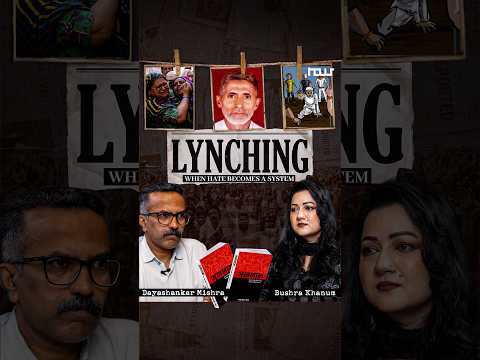
What turns ordinary people into a violent mob? And how does hate speech travel from words to the streets? In this conversation, author and journalist Dayashankar Mishra speaks to senior journalist Bushra Khanum about his latest book, Akhlaq: Bharat Mein Mob Lynching Ki Vistrit Zameeni Padtaal. Th…
 1:09
Why write about lynching when so few are willing to speak about it openly?
 1:16
"Step away from elections until you're given a fair share."
 1:46
“If there is an informed intervention, then you can do that to the machinery.”
 1:00
"The real challenge is no longer preserving symbols—it is defending citizenship."
 1:36
“Activism will be more fruitful and more effective only when we gain conceptual clarity.”
 2:00
“The Khilafat movement was anti-colonial in tenor.”
 1:32
“Wounds heal, but there will always be scars.”
 1:07
“We have all given our blood for this reality: that our nation-state will be India based on this contract.”
 1:30
“Composite nationalism, if we understand it, betrayed its own idea.”
 2:09
“First time, Shia and Sunni organizations came together to oppose creation of Pakistan.”
 0:47
“A genuine discussion about terrorism is possible only by bringing the nation-state and nationalism to the centre.”
 1:25
“The Khilafat movement was the first really India-wide mass mobilisation.”
 2:05
"Zakat was not simply an act of individual charity."
 2:29
"For Hindutva, Muslims have to remain 'the other'—without that, it cannot survive."
 1:33
"Why should we go to Pakistan? We chose India because it promised equal citizenship under the Constitution."
 0:55
"Gandhi did not want India to simply replace one form of tyranny with another."
 1:50
“If you look at it according to proportional representation, there should be at least 77 Muslims in the Lok Sabha.”
 2:59
The Caliph and the Nizam: a story of political possibility that history left behind. Ali Javed speaks with Imran Mulla, author of The Indian Caliphate: Exiled Ottomans and the Billionaire Prince, about the forgotten ties between the Ottoman Caliphate and Hyderabad—and the political possibilities …
 2:40
“The Indian Muslims weren’t under Ottoman rule.”
 2:00
“We begin with reality, but it is quite another to end also with reality.”
 1:28
“Muslims were saying to Muslim League: get lost from here. We will take care of the Hindu-Muslim issue.”
 1:06
“The fear of being a Muslim in India started after Narasimha Rao’s tenure.”
 0:59
"The majority cannot trespass upon certain rights."