A question about 1947, answered with another question
The exchange opens with a question that keeps resurfacing eight decades after independence: looking at today's India, how should Muslims' role in the freedom struggle be understood, given that some Muslims backed Pakistan and Partition while most did not — and why did each group want what it wanted? The interviewer is addressed once in the recording as "Bushra," though neither she nor the person answering is otherwise named.
Rather than answering item by item, the speaker calls the question itself dangerous — a "horrendous situation" in which an entire community is put in the dock and asked to prove it loves the country, what he calls being "hubbul watan," or patriotic. His response is to refuse the premise and redirect the same test toward Hindu nationalist organizations, whom he holds should answer first for their own record in the independence movement.
Whose slogan was "Quit India"?
He dates the Rashtriya Swayamsevak Sangh's founding to 1925 and the Hindu Mahasabha to slightly earlier, then asks what either organization contributed to the movements that followed: the Khilafat agitation, the Non-Cooperation Movement, the Salt Satyagraha, and finally the Quit India Movement of August 1942. That call, he says, was issued by the Congress under Mahatma Gandhi and Maulana Abul Kalam Azad's leadership, and taken up by Subhas Chandra Bose and Sardar Patel — not by the RSS or the Hindu Mahasabha.
He frames this as his real counter-question: if the slogan "Angrezon Bharat Chhodo" — the British Quit India — belongs to Azad, Bose and Patel, what was Hindu nationalist politics doing during that same period, which he says was marked by killings across the country as the British cracked down on the movement? The recording was made in the week marking the 84th anniversary of Quit India, meaning roughly 1942 plus 84 years.
A flag one newspaper is said to have called "an evil"
The most pointed section concerns the tricolor. The speaker says that on 14 August 1947, an English-language newspaper he associates with Hindu nationalist opinion published a passage arguing that the flag's third colour was "in itself an evil" and would have a bad psychological effect on the country, urging that Hindus should never accept or respect it. He reads the English lines aloud before promising a Hindustani rendering, using the episode to ask why people who now demand that Muslims prove their devotion to the tricolor were never made to answer for a press position that opposed the flag outright.
He extends the same challenge further: name one person from Hindu nationalist ranks who was injured in the freedom struggle, or one documented instance between 1925 and 1947 of "Vande Mataram" being raised against the British at a Dussehra gathering. Both, in his telling, are tests he believes the Hindu right cannot pass — the same kind of test, he argues, that is now routinely applied to Muslims as a community.
Provincial governments shared with the Muslim League
He argues that generalizing about "all Muslims" is itself the problem: some Muslims collaborated with the British and opposed independence, but they should not stand in for the far larger number who fought for it. He then turns the same distinction on his opponents, saying Hindu nationalist politics ran provincial coalition governments with the Muslim League in Sindh, Bengal and the North-West Frontier during the very years Congress leaders were jailed for demanding Quit India.
He contrasts this with Subhas Chandra Bose's Indian National Army, which he says drew Hindus, Muslims and Sikhs into its ranks and counted two Muslim officers among its leading commanders. Bose, he says, understood how divisive the slogan "Vande Mataram" had become — tied as it is to a novel he describes as depicting violence against Muslims — and replaced it in his movement with "Jai Hind." He also references a meeting between V.D. Savarkar and Muhammad Ali Jinnah, at which the two are said to have agreed they represented separate nations, using it to argue that Hindu nationalist and Muslim League leaders found common ground even as ordinary Muslims were later collectively blamed for the idea of Partition.
1857, and the arithmetic he cites
Pushed further back, the argument moves to the revolt of 1857. The speaker cites government data putting the Muslim share of the population at about 25 percent in 1947, and separately claims that Muslims accounted for roughly 40 percent of those martyred in the 1857 uprising — a disproportionate share he says he can support from primary, contemporaneous documents rather than secondary retellings.
He describes 1857 as a shared uprising, with Hindus, Muslims, Sikhs and Christians fighting "shoulder to shoulder" across the country, so that, in his words, there is no inch of Indian soil that was not soaked in their combined blood. Against this, he places the princely states and rajwaras that instead collaborated with the British after 1857 — regardless of the ruler's religion — arguing that this same lineage of collaboration fed, in the twentieth century, into the founding of the RSS, the Hindu Mahasabha and the Muslim League alike. The recording ends mid-sentence on that claim.
The larger claim
What holds the response together is a single move: refusing to answer for "all Muslims" as a bloc, while insisting the same courtesy — separating collaborators from freedom fighters — be extended to the Hindu nationalist organizations now posing the question. Whether every date, statistic and anecdote in the exchange would survive a historian's cross-examination is a separate matter from what it reveals about how the debate over Partition-era loyalty is being fought today: not with new evidence so much as with old grievances, read back into a shared and contested past.


 11:27
11:27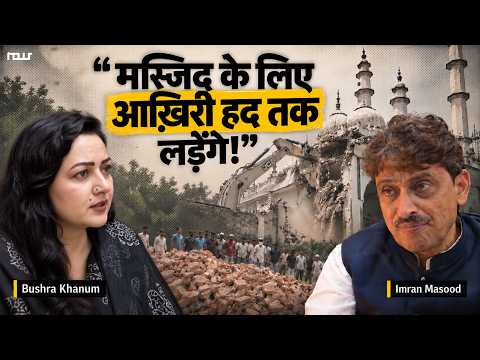
Discussion
0Readers only · Comments are reviewed by the desk before they appear
The journalism is free for everyone — create a free account to join the discussion.