When you look at 1947 and then at India today, 80 years later, how do you view the role of Muslims in the struggle for independence? And in your book, you mentioned that not all Muslims were in favor of Pakistan or a separate nation; who were those Muslims? And what did those who were not in favor actually want? And why were those who were in favor, in favor of it?
Actually, you have described it well, and it is a truly horrendous situation. It is a very, very dangerous situation that the Muslims of this country are being told they are not patriots and that they do not love India. They are being put on trial and placed in the dock regarding this. Do not do this at all. There is no need to give any answer. Instead, ask the RSS members and those Hindutva proponents who are raising this question: what role did you play in India's freedom? The RSS was formed in 1925, and the Hindu Mahasabha was formed even earlier; these contractors, whose descendants are ruling this country today. They should tell us.
After 1925, there were many crucial movements during the freedom struggle. There was the Non-Cooperation Movement. After that, the Salt Satyagraha. Before that, there was the Khilafat Movement. After that, the Quit India Movement. And this is the 84th anniversary of the Quit India Movement. I mean, this is the week when there was a massacre happening across the entire country. Because under the leadership of Gandhi ji and Maulana Azad, the Congress had taken a decision. Quit India, Britishers. Quit India, Britishers. The RSS did not raise this slogan. The Hindu Mahasabha did not raise this slogan. The Congress members raised it. Maulana Abul Kalam Azad raised it. Netaji Subhash Chandra Bose raised it. Sardar Patel raised it.
So, we must first ask these contractors of Hindu religion and Hindus. What is happening is that the tide is turning against us, and we are told to answer for it, and we end up answering. We must ask counter-questions. We must ask counter-questions about what happened in 1942. And after that, many of the movements I mentioned took place. What role did the RSS play in this?
Today, they are telling us to hoist the tricolor flag, to use the tricolor. Does this country know that on August 14, 1947, their own English newspaper wrote about the tricolor flag? I will read the English first, because it is an English newspaper. I am reading out its English version. I will provide its Urdu translation, its Hindustani translation. The people who have come to power by a fluke of fortune may give us the Tricolour in our hands. But it will never be respected and owned by Hindus. The word 'three' is in itself an evil, and a flag having three colours will certainly produce a very bad psychological effect and is injurious to a country. Those who have come to power in India by a fluke of fortune. They want to place the Tricolour flag in the hands of the Hindus of this country. There are three colours in the Tricolour flag. Therefore, it is ominous. They used the English word, saying it is an evil. The word 'three' is an evil, and Hindus will never accept it, and it will have a very bad psychological impact on them.
Today they are telling Muslims to hoist the Tricolour flag. You do not love the Tricolour flag. We are grabbing them by the collar and asking them to tell us if they did this, and to name even one person of yours who lost even a fingernail in the freedom struggle. In the freedom struggle. You talk about Vande Mataram. Vande Mataram! Tell us if you ever raised the slogan of 'Vande Mataram' in your private meetings against the British on the day of Dussehra, from 1925 to 1947.
And the legacy of Muslims that we come from, one thing is that they should stop talking to us like 'all Muslims, all Muslims!' Hey, those Muslims who were against this country, those Muslims who were agents of the British, who did not want the freedom of this country—RSS members, you rulers of this country, friends of Modi, members of Modi's clan—you were running governments with them. Exactly 84 years ago today, during the Quit India Movement, you were running governments with the Muslim League in Sindh, in Bengal, and in the North-West Frontier.
Today, when Netaji was forming the Azad Hind Fauj, which included Hindus, Muslims, Sikhs, and everyone else, two of its leading commanders were Muslims. And this Netaji was the one who knew how much conflict Vande Mataram was causing, which is why he kept 'Jai Hind'. He had removed Vande Mataram. Vande Mataram, to all...because Vande Mataram is linked to a novel that speaks of the massacre of Muslims; he removed it and said that we will say Azad Hind, we will say Jai Hind. Yes, so those you... but the traitorous Muslims, those who were against this country, you had a friendship with them. Savarkar-sahab used to have meetings with Jinnah, and he would say that we are one.
If you want an account of us Muslims, we will tell you how we took part in the freedom struggle, and that history is truly golden. It is magnificent; it's not just about the independence of August 15, 1947, but the 1857 war of independence where we note that Muslims were 25% of the population in 1947. It's official government data, 25% of the Muslims; sure, there were Muslim agents for the British, but those who fought accounted for 40% of the martyrs in the 1857 war.
In the 1857 war, and on that, Bushra ji, let us talk about it. What did Muslims do in 1857? How Muslims stood shoulder-to-shoulder with Hindus; there isn't an inch of this country that they haven't drenched with their blood. I have documents from that era. I speak based on primary sources. So, if you talk about 1857, I can tell you every detail about what Hindus, Muslims, Sikhs, and Christians did together for this country. And the RSS, the princely states that acted as agents for the British, and the Muslim princely states that acted as agents, they went into the Muslim League or the Hindu Mahasabha. All those treacherous states and kingdoms only served the British after 1857, and later in the 20th century, they all became the founders of the RSS, Hindu Mahasabha, and Muslim League.


 11:27
11:27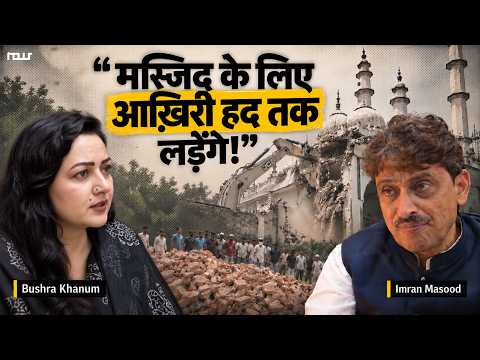
Discussion
0Readers only · Comments are reviewed by the desk before they appear
The journalism is free for everyone — create a free account to join the discussion.