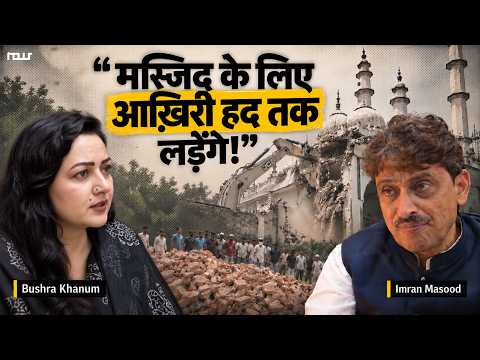
Nous Explainers· 31 Jul 2026· 7:09

Why Muslims Face More Than Citizenship Questions

This is an excerpt from a longer conversation.

Full Transcript

Do you lose your citizenship again and again dependence India history may take their head? Muslim is Pakistan right? You all the communities against this call you scare get all the communities that you treat you get all the people second class citizen second class citizen together get you get all the social groups that you get all the definitely. Cast me I'm getting a key that let's go here at me I'm getting all the key. You get all the key again. You get all the key again and again you get all the key again. You get all the political mobilization that let's go all the situation that you get all the situation again and again you get all the situation again. You get all the situation. You get all the Muslims situation you get all the Muslims political situation citizenship again and again you get all the experiments all the communities that you get all the experiments again. >> Uh Momentarily it has happened. >> Yeah. >> Uh it is not Muslims alone who suffer from this kind of a uh you know citizenship rights being you know eroded in some ways or the other. I would say that at one point of time of course the Sikhs were >> Right. >> uh they were seen as suspect community. uh I have myself observed how while traveling the train etc. their luggages would be checked and others would be spared. uh So so yes it it that sense I would say Muslims were not alone. uh However what is happening with Muslims or has happened with Muslims is a point which I referred to earlier also. Is it not only the citizenship but it is the project of denationalization. >> Right. >> Which uh a combination of two makes the Muslim case far more you know uh it adds to the specificity of the Muslim case or khas karke uske woh jo hai uh potentially zyaada you know uh you know khatarnaak ya dangerous you can say uh happens you know in Muslim Muslim case. So, what denationalization does is ki ek toh aapke claim on India as a motherland as a nation itself uh it questions that. >> Mhm. >> You cannot make equal claim. >> Mhm. >> Every time you try to make it >> Mhm. >> jitna aap bolenge utna hi aap suspicion ke uh ghere mein aate hain. Like for example, I know that nowadays Mr. Asaduddin Owaisi is trying to be as aggressively anti-Pakistan as aggressively you know nationalist as possible. >> Right. >> Trying to be a step ahead of you in the Hindutva nationalist but doesn't that doesn't make any difference as such. >> Right. >> Because denationalization project is so deep and in in the Indian subconscious that um uh it every other exercise would be seen as only uh uh uh symbolic one >> Yeah. >> as uh something which where your heart is not into it but you are doing it as for performance. Uh This combination just sit the citizenship erosion and denationalization. Yeah. Takes you know the direction of questioning the loyalty direction of uh in which uh unwarranted violence you know you are faced with. >> Mhm. >> Uh Uh unwarranted in the sense that the way in which we have heard stories about lynching etc. You are traveling in a train or you are uh going you are in a marketplace or you are excluded in a school or something. This is something which is being normalized now. So, you you took the example of the Dalits. The Dalits have a different from great which is which is structural in the sense So, the Dalit question is an important question that way. Uh But, at the same time if you see that the Dalit question is not associated with the national No one is questioning the >> nationality of >> nationality, you know. Uh in fact uh right from the founding of the Indian state uh that uh uh Dalits have paid faced entrenched uh social you can see operation, you know. Dominant groups have attacked them. Also, there's been violence against them. Uh But, uh when it comes to largely the political dynamics none of the political process, even those of the Hindutva variety >> Mhm. >> in terms of at least their uh discourse, their utterances, their campaigns uh can claim themselves to be and build their politics >> Right. >> being anti-Dalit. They might be anti-Dalit in uh in terms of their thought etc. But, when it comes to utterances, when comes to their uh you know, organizing politics etc. They that dynamics which which which Muslims are faced with is not where the Dalits >> That does not exist there. >> So, Dalits are seen as part of the now at at present by the Hindutva theories as part of the Hindutva project. >> Right. >> Uh in fact, there's a attempt by the Hindutva nationals to >> Come on. >> them within. And that is why you see that at least if many of their prominent figures are also Dalits. Their also prominent figures including the Prime Minister claims that he is an OBC. To do marginalized politics identity framework may hold it. Let's go Hindutva politics is is trying to accommodate in some ways. But that the same thing they will not do with Muslims. Because Muslims have to be another It it is it is important for them to remain as the other. >> Right. >> Without which Hindutva itself will not survive here.

Companion article

India's National Register of Citizens and Citizenship Amendment Act debates are usually framed as a bureaucratic problem: whose papers hold up, and whose do not. But this Nous Explainers episode argues that framing understates what is actually underway for India's Muslims. The issue, the episode contends, is not simply whether documents survive scrutiny. It is a deeper, ongoing questioning of whether Muslims can ever fully claim India as their own. (The episode's speaker is not identified by name in the material reviewed for this piece, so the analysis below is attributed to the episode itself rather than to a named individual.)

That distinction matters because so much of India's recent politics around belonging has been litigated in legal terms: the Assam NRC exercise that left roughly two million people, disproportionately Bengali-speaking Muslims, unable to prove citizenship to a tribunal's satisfaction; the Citizenship Amendment Act, which offers a fast track to Indian citizenship for persecuted religious minorities from neighboring countries while pointedly excluding Muslims; and recurring proposals for a nationwide register modeled on Assam's. Each of these has been debated, challenged in court, and defended by the government as a narrow administrative matter. The episode's argument is that treating them as narrow and administrative misses the point: the paperwork is downstream of a prior, harder-to-litigate question about who gets to belong.

Two Projects, Not One

The episode opens by conceding that Muslims are not the only community whose citizenship rights have come under strain. It points to Sikhs, who at one point were treated as a "suspect community": the account recalls how, while traveling by train, Sikh passengers' luggage would be searched while others were waved through. Even so, the argument goes further for Muslims. It is not only about citizenship status but about what is termed a "project of denationalization." It is the combination of the two, the episode says, that "adds to the specificity of the Muslim case," making it more dangerous than the pressures faced by other communities. Denationalization, in this account, directly questions a Muslim's claim on India as a motherland, as a nation itself — a claim other communities are not asked to keep relitigating.

Why Assertions of Loyalty Don't Help

This is where the argument gets its sharpest edge. The episode holds that the harder a Muslim works to prove national loyalty, the more suspicion it can invite: "jitna aap bolenge utna hi aap suspicion ke ghere mein aate hain" — the more you assert it, the deeper into the circle of suspicion you fall. As an example, it cites AIMIM leader Asaduddin Owaisi's efforts to position himself as aggressively anti-Pakistan and nationalist, even "a step ahead" of Hindutva nationalists on that score — arguing that this makes little real difference to how he is perceived. Because the denationalization project runs so deep in what the episode calls the "Indian subconscious," such displays are read as merely symbolic, performance rather than genuine conviction. This combination, it argues, pushes the questioning of loyalty toward "unwarranted violence" — citing lynchings, and exclusion on trains, in marketplaces and in schools, as harms that are being normalized under this logic.

How the Dalit Case Differs

To sharpen the distinction, the episode turns to India's Dalit communities, whose discrimination it describes as different, and more "structural": entrenched social exclusion and periodic violence from dominant groups, dating back to the founding of the Indian state. Crucially, though, no one questions a Dalit's nationality. Even Hindutva-aligned politics, the argument holds, while it may carry anti-Dalit currents in substance, does not build its public discourse, campaigns or utterances around anti-Dalit positioning. If anything, Hindutva political actors have actively sought to absorb Dalits into the fold — pointing to prominent Dalit figures within the movement, and to the Prime Minister's own claim to an OBC identity, as evidence of that accommodation. A marginalized-identity politics, in other words, can be folded into the Hindutva project.

Muslims, the episode argues, are not offered that same accommodation, "because Muslims have to be another." "It is important for them to remain as the other," the argument concludes, "without which Hindutva itself will not survive." Taken together, the analysis reframes the citizenship-documentation debate as only the visible surface of something more durable: a political logic in which Muslim identity itself, not merely paperwork, is treated as inherently suspect — and where the usual antidotes to suspicion, loyalty, patriotism, political alliance-building, do not work the way they might for other minority groups, because the mechanism was never really about proof in the first place.


Discussion

0

Readers only · Comments are reviewed by the desk before they appear

Readers only

The journalism is free for everyone — create a free account to join the discussion.

More from Nous Explainers