

 2:02
Video· Nous Shorts
Did Aligarh Support Pakistan in 1947?
The discussion on Aligarh explores the divisions within Muslim society over the Pakistan movement.
2:02The discussion on Aligarh explores the divisions within Muslim society over the Pakistan movement.
 2:44
Author Imran Mulla traces the transformation of the Ottoman caliphate, from Sultan Abdul Hamid II’s pan-Islamic vision to the Young Turk Revolution of 1908.
 1:00
Atif Syed examines how existing buildings and infrastructure were adapted for the college, alongside the construction of new structures.
 1:43
"Partition cost Aligarh Muslim University some of its greatest talent"- Atif Syed
 1:43
“If I have the right to life, but I cannot stay here, there is a disconnect between the two.” - Dr Sabreen Ahmed
 2:23
“The state should not ignore the conscience of women of faith.” - Dr Sania Ismailee
 2:08
"You may disagree with his ideology, but he was not a tyrant."
 1:15
Prof Faisal Devji explores Iqbal’s reading of Hindu identity and the role of the Manusmriti.
 1:07
Uniform Civil Code debate raises questions about gender justice.
 0:40
Journalist Dayashankar Mishra examines how majoritarian politics can influence even those who oppose the BJP and Prime Minister Narendra Modi.
 2:18
“Foreigners’ tribunals decide whether a person is a citizen or not, but they do not have the protections that a court deciding such fundamental rights should have.”
 2:58
“The story of Islam replacing communism as the West’s main enemy is not as straightforward as it seems.” - Prof Irfan Ahmad
 2:16
“The same ideology can condemn Jews in one context and admire Zionism in another.”
 1:07
“The point of it was to create a nation where one didn’t before exist.”
 1:24
Prof Tanveer Fazal discusses how can Muslims reconcile Indian citizenship and patriotism with the Ummah?
 1:10
Author Javed Gaya discusses how has cow-belt politics prioritised cultural and religious issues over economic reforms, shaping India’s political discourse and policymaking?
 1:33
The May 2026 Bhojshala ruling invoked Ayodhya principles while reassessing the site’s religious character and historical evidence.
 2:49
“Deportation means asking what awaits refugees back home.”
 2:03
“India’s historic links with the Middle East reveal how important the subcontinent was to the global Islamic world.”
 2:17
“The foundations of Islamic thought remain, but its interpretation can be re-examined.”
 1:06
How does hate speech turn into mob violence?
 1:44
Why Does India Intervene in Some Religious Practices but Not Others? Dr Sania Ismailee discusses the traits of Indian secularism.
 1:18
"The Mughals gave India a political idea, and the British consolidated it."
 1:34
Prof Shamsul Islam examines the RSS’s role during the freedom movement, its historical position on the national flag, and the political debate surrounding the demand to unfurl the Tricolour today.
 1:49
Dr Sabreen Ahmed examines India’s refugee policy, the absence of a comprehensive refugee law, and how the government’s discretionary powers shape the protection offered to different refugee communities.
 1:08
Senior journalist Dayashankar Mishra examines how political speeches frame Muslims as a threat to people’s rights and livelihoods, while issues such as unemployment and jobs receive less attention.
 1:26
Raju Parulekar discusses who was behind the Anna Hazare movement, and what were the political interests shaping it.
 2:34
Raju Parulekar discusses who was behind the Anna Hazare movement, and what were the political interests shaping it.
 2:13
How Does RSS Expand Through Movements?
 1:07
“For BJP, especially for Modi, Hindutva is not a means to an end. They believe in it from the heart.”
 2:18
“What will the police do? They will arrest you — saying that they are arresting you for your safety.” - Adv Tahmina Arora
 2:14
"It’s only in the modern system that Islam comes to play a role as a proper name.” - Prof Faisal Devji
 0:49
Dr Sania Ismailee examines the limits of imposing a uniform liberal framework on communities with distinct religious practices.
 2:57
Why is Hamas so often discussed in Western media primarily through the lens of terrorism?
 2:08
“Any talk of human rights has to be subordinated first to the interest of Germany as a state.”
 2:48
“Only Foreigners’ Tribunals have the power to decide whether a person is an Indian or a foreigner.”
 1:55
The JEM Report highlights five recurring legal patterns shaping religious-site disputes beyond Ayodhya.
 1:14
“One of the results of this exercise is to produce majorities and minorities.”
 1:17
Dr Waris Mazhari explores intellectual renewal, disagreement with tradition, and the need to rethink Islamic ideas in response to contemporary challenges.
 1:07
Dr Mohsin A Bhat discusses how citizenship verification has left many facing Foreigners’ Tribunals, uncertainty, and years of legal struggle, in Assam.
 0:53
Dr Sania Ismailee examines the tension between religious autonomy and uniformity in debates over the Uniform Civil Code (UCC).
 1:20
IPS (Rtd) Abdurrahman examines the political representation of OBCs and Muslims, who lack political reservations comparable to SCs and STs.
 2:55
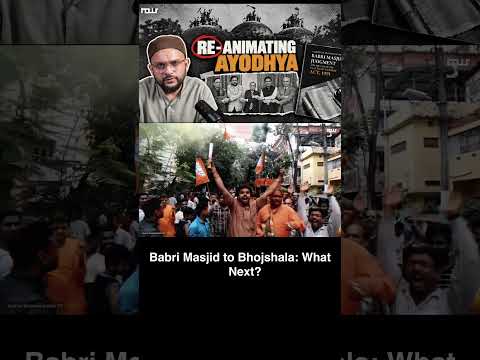
“The 2019 judgment was never just about a Masjid. It was a method.”
 1:59
Why have reported attacks on Christians increased in India?
 2:31
Neutral laws can have unequal effects on religious minorities, affecting education, employment and social mobility.
 2:32
The Uniform Civil Code imposes a dominant majoritarian framework (the Hindutva framework) on all citizens of the country. Sania Ismailee dismantles the idea that uniformity can lead to substantive equality. The first episode of Emerging Perspectives is now live:
 1:35
“There has never been a discussion on why a community is so politically deprived.”
 1:54
The 2025 Waqf Act reshaped waqf governance, raising broader questions about religious sites, legal safeguards, and historical disputes.