

 3:44
Video· Nous Clips
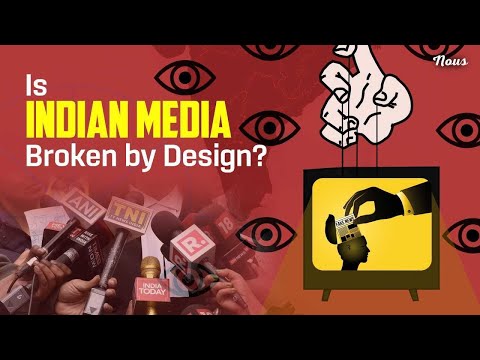
Does Liberal Media Serve the System Better?
We’re surrounded by news, all the time. But what if the news isn’t just telling you what’s happening, it’s shaping what you’re allowed to think?
The mainstream Indian news media has gone rogue. Over the past few years, it has increasingly been called out for spreading polarisation, hate and toxic propaganda. Watering the seeds of prejudice, it has been condemned for its communally divisive programming and anti-Muslim dogwhistling.
We inhabit a world of information. We walk with it, eat with it, sleep with it. The world has never been so informed. It has also never been so misinformed. Misinformed and disinformed. Polarized into echo chambers. Us. Them. Propaganda. Propaganda has taken many forms and faces across history. What does it look like in our times? Let's look at the Indian news media Hate speech on TV news channels Indian TV news has become a battleground of angry arguments India was the biggest source of COVID-19 misinformation in the world Communal issues, Hindu versus Muslim debates, controversies The Supreme Court has come down heavily on TV channels for spreading hate speech
Now we know that the Indian media gone bad is not a news story. It's been around for a while and it's an ongoing story. But is this dissent into toxicity and aberration? Or does it tell us something about news media as an institution? Was there ever a time when Indian media was good before it got bad? Or are there certain rules by which media as a system plays by? What does media theory tell us? It's the late 1980s and two American men, Edward S. Herman and Noam Chomsky, publish an institutional analysis of mass media that forever changes the way we look at media.
They call it propaganda. They contend that the news media as an institution primarily serves the interests of those in power. What becomes news and what doesn't, what you can and cannot talk about, the limits of the news discourse. All of this serves the priorities of the powerful and by deciding what the public is allowed to see, hear and think about, mass media manages public opinion. It manufactures consent. To study this, Herman and Chomsky propose a propaganda model with five structural filters. The limits of the system are foremost defined by those who own and control control news media, and that's the first filter of the propaganda model.
Media Ownership India is one of the biggest media markets in the world, but the ownership of its national media is concentrated in the hands of a few private players, large corporations, business families and individuals. In broadcast television, you have the recent Adani takeover of NDTV, the Ambani's who who own Network 18, Subhash Chandra, Z Media, or Arun Puri, India Today. While in print, you have the Birla's who own HT Media, the Goenka's of Express Group, or the Jain's from the Times Group, who, like many others, are key players in multiple media sectors.
Now, these conglomerates don't just own media houses. They also have other businesses to run, and most importantly, profits to make. And so, multiple conflicts of interest arise. How to run your media business without hurting the commercial gains of your other businesses? Or how to be critical of a government that has significant powers to influence your corporate interests? Whatever privatizations of public resources that governments do, the biggest beneficiaries are the biggest media owners.
So tomorrow, Spectrum is privatized. Who are the gainers? Ambani's, Mittal's, Tata's, Birla's, oil and natural gas are privatized. Mining is privatized. Therefore, ownership determines what business and political interests the news media caters to. And while the current media regime operates in the extreme, Clean and clear image. There is no political match to Modi. Narendra Modi is the most popular leader in the world.
There is nothing new about a cosy relationship between the government and the media. Post-independence, because we had come out of an independence movement where everybody thought they were part of nation building, the coziness between newspapers and political leaders was seen as a necessary act of where the nation should go to. And as the political class itself changed from 60s to the early 70s to Indira Gandhi, This coziness becomes complicity because then you are suddenly supporting an idea which is not about nation building, but is about self-building, about political aggrandizement.
You have the emergency coming in. The only press that really stands up is the Indian Express, but it has also its political reasons. It's run by a family which is a Jansang family. So it does not come out of journalistic instincts necessarily, but due to political reasons. And then you have this transition into liberalization and then you see groups like the Rahejas for Outlook, you see Reliance, which sets up News18, that you have large businesses which have huge other business interests buying into media.
So as a result, and even the old legacy owners, when you look at places like the Hindustan Times, it's the Birlas, they have a huge set of other businesses. The problem this creates is evident because even post-liberalization, we are a semi-liberalized economy. If you have to do your business well, the government has control over licenses, permissions and a hundred other things that they do. So you can't act independently and risk losses in other businesses. This government-corporate nexus determines media biases. And only those who reflect these interests make it to positions of power within media organizations.
The board positions and leadership roles in Indian newsrooms are occupied by the upper caste elite. Chomsky argues that this is a kind of pre-selection that happens of individuals who have internalized the constraints of the market forces, which in India also includes caste structures. Caste is in India pre-selection to an extent that even Chomsky can barely dream of. You know, what the market does or capital does is a very small portion, given the kind of control.
The caste, I always argue, is the basic framework on which Indian society operates. Dominance of the upper caste is a given. And when we talk of that dominance, we are talking actually of a dominance of basically the mercantile caste, what we would call the banyans, and the intellectual priestly class, which is what we call the Brahmins. The newsroom is led and staffed. if you look at it, the percentage of Brahmins, not even when you look at upper caste, but if you look at the percentage of Brahmins, because intellectual capital isn't the control of Brahmins in India, even more so today, you look at the universe, etc. is this caste. And the traditional drivers of Hindutva in India has been this combination of the mercantile and the priestly caste.
Interests of the dominant elite, political interests, business interests, all of it goes goes back to media ownership. It is ownership patterns that necessitate the system serving those in power. But speaking of business interests, it takes us to the next filter of the propaganda model, funding. News media is a business enterprise and businesses have economic imperatives. And what is the revenue model of news media in India? Advertisement with a capital A. It's simple. News media needs money to run and you and I are not paying that money. Enter So while advertisers might not have editorial control over content, they do decide which media organization they give their money to.
And who are these advertisers? Governments and corporations. Yes, the power groups come back and so do their interests. In an ad-dependent revenue model, both compliance and dissent are rewarded and punished, respectively. So if you're Udainik Bhaskar, one of the largest red newspapers in India, and you report on the collapse of government infrastructure during the second wave of the COVID pandemic, brace yourself for half of your government ad revenue disappearing. But if you're a network 18 that tows the government line program after program, year after year, then rejoice, you have topped the ad revenue charts.
There's another aspect to the advertisement game in India, TRP. TRP is viewership data that measures TV audiences And advertisers use these ratings to give ads. The higher your ratings, the more ads you get. So channels compete for these ratings or engage in rigging them. Competition means that news becomes less about public interest and more about what sells. And so you have sensationalism enter the picture. And in India's current political climate, polarization and hate.
So funding too determines what private and government interests the media serves. Now, the government is not just a source of revenue, it is also a source of information for the media. Filter number three, sourcing. The political establishment is a source of information scoops, official accounts, exclusive interviews. Closeness to power determines who has how much access to this information. And so you have Anand Goswami in his leaked chats, boasting about his close relations with the PMO. Or you have the group editor of the Times Now group flaunt a whole brigade of sitting cabinet ministers, including the Prime Minister, attend her son's wedding.
Such close proximity with power comes with its terms and conditions. If you want access, then complicity is expected. And so in exchange of proximity, you have news personnel parrot the government's version and discredit a people's movement like the 2021 Farmers' Protest, or celebrate bad economic moves, or provide cover to a failed administration during a deadly pandemic, or even spread outright fake news around Indochina border disputes. And thus, power centres manage and manipulate media narratives.
Again, access journalism is not a new phenomenon. The government is a source of information. What is different, however, with the current political dispensation is the kind of exchange happening. While there is complicity, there's not really a lot of access. Access journalism is part of journalism. You need to have access. You need to be able to approach people. The problem is when the access journalism becomes one way where your access to a politician means that you get favours from the politician and you do the news that the politician is providing. Even when journalists were aware that some major corporate group is actually fiddling with cabinet formation, they were more interested in finding out the name of cabinet minister rather than finding out which corporate was influencing which cabinet position and they did not reported this clearly there on the radio what is happening today is a extreme magnification of this tendency because what we are now seeing is not even access journalism it is the
complete control over the pipeline this is spoon-fed journalism compliance is maintained through other mechanisms of reward and punish and in the name of access you get memos of tweets to to be copy-pasted or exclusive information about what your leader eats, how much he sleeps or his superhuman tendencies. Do our Prime Ministers eat mangoes? Why don't you get tired? Prime Minister Modi is a time-consumer. No matter how long he is awake at night, he always wakes up.
What is the secret to Modi's hard work? 20 hours of work and 4 hours of rest. reducing mainstream media to a servile PR spouting machine running propaganda campaigns. And so you have media baron Arun Puri at his own 2023 India Today Conclave sharing the stage with the Prime Minister. But at this media event, the only thing he has to say to a Prime Minister who has never held a press conference is not a question but a meek complaint about lack of access. Sir, if you don't mind, I would like to say one thing.
And then in true Orwellian doublespeak, the Prime Minister advises the media not to work under any pressure. In a system where only compliance is rewarded with access, and sometimes not even that, any challenge to power will have its consequences and so we have the fourth filter flack when the media doesn't told the narrative of power it gets flack negative repercussions which can be financial editorial where your credibility is made suspect or the government can unleash its agencies
 1:11:48
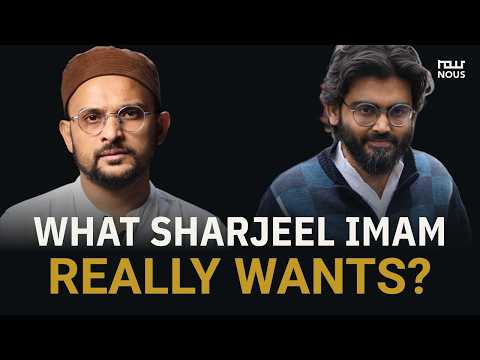
In September 2026, Sharjeel Imam, writing from Tihar jail, called Jinnah "a great democratic leader of Indian Muslims in British India." One side called it a confession. The other called it courage. Almost nobody looked at what he actually asks for.
 24:49
How did the madrasa evolve from an integrated centre of learning into an institution often portrayed as separate from modern education? This explainer traces the historical transformation of Islamic education, examining the impact of colonialism, the disruption of traditional endowments, and the …
 38:02
The 2019 Supreme Court judgment on the Babri Masjid–Ram Janmabhoomi dispute remains one of the most consequential rulings in India’s constitutional history. The Court acknowledged the illegality of the 1992 demolition while awarding the disputed land to the Hindu side. This explainer examines the…
Discussion
0Readers only · Comments are reviewed by the desk before they appear
The journalism is free for everyone — create a free account to join the discussion.