

"They Are Humiliating Him": Inside the Fight to Save Azam Khan's University
With a 15-day demolition notice hanging over Mohammad Ali Jauhar University and its founder still in jail, Dr. Tazeen Fatma describes a campaign she says is designed less to recover land than to make an example of her husband.
Contents · 5 sections
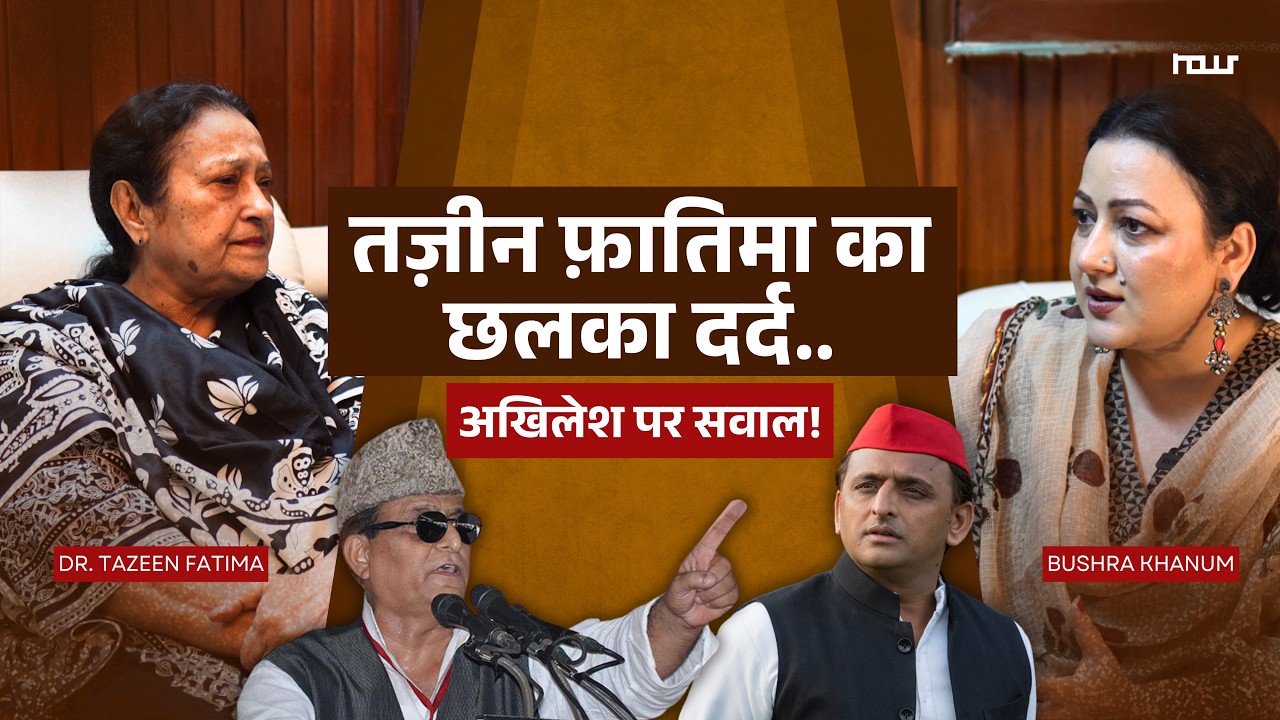
Mohammad Ali Jauhar University in Rampur, Uttar Pradesh, was built over roughly a decade from 2006 largely through public donations and volunteer labour — what Dr. Tazeen Fatma, in conversation on the Nous Podcast, repeatedly calls kar sewa, the same term used for devotional volunteer service at religious sites. Now, nearly a decade after its buildings were completed, the Rampur Development Authority has issued notices declaring 38 of the university's 40 buildings illegal, giving the trust 15 days to demolish them voluntarily or have the authority do it and recover the cost. More than 3,000 students are currently enrolled.
Fatma is uniquely placed to speak to the stakes. A former Rajya Sabha member and former MLA herself, she is also the wife of Azam Khan — the Samajwadi Party veteran who built the university, has been jailed multiple times on a long list of criminal cases, and remains in custody as the demolition notice lands. She has herself spent roughly 18 months in prison across two separate periods. She is 77.
"Built by spreading his apron"
Fatma's central argument is about the gap between when the university was built and when the state decided its buildings were illegal. Construction ran from roughly 2006 to 2017; the demolition notice arrived in 2026 — under the authority of the RDA, a body Fatma says did not even exist when most of the construction took place. Her inference is direct: the legal defect being cited now is a pretext applied retroactively, not a problem anyone raised at the time.
On funding, she is emphatic that the university was not built with government money or Khan family wealth. "Azam Sahab had said that he built this university by spreading his apron to collect donations," she says — donations she stresses came from Hindus and Sikhs as well as Muslims. No member of the family studies there now, she adds, and none of them draws any income from the institution; if anything, the family contributes to it. The university's minority status, conferred by an act passed through the state legislature, does not restrict enrolment to Muslims, she says — it is, in her words, "for everyone."
A second demolition: the ₹20-a-month schools
The university is not the only education project Fatma says has already been dismantled. Alongside it, the trust ran several CBSE-affiliated Rampur Public Schools, housed in dilapidated government buildings that Khan had taken on lease and rebuilt, where children of the poor, of orphans, and of bidi (hand-rolled cigarette) workers and daily-wage labourers were educated for a monthly fee of ₹20. Fatma challenges anyone to name another CBSE school in India charging that little. The state cabinet decision that had allowed the schools to operate in those buildings was later reversed, the buildings reclaimed, and the schools emptied of students — a precedent, in her telling, for what the university now faces. "If it can happen to 100-year-old mosques," she says, invoking the wider pattern of demolitions across Uttar Pradesh under the Adityanath government, "it can happen to the university too."
Asked directly whether she believes the demolition notice is retaliation, she doesn't equivocate: "Yes, it is definitely being done as an act of revenge," citing Khan's standing as an opposition leader. She also addresses a separate theory circulating locally — that the university is targeted partly over its name, Jauhar, after the freedom fighter Maulana Mohammad Ali Jauhar. If that is the real motive, she says, it is a particular kind of shame: punishing an institution for honouring a man who said he did not even want to die in a colonised India.
What jail has looked like
A significant part of the conversation turns to conditions inside the jail where Khan and the couple's son, Abdullah Azam — himself repeatedly arrested and released on a cycle of cases — are held. Fatma pushes back directly on an assumption she says the public makes about politicians in custody: that they get comforts — a cooler, an air-conditioner, a proper bed. She describes the opposite. On the day of arrest, she says, Khan's personal belongings were initially refused entry into the jail unless carried in a sheet or bag rather than a suitcase, prompting him to refuse food and water until the items were allowed in. There is no bed; both men sleep on the floor, where she says they are bitten by mosquitoes, and an English-style commode seat had to be installed at their own expense because none existed. In the summer heat, she says, there is no cooler.
She frames this treatment as deliberate rather than incidental: "Behind arresting Azam Sahab, one thing was that he had to be arrested. He had to go to jail. There was also an intention to humiliate him in a way." Asked whether the message is aimed beyond Khan himself — at any Muslim political figure who accumulates comparable stature — she agrees without qualification, describing it as a demonstration that even a leader once powerful enough in Uttar Pradesh that his word "carried weight" and was sometimes called arrogance can be broken down to this.
A party that isn't showing up
Perhaps the most pointed thread in the conversation concerns Khan's own party. Fatma is asked directly why Samajwadi Party leaders Akhilesh Yadav and Dimple Yadav, visibly active on other issues from Delhi, have been largely absent from Rampur during the demolition crisis — including the local MP, who the interviewer notes was reportedly turned away at the university gate by police without incident afterward. Fatma declines to criticise the MP by name, recalling that Khan himself, on going to jail, insisted he had gone not to a prison but to "a reform home" — a remark she treats as closing the subject.
On the party leadership more broadly, she is careful but unmistakable. Asked if she has complaints, she says no — then immediately qualifies it: "I have felt this on some other occasions before too." Pressed on whether leadership should have stood shoulder-to-shoulder with the family through this, she allows that colleagues have mostly been present, "but while they have been there, it is not very visible" — a sentiment she says is shared by ordinary people in Rampur if you ask them directly. When the interviewer suggests Akhilesh Yadav's energy seems directed toward a national rather than a state stage, Fatma redirects pointedly: the more immediate electoral task, she says, is winning the Uttar Pradesh chief ministership again, given what she describes as systematic voter-list manipulation and institutional capture — ambitions toward Delhi, in her framing, are getting ahead of the fight actually in front of the party.
What ends, and what doesn't
Fatma is asked, finally, whether the political legacy she and Khan built — through his ten terms as an MLA, his time as a Lok Sabha member and minister, and now their son's own entry into electoral politics — has effectively been erased, and whether her only remaining wish is to see her husband and son released to live quietly at home. She rejects the premise. Whatever happens to Khan and Abdullah personally, she says, neither of them is the kind of person who would simply retreat into domestic life: the university he built with, as she puts it, his own blood and sweat is a commitment that continues regardless of what happens to him — and one she expects him to keep fighting for from wherever he is.



Discussion
0Readers only · Comments are reviewed by the desk before they appear
The journalism is free for everyone — create a free account to join the discussion.