

After Nations: Rana Dasgupta on the Fraying Promise of the Nation-State
The writer and historian argues that the nation-state was never a natural or permanent form of political life, but a specific, capital-driven invention now buckling under a backlash it has no real alternative to.
Contents · 8 sections
A very young and very unusual experiment
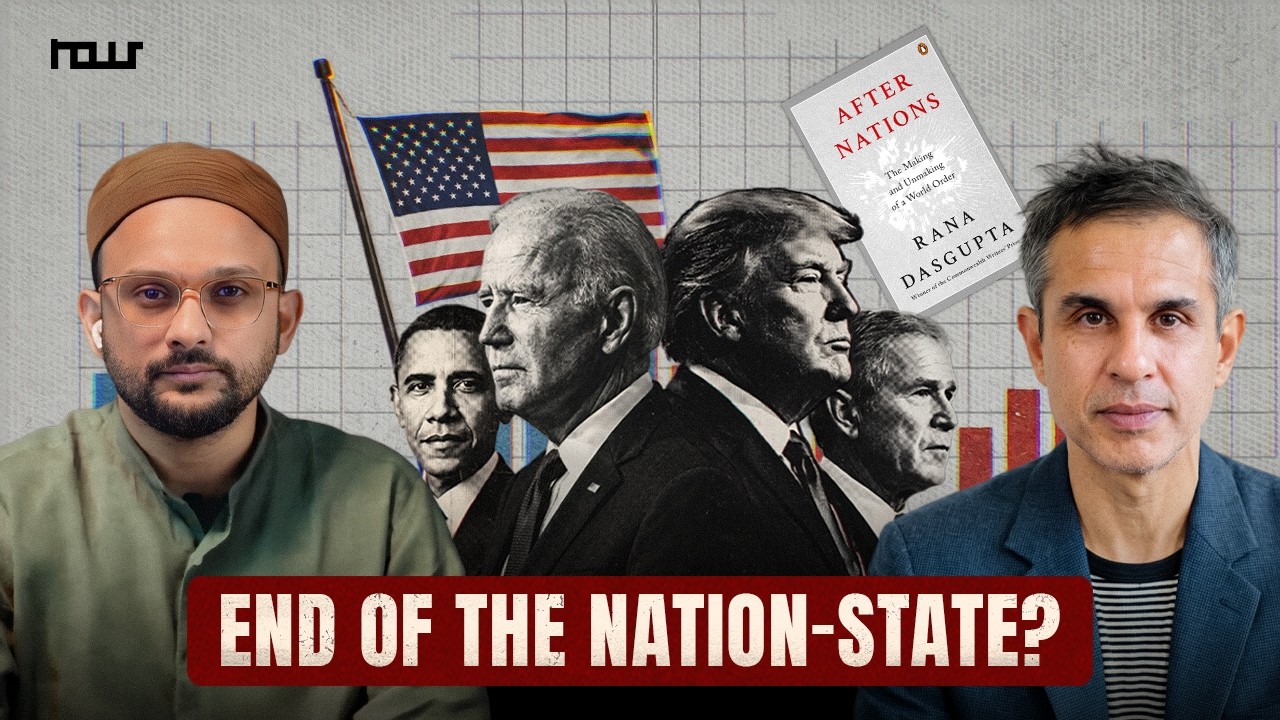
Rana Dasgupta, author of After Nations: The Making and Unmaking of a World Order, opened his conversation on Nous by insisting on a point that sounds almost obvious but rarely gets taken seriously: the world of roughly 193 sovereign nation-states we now treat as the natural order of things is barely eight decades old, and there is no good reason to assume it will last much longer. The mosaic of formally equal sovereign states that emerged after 1945, as the United States and Soviet Union dismantled European empires, was "an experiment that's never been tried before," Dasgupta said — one that lacks the seven centuries of the Ottoman Empire or the two millennia of Chinese imperial continuity that might let us call it a proven, durable system. What looks permanent from inside it, he argued, may simply be too young to have shown its cracks yet.
Dasgupta traced the nation-state's origins directly to European colonialism, arguing that the rights Europeans built at home — universal suffrage, welfare provisions, mass education, all largely in place in Britain by the early twentieth century — were financed by denying the same rights abroad. What makes the nation-state specifically modern, in his account, is not that states are new (they are thousands of years old) but the intensity of the tools it deploys: a monopoly on organised violence enforced through modern military technology, propaganda machinery in the form of mass education and media designed to manufacture a shared national mythology, and bureaucracies capable of administering individual lives "from birth to death." That apparatus, developed piecemeal in Europe, was "universalised and generalised across the world" only after 1945.
Twin systems: the state and the market
Perhaps Dasgupta's most structurally important claim is that the nation-state should not be studied on its own, but as one half of a single object whose other half is the capitalist system. States, he argued, supply the political infrastructure — enforcing contracts, disciplining a labour force through education, guaranteeing property rights — that corporations need but cannot generate for themselves, and since the 1980s, dependence on debt and foreign capital has left states with little choice but to act as capitalist agents regardless of their formal ideology. What looks like a world of distinct national economies, he said, is largely fiction dating to a specific historical window — the mid-twentieth century's closed, highly taxed, war-organised national economies — that has since given way to what he called "a pretty much continuous planetary capitalist zone."
National borders have not disappeared in that zone; they have been repurposed. Dasgupta described them as an "arbitrage system for capital," in which some jurisdictions offer rich legal protection for investment and elite living, while others exist precisely because they allow cheap labour, weak environmental oversight, or resource extraction "without too much legal oversight." The variety among nation-states, on this reading, is not a failure of the system but a functional requirement of it: capital needs different kinds of zones for different purposes, and the nation-state system supplies them.
Bengal's silver and the making of the West
Dasgupta's account of how Europe caught up with Asia economically runs directly through Bengal. As late as the eighteenth century, he noted, India and China together produced something close to half of global GDP by some historians' estimates, and centuries of European trade with Asia — running from Venice's Crusade-era trade routes through the great spice, silk, porcelain and textile trade — had left Europe structurally dependent on Asia for goods it had to buy with gold and silver. Spain's American silver, extracted from Peru and Bolivia, largely ended up flowing onward to China in exchange for tea and goods destined for European markets, creating what Dasgupta called an "accumulating desperation" in Europe for ever more bullion to keep pace with Asian economies. The East India Company's drive to seize control of Bengal's textile industry and its tax base was, in his account, substantially a response to this dynamic: Bengal held one of the world's largest reserves of silver, and controlling it let Britain keep buying from China without depleting its own reserves — a seizure that produced, among other things, mass famine in Bengal and, when Britain tried to make its American colonies help absorb the costs of that same Bengal economic collapse, contributed to the loss of America itself. Slavery and the Industrial Revolution, in his telling, were Europe's twin catch-up strategies for competing with economies it could not otherwise match, and Britain only became a genuine global capitalist superpower not by defeating Napoleon, but by breaking India and China's economies decisively by the 1840s — the terminal decline of the Mughal Empire alongside Britain's victories in the two Opium Wars.
Three empires, three blueprints
Dasgupta also distinguished between the competing imperial visions that fed into the eventual nation-state settlement. France, he argued, initially imagined its empire evolving into a single integrated political zone rather than fragmenting into separate states — by the 1930s and 40s, some African colonies were sending deputies to the parliament in Paris, and some colonial elites in places like Senegal and Côte d'Ivoire feared formal independence precisely because it meant losing that integration and becoming small, isolated economies. That model collapsed only because the United States and Soviet Union both insisted, after 1945, that all colonial dependencies become separate sovereign states. Britain and the United States, by contrast, shared a basic commitment to enforcing property rights and open trade routes globally, but pursued it differently: Britain, limited by the technology of its era, pursued direct territorial occupation across continents, while the United States — shaped by its own long experience treating already-sovereign Latin American states as client economies it could manipulate from outside — preferred a world broken up into formally independent nation-states it could still coerce asymmetrically through trade, currency and military power, without the overhead of direct occupation. That American vision prevailed, Dasgupta argued, precisely because it was the one outcome that both the era's most powerful actor and its most powerless ones — anti-colonial movements insisting on national sovereignty as the only acceptable postwar settlement — could each accept, for entirely different reasons.
Why rights were ever conceded at all
Asked why European states withheld democratic rights for so long after democratic ideas were already fully articulated — Britain, he noted, did not achieve universal suffrage until 1928, despite having understood the concept for over two centuries — Dasgupta's answer turned on class conflict and economic dependency rather than moral progress. Through most of the nineteenth century, Britain's elite wealth came from empire, not from domestic peasant labour, so an unorganised, largely illiterate citizenry posed little threat and needed few concessions. That changed once Britain industrialised and depended on its own working class to run its factories: workers who could strike could now stop the economy, and a state that needed them healthy, literate and punctual had strong incentive to invest in public education and healthcare. By the 1920s, he noted, welfare spending had for the first time in European history overtaken military spending — a genuine, if instrumentally motivated, "golden era" running roughly from 1945 to 1975, in which Western states delivered dramatic gains in infrastructure, development and functioning democracy.
That era, in Dasgupta's telling, provoked its own backlash. Elites who had endured high taxation and capital controls "felt they were living in a kind of communist prison," and from the 1970s onward pushed to make capital mobile again — offshore tax havens, the offshoring of labour to evade Western regulation, and a new capacity to hold nation-states "to ransom" by threatening to relocate investment unless taxes fell and labour protections were diluted. The chief beneficiary of that shift, he argued, was China, which absorbed the manufacturing capacity that Western deregulation exported, while Western states were left "hugely indebted" and stripped of the leverage over their own economies they once had. Deprived of the ability to materially enrich their populations, he suggested, such states increasingly compensate with mythology instead — "I can't put more money in your pocket, but I can give them a better mythology," whether that means promises of racial or religious grandeur, a dynamic he said is now "quite explicit in India."
Sayyid Qutb and the theological rejection of the state
Dasgupta situated the modern nation-state's claim to power as fundamentally theological, not merely administrative — a radical eighteenth-century assertion, in the wake of Europe's religious wars, that the state would tolerate no rival authority: not church, not aristocracy, not family, not any transnational community of belief. That total claim, he argued, is precisely what draws sustained theological pushback, from right-wing Catholic thinkers like Charles Maurras in early twentieth-century France to, far more influentially today, the Egyptian Islamist thinker Sayyid Qutb. Dasgupta traced Qutb's radicalisation to lived experience: revulsion at French and British colonial administration in Egypt, disillusionment after visiting the United States in the 1940s, and, decisively, imprisonment and torture under Gamal Abdel Nasser's secular, authoritarian Arab socialism in the 1950s and 60s. Out of that experience, Qutb developed an account of political sovereignty that recognises only the sovereignty of God, casting the modern nation-state — and Muslims who make peaceful accommodation with it — as a form of idolatry, and permanent revolution as the only legitimate Islamic response.
Dasgupta's interviewer situated Qutb within a wider, longer-running South Asian debate about the legitimacy of national sovereignty — one that also produced Muhammad Iqbal, the Deobandi scholar Hussain Ahmad Madani, and Abul A'la Maududi, whose writing Qutb read closely. Dasgupta's own interest lies less in adjudicating that theological argument than in what it exposes: that critiques of unlimited state sovereignty are not confined to any one tradition, but recur wherever a state's totalising claim collides with an older loyalty — religious, familial, or communal — that the state insists on subordinating to itself.
What survives after nations
Asked what alternative political structures might follow the nation-state, Dasgupta pointed backward before pointing forward, invoking pre-national imperial models like the Ottoman millet system, under which non-Muslim and non-Sunni communities — Jews in Salonica among them — flourished for centuries under an empire that "placed a lower set of demands on their citizens but gave them much greater freedoms": pay your taxes, participate in trade, and the empire otherwise left marriage, education, and language largely alone. He argued that much of the territory once held by the Ottoman Empire has visibly suffered under the nation-state successor system that replaced it, now in various states of war and authoritarian collapse. The same instinct led him to Southeast Asia, where he sees organisations like ASEAN as carrying "the imprint" of older, pre-national civilisational networks — Indian Ocean trade routes, diverse religious coexistence — that modern national governments have overlaid but not fully erased.
Dasgupta was careful not to predict the nation-state's collapse. Because it remains, in his account, one half of an exceptionally "robust and flexible" capitalist system, he does not expect nation-states to disappear — but he argued their current, narrow, competitive form is proving inadequate to real problems, above all the Israel-Palestine conflict, where a security logic organised entirely around the nation-state offers, in his words, "no end point... except the further militarisation of these societies to the point of the total destruction of the region." He pointed to Europe itself — the continent that invented the nation-state — as already having partially conceded the point, building supranational arrangements precisely because national competition in its rawest form nearly destroyed the continent twice. His own conclusion, described only in outline in this conversation but developed further in the book, is that averting similarly destructive outcomes elsewhere will require building new transnational structures — what he called "public commons" at an international scale — that can constrain the raw military and economic competition nation-states are otherwise structurally built to pursue.
A crisis without a script
What distinguishes Dasgupta's account from a simple story of decline is his insistence that none of this is predetermined. States are not inherently democratic, he stressed, nor inherently authoritarian; a fifty-year window of Western welfare-state democracy was itself a contingent response to a specific balance of class power, not evidence of some deeper civilisational destiny. The current period, in which figures like Donald Trump openly abandon the postwar language of universal rights and freedoms in favour of naked, amoral power politics, marks for Dasgupta the visible unravelling of an "official morality" the nation-state system had worn, more as convenient cover, for less than a century. What replaces it, he suggested throughout the conversation, is being worked out in real time, through trial and error, by leaders and movements — from Big Tech's accumulation of power that rivals state authority, to Islamist theological rejection, to regional blocs recovering older civilisational habits — none of which yet amounts to a settled answer, but all of which testify to how contingent and unfinished the nation-state's claim to permanence really is.



Discussion
0Readers only · Comments are reviewed by the desk before they appear
The journalism is free for everyone — create a free account to join the discussion.