

Amaresh Misra: 'Netanyahu Is No Longer in Control of Israel'
The political analyst argues that a month into open war, Iran has flipped the balance of power against Israel and the United States, and set out five conditions Washington cannot easily accept.
Contents · 6 sections
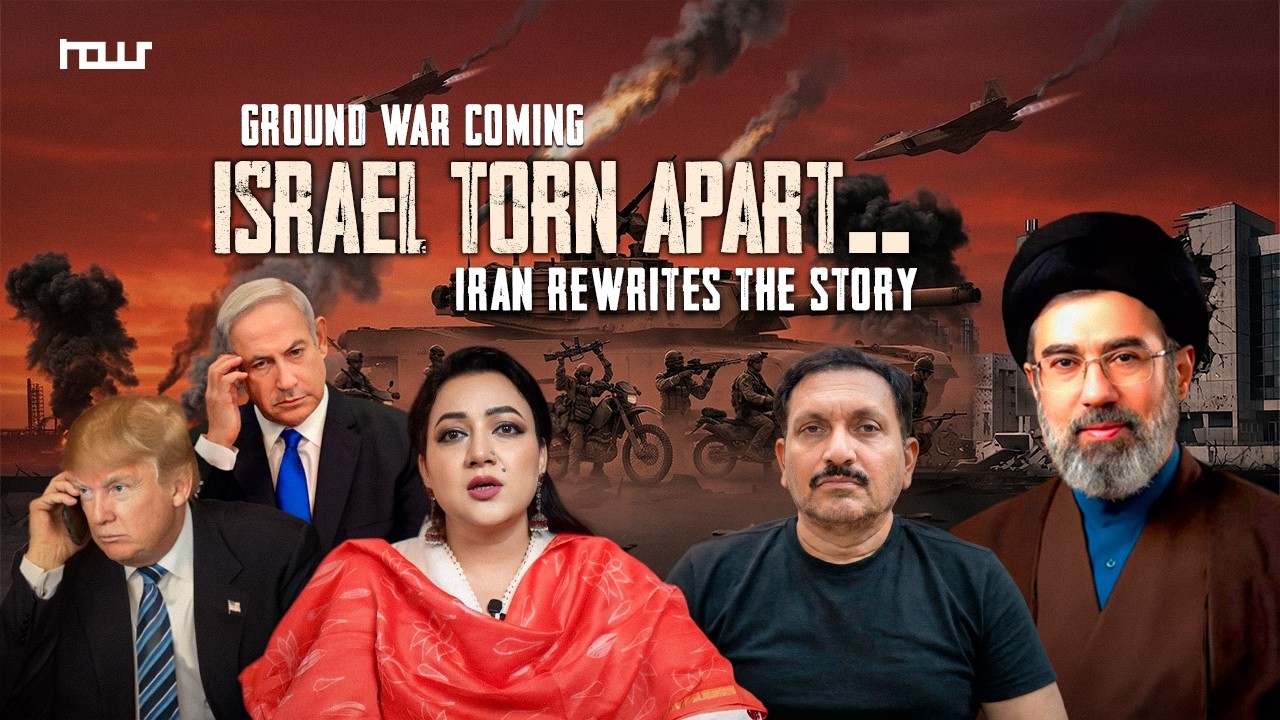
A month into open war between Iran, Israel and the United States, host Bushra Khan Fahad put a blunt question to the author and political analyst Amaresh Misra on Nous Podcast: is Donald Trump's stream of contradictory statements — declaring victory one day, mobilising troops the next — a deliberate strategy, or something closer to delusion? Misra's answer, developed across the conversation, was that Iran has systematically dismantled the premises the war began on, and that the contradictions in Washington's messaging are a symptom of that reversal rather than a plan.
A president talking to himself
Misra opened by comparing Trump's behaviour to a well-documented pattern among certain Roman emperors — he named Caligula and Nero specifically — who, in his telling, genuinely believed their enemies had already been defeated before them, mistaking poison for a gift and a gift for poison. He was careful to frame this as historical pattern rather than diagnosis: what is different now, he said, is the technology and the scale, not the underlying psychology of a leader losing touch with events on the ground.
Where Joe Biden's failure, in Misra's account, was that he stopped registering information altogether, Trump's version is that he actively constructs his own record of daily "achievements" — a distinction Misra called a sign of a leader in a state of extreme delusion, compounded, he argued, by Benjamin Netanyahu's own obsessive drive to see the war through regardless of cost. The pairing of the two men, he suggested, is what produced the abnormal character of this war.
Reading the damage through the blackout
With Israel operating under wartime censorship, Misra said, most detailed information about the state of the country is reaching the outside world through social media rather than official channels or credible satellite analysis, since satellite imagery can show structural damage but not whether supply chains have actually failed. On that basis, he described Haifa's power station and desalination plant as destroyed, cutting deeply into an energy supply that meets more than half of Israel's needs, and named Dimona — the site of Israel's nuclear programme and satellite communications — and the nearby Beit Shemesh satellite hub as targets Iran struck roughly ten days into the war.
He was careful to note the limits of what can be confirmed: no radioactivity has been reported at Dimona, he said, which likely means Iranian strikes hit facilities around the nuclear site rather than the core itself, but in a way that may have made it impossible for Israel to safely move weapons stored there. Combined with the Haifa refinery, which he said supplies the bulk of Israel's oil needs, the picture Misra drew was of a country in a deepening energy crisis it cannot openly acknowledge.
Iran's five conditions
Misra dismissed Washington's own fifteen-point proposal for a ceasefire as "fake," without substance, and said Iran had rejected it outright in favour of five conditions of its own. First, any ceasefire must come with written guarantees — signed by Britain, France and other powers, not just the US — that Iran will not be attacked again. Second, all US sanctions must be lifted, not merely the recent easing that has already let an estimated 178 million barrels of oil back onto the market. Third, Iran is demanding compensation, a demand Misra called legally awkward for Washington to refuse in principle, since international law obliges an aggressor to compensate the party it attacked — but one Washington cannot accept without conceding it was the aggressor in the first place.
The fourth condition concerns control of the Strait of Hormuz. Misra said Trump had floated joint US-Iranian control of the strait — with "the Ayatollah and I" managing it together — and that this was a genuine proposal, not a joke; Iran rejected it outright. The fifth condition is the broadest: an end to Israeli fire on Palestinian civilians, an Israeli withdrawal from Lebanon and Syria, and a US withdrawal from Iraq — in effect, a demand that the region be vacated by both occupying and basing powers, opening space, Misra argued, for an independent Palestinian state.
The battle in the air, at sea, and what a ground invasion would mean
Misra's account of the war's military trajectory rests on a specific technical claim: that Iran defeated American stealth technology not by beating its radar-evading design, but by ignoring radar altogether. Aircraft like the F-35, he said, emit enormous amounts of heat, and Iran used infrared sensors — which track heat rather than radio-frequency signatures — to shoot down F-18s, F-35s, F-15s and F-16s. The premise that stealth aircraft were effectively unkillable, he argued, has collapsed.
At sea, he pointed to reported technical failures aboard the USS Gerald R. Ford, the US Navy's newest and most expensive carrier, and to the USS Abraham Lincoln's carrier group withdrawing and then attempting to return, only for its drones to reportedly come under fresh attack. With both the air and naval campaigns faltering by his account, he said the US is now exploring a ground invasion — the one domain where Iran is conventionally considered strongest rather than weakest.
He described the forces being assembled for that scenario — the 11th Marine Expeditionary Unit arriving via the USS Tripoli, Delta Force, the 82nd Airborne, Army Rangers and Navy SEALs — as elite units built for amphibious assault, but noted that Iran has spent years fortifying Kharg Island's caves and mountainous terrain specifically against this contingency. Rehearsing an invasion scenario on American soil, he said, is not the same as executing one on ground Iran has spent years preparing to defend, missile emplacements and all.
Arab silence and Qatar's dissent
Asked whether Saudi Arabia and the UAE might join the war directly, as some Western reporting had suggested, Misra said the more recent and more telling signal was Qatar's public statement that it stands with Iran — a position, he said, that makes it politically impossible for Saudi Arabia to act against Tehran without Doha's cover, since neither Kuwait nor Bahrain carry independent military weight and Oman would not fight Iran regardless. Saudi Arabia, he added, has already denied the reports attributed to it.
The deeper reason Arab governments cannot move against Iran, in Misra's telling, is that Iran has explicitly put the Palestinian question at the centre of the war — the one issue no Arab government can be seen opposing, whatever it has or has not done for Palestinians in practice. He drew a distinction between not acting on Palestine, which is true of most Gulf states, and actively joining a war against the one state that has backed Hezbollah and Hamas materially. Turkey, a NATO member, he said, has also stayed quietly aligned with Iran, dismissing Israeli-attributed strikes on Turkish soil as false-flag operations of a kind Israel had allegedly carried out before.
A war already reshaping the world
Misra argued the war has already produced a global economic shock, visible in oil, gas, fertiliser and petrochemical shortages that ripple into industries as specific as Gujarat's plywood sector, and warned this could deepen into a wider crisis affecting food grains, given how much of that supply chain runs through petrochemical inputs. That economic strain, he suggested, carries its own political risk of triggering unrest and even regime change in states far from the immediate battlefield, echoing what he described as an internal social uprising already under way inside Iran itself — one he characterised as a second revolution, distinct from 1979, driven by ordinary workers, women and men taking to the streets in support of the state against the war rather than against it.
He closed by rejecting the idea that Iran had granted safe passage through Hormuz to five "friendly" countries — including India, Pakistan, Iraq, China and Russia — as a favour to the Modi government specifically; he read it instead as recognition of Indian public sentiment, pointing to displays of solidarity from Kashmir, even where New Delhi itself has stayed silent. Misra's closing framing was direct: just as Hamas's October 7, 2023 attack changed the world, he said, Iran's conduct since the war began has changed it again — and the world would be better served understanding that quickly rather than waiting for the casualties, in and out of uniform, to make the point for it.


Discussion
0Readers only · Comments are reviewed by the desk before they appear
The journalism is free for everyone — create a free account to join the discussion.