

Did Indian Muslims Really Want Pakistan? Revisiting a Question Without an Answer
A historian argues that the evidence for Partition — a narrow colonial franchise and inconclusive migration data — cannot tell us whether Indian Muslims actually wanted Pakistan, and that assuming they did let everyone else off the hook.
Contents · 6 sections
A Debate That Refuses to Settle
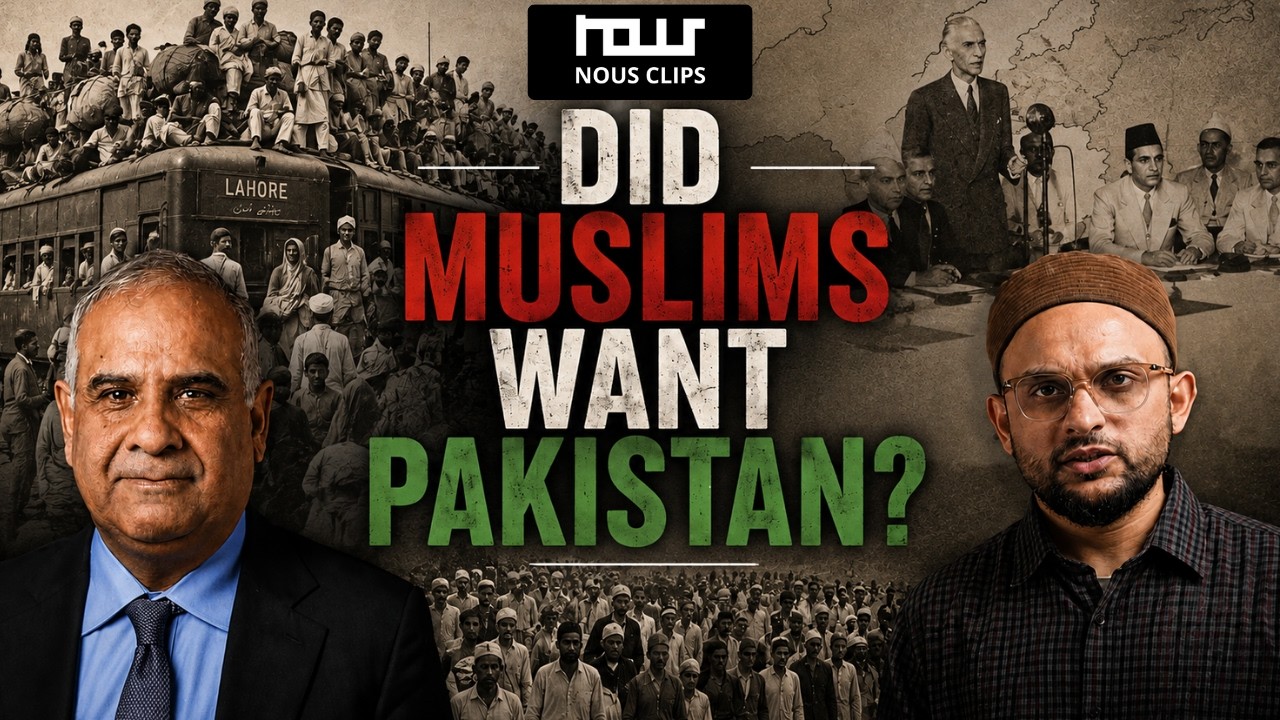
Nearly eight decades after Partition, one of the most basic questions about it remains unresolved: did India's Muslims, as a community, actually want Pakistan? The historian Venkat Dhulipala has argued that the demand for a Muslim homeland was not a last-minute bargaining tactic but a project with deep roots reaching back before the 1940s. Other scholars, including Ayesha Jalal, have countered that Muhammad Ali Jinnah treated the idea of a separate state more as leverage in negotiations with the Congress and the British than as a fixed goal. The gap between these two readings is not a minor academic quibble. It shapes how India remembers its Muslim citizens' loyalty, and how it has treated them ever since.
A historian pressed on this question in conversation pushes back against Dhulipala's framing on two fronts: what his account leaves out, and what the evidence can actually support. Dhulipala centers his study on the United Bengal Provinces, and points to figures such as Maulana Usmani as evidence of a genuine strand of Muslim separatist ideology. That strand undoubtedly existed. But, the historian argues, Dhulipala does not seriously reckon with the other half of the story: the attitude of the Hindu right and the Congress toward the legitimate concerns Muslims raised in the years before Partition. A book that examines Muslim separatism without examining what Muslims were reacting to, he suggests, tells only half the story.
A Book Born of Its Moment
Context matters here. Dhulipala's book, the historian notes, appeared at a moment when Samuel Huntington's "clash of civilizations" framework was, in his words, "flavor of the month," and when Muslims were widely being cast as aggressive, difficult, and prone to violence. In that climate, it became fashionable to lay the blame for Partition squarely at the feet of Muslim separatism. The argument is not that Dhulipala's scholarship is dishonest, but that its reception, and perhaps its emphasis, cannot be separated from the intellectual fashions of the era in which it was written and read.
Why the Numbers Do Not Answer the Question
The strongest part of the historian's argument is empirical rather than interpretive. Two kinds of evidence are usually invoked to prove that Indian Muslims wanted Pakistan: election results and migration patterns. Neither, he argues, can bear that weight.
On elections, the problem is structural. The Government of India Act of 1935 extended the franchise to only about 14 percent of the population. A vote won under so narrow a franchise cannot be read as a referendum on the wishes of an entire community, let alone of Muslims as a whole. Even the pivotal 1946 provincial elections, often cited as proof of overwhelming Muslim support for the League, took place at a moment of extreme political polarization, when positions had already hardened. A 14 percent electorate voting amid crisis, the historian argues, is simply not evidence of what ordinary Muslims believed.
There is also a class dimension that complicates the picture further. It was disproportionately the better-off and educated who were enfranchised and politically active, particularly young graduates who feared they would find no room for themselves, professionally or socially, in a Hindu-majority India. Their prominence in the Muslim League, the historian suggests, often reflected economic anxiety about status and opportunity as much as religious conviction. Treating their politics as representative of the wishes of India's entire Muslim population, spread across every class and region, is a leap the evidence does not support.
Migration Was Not a Vote
The second body of evidence, migration across the new border, is treated with equal skepticism. Of India's Muslims, the historian notes, only around 7 million actually crossed into the western or eastern wings of Pakistan. Millions more, especially Punjabi and Bengali Muslims, simply stayed where they already lived; for them there was no question of "opting" for Pakistan since their homes were now inside it or remained inside India. Even among those who did cross, the reasons were rarely a straightforward ideological embrace of the new state. Some fled because they were, in the historian's phrase, "actually subject to violence," much as Hindus and Sikhs fled Punjab in the opposite direction out of fear rather than desire. Sardar Patel's suggestion that Muslims who crossed over were somehow disloyal to India is, on this reading, a misreading of what was frequently a decision driven by survival, family ties, or circumstance rather than conviction. The historian offers his own family as an example: one uncle crossed the new border, while the rest of the family did not, a choice that had little to do with ideology one way or the other.
A Gift That Let Everyone Off the Hook
If neither the ballot box nor the migration figures can settle the question, then the confident claim that Muslims "wanted" and therefore "got" Pakistan rests on weaker ground than it is usually given credit for. The historian argues that this uncertainty was, and remains, deeply consequential. Sections of the Hindu right treated the creation of Pakistan as a gift so generous that no further accommodation of Muslims in India was required afterward. Their needs, on this view, had already been met by the very existence of a separate state, so they could make no further demands on Indian society. That framing, the historian argues, is the most tragic legacy of the whole episode, one that has "bedeviled the Muslim question" in India ever since, because it lets the state and the majority community treat any grievance the community since raises as already settled, whether or not the underlying premise about what Muslims wanted in 1947 was ever true.
What Partition Actually Produced
The demographic aftermath complicates the popular story further. India's Muslim population fell to roughly 11 percent after 1947, but the historian attributes this mainly not to mass emigration, which involved a comparatively small number of people, but to the simple fact that Punjab and Bengal, the two Muslim-majority provinces, were the ones partitioned away. Their large Muslim populations left India's demographic map not by choice but by the redrawing of borders around them.
The historian closes with a less examined observation: Partition also served Congress's political interests. Removing the Muslim-majority provinces left the party freer to dominate a more religiously homogenous polity, a dynamic he says helped secure Congress hegemony for roughly three decades after independence. In this reading, Partition was not simply something that happened to Muslims because of what they wanted or did not want. It was also convenient for the political actors who inherited the country that remained.


Discussion
0Readers only · Comments are reviewed by the desk before they appear
The journalism is free for everyone — create a free account to join the discussion.