

 6:41
6:41Video· Nous Clips
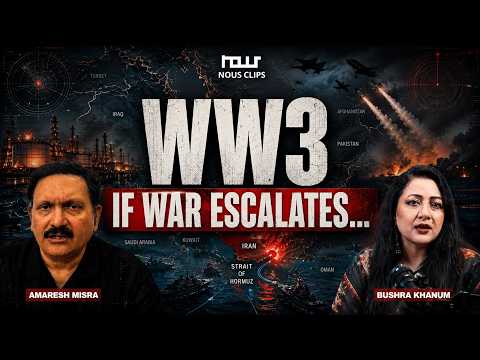
Iran, Israel & the Future of West Asia I nous Clips
This is an excerpt from a longer conversation.
Is West Asia moving towards another major conflict, or is deterrence reshaping the balance of power? In this conversation, senior journalist Bushra Khanum speaks with author and political commentator Amaresh Misra about Iran's military preparedness, public sentiment, and the strategic calculation…
So, there was an emotional atmosphere. But along with the emotion, did you see widespread anger? Did you feel that if war were to break out again, did you see people prepared for it? The point is that if such a strike were to happen, Iran is ready. Mentally prepared. Its people are ready. Its military is ready. And then there's the possibility that Iran could launch a ground invasion. What exactly is Trump trying to achieve with this entire position that the US is maintaining? And that's why a statement came from Iran today. Look, in the current situation, if we conduct a commando operation and capture 100 Americans, that would be a very easy task. So, if Iran launches a ground invasion, are their troops prepared for it? The state of Hormuz should be made absolutely clear. Iran doesn't consider it a temporary issue. It has now become part of Iran's national security doctrine. My question again is, how do you view the Hormuz situation right now? Do you think Iran would be interested in finding a middle ground? Trump shares the same mindset as Netaev . It's just that he doesn't openly talk about genocide. But he does talk about such things. It used to be that the world believed whatever he said. Even Americans believed it. But now the situation has completely changed. People have seen it , seen it in Iraq, seen it in Afghanistan. So, the situation is extremely volatile right now, and the biggest thing about this volatility is that America is not prepared for Israel. At NOW, we use data and ground realities to bring to you stories that are often suppressed or misrepresented. We are an independent platform, meaning we have no corporate backing. Our true strength lies in you. If you want to keep seeing such true and important stories, please share our videos as much as possible. Subscribe to the channel, and if possible, support us using the QR code on the screen so we can continue to bring you stories and continue our work . You're watching Aadab News Network. I'm Bushra Khanum Fahad with you. Has war broken out again between Iran, Israel, and the United States? Given the exchanges we've been witnessing between the United States and Iran over the past three or four days, can this be considered a full-blown war now, or will we see more such exchanges in the future? You saw that nearly 43 million people attended Ayatollah Ali Khamenei's funeral, a record in itself. Some even claim it was the largest funeral in human history. But after that, or almost during that time, we saw Iran targeting two ships in Hormuz, followed by the US attack on Iran. Since then, we've been witnessing a continuous wave of attacks on Iran. Although these attacks are currently limited to Southern Iran, they are continuing, and according to reports, 30 Iranian soldiers have been killed so far. However, it's also being claimed that many US soldiers have also been killed and a large number injured. Because of the massive scale of Iran's retaliation in Bahrain, Jordan, Qatar, Kuwait, even Oman and the UAE, and the way Iran has attacked here, especially in Bahrain and Jordan, the images of Iran's retaliation are very alarming. But another question arises: is this conflict no longer just between Iran and the US, but has it become multi-front? As you may have noticed, another front of war has opened between the Houthis and Saudi Arabia. Is this some new conspiracy by America? Where does this entire conflict, this war, seem to be heading now? What will its consequences be? Will America want to drag this on until November? Will Trump want to drag it on? Because the mid-polls are in November. The mid-Trump polls are there, and after that, we'll see this turn into a major war. Is what America is doing now at Israel's behest, and is the center of this entire war now becoming just Hormuz? Who will be its leader? Who will occupy it? To answer these questions and discuss these aspects, war historian Vestige and renowned expert on these matters, Amresh Mishra has joined me. Amresh Mishra has just returned from Iran. He was present at the historic funeral of martyr Ayatollah Ali Khamenei. He has also done extensive ground reporting from there. In fact, he was there when the war began. So, one could say they got a taste or experience of that as well. However, coincidentally, Amrishji was there before the 12-day war. Amrishji, welcome to the NOW network. Thank you. Thank you. Amrishji, first of all, my question is, I'll touch on your experience. I'd like to ask you what you saw in Iran? How much have you seen Iran change between when you visited there and now? But before that, my question, which the audience will be most interested in knowing, is where do you see this war going? Would you say that it has begun? Look at what's happening? In the current situation, the MoU has ended, and after the MoU ends, war is the next step, logically. But to say that the war has begun or that it has reached its peak is wrong. It's a bit premature to say that the US is going to the US on Saturday, and I don't think the US will retaliate in that way before Saturday. If you look at the last two days, the US hasn't responded to even one-tenth of what Iran has fired. A major reason for this is what Iran wanted to prove. Take the example of Jordan. King Faisal Base is a very famous American base in Jordan. Iran fired four missiles at it. The videos that came out of that date are from July 13th. The videos that came out today, July 15th, show that the interceptors are gone. There are no interceptors, no one is going to intercept them. Then it came to Bahrain . Now, Iran fired 12, 13, and 14 consecutive missiles in Bahrain this morning. In the videos coming out of Bahrain, a US interceptor launched to intercept a Patriot missile and it exploded in mid-air. This means that the US is currently supplying its third-grade goods to Gulf countries for self-defense, and this is the biggest issue. Why isn't the US retaliating? Because the US doesn't understand how to escalate the war at this time. Meanwhile, Israel is exerting immense pressure, and my interpretation is that the news Israel spread to Trump, telling him that Iran will assassinate him, was actually Israel conveying that Israel could assassinate Trump, and that Trump would succumb to that pressure, and this is because it's not in their best interests. The entire ruling class of the US system is also divided on how to start a war with Iran now. The hawks who want war, you may have noticed, have been speaking alone ever since Trump announced it; neither Pete Hackett nor Marco Rubio are speaking with him. There is a pro-war section, JD Vas, who is the Vice President, was in favor of talks and MoU with Iran from the very beginning. So the situation in America is that there is no clarity that now this has been done, the MoU has been torn and thrown away. Iran's Parliament also met after a long time, after three-four days, and Iran took a historic resolution and said that we are breaking this agreement, not only this, but all the agreements with the Western powers till now. We will conduct an inquiry into who made those agreements, how they were done, what was the result of it, how much did the penetration of CIA and Mossad increase, all this matter is covered in that. And the backdrop to this is that not only Mozamba Kham, but the Supreme Leader, the highest leader of the Ulema, the Head of State, and the Commander-in-Chief of the Army, has clearly stated his position, and it's also reflected in Iran's parliamentary resolution. The Iranian government has been warned, in a way, by the Iranian parliament to adhere to the revolutionary line. Now, tell me, this is mentioned in it. Follow the revolutionary path. The revolutionary path means anti-Israel, anti-American commitment to uproot America from the Middle East and Israel. America and Israel from the Middle East. So, look at the situation today, July 15th, if we try to understand the reality, the entire ground reality, we'll see that there's a strange stalemate, a stalemate in which Iran's side is dominant and becoming more dominant. Rather, we'd say it's one-sided. In the last two or three days, things have become a bit one-sided. Although this is a war, it won't be one-sided; the war will only escalate. Now, the leadership is going there, and what happens, what doesn't. The potential for war is already clear. One aspect of this multi-front war is that in the first week of May, Trump wanted to launch Project Freedom, where American planes would escort ships from the State of Hormuz. Saudi Arabia refused. After that, Saudi Arabia is still unwilling to take on Iran. They were told, "You can do something about Yemen ." What happened was the Iranian plane landing, and the bombing of Sanaa. The reports of Saudi Arabia mobilizing, etc., are still half-hearted. My sources within Saudi Arabia are saying that everything is half-hearted. MBS doesn't want it. MBS and others were currently busy with their 2030 vision of development. They're being dragged into the war. Imagine, there's been a lot of chaos. And let me tell you, you asked me something about Iran: when we first visited Iran, during the first 12 days of the 40-day war, even after the 12-day war, there was a different kind of joyful atmosphere in Iran. In the sense of a relaxed atmosphere, shops were open, goods were available, and people could come and go freely. But the 40-day war has definitely left a significant impact. People in Iran have become very cautious. They've become very suspicious of foreigners. And we saw this even at funerals. Foreigners of all kinds were being thoroughly screened. This wasn't a concern at all. The older you get, the more you'll think about Iran's conscious effort to ensure that not even their own Xi Jinping or Xi Jinping came, but delegations and lower-level officials came, because Iran believes that lower-level officials are closer to ground reality. I'm talking about a general thing, not about any specific country. A delegation from Saudi Arabia came, and I mentioned that a Quranic verse was read before them, clearly stating, "Remember the Battle of Badr, that Muslim unity is essential." Qatar's delegation came, and the verse about repentance was read before them. Then, Turkey's delegation came, and it was read to them that passivity is wrong. Talking without action is very wrong. So, all these things, this new kind of diplomacy and new kind of politics, Iran as a country changed significantly, and it entered into revolutionary mode. It entered into war mode. Its economy is also in war mode. When you went there...there was an emotional atmosphere at the time. It's obvious that they were paying their last respects to their martyred Supreme Leader, and after a long wait, his funeral took place. So, there was an emotional atmosphere, but along with the emotion, did you see widespread anger? Did you feel that if war were to break out again, did you see people prepared for it? And not just the people, but the infrastructure, did you also see all the things well prepared? Or did you feel, or not, that this country had just gone through a war, and that too, a war that they fought against the world's superpowers, and in which they claimed to have won, so did you get to see that in general? And when you say, Amrish ji, that they were looking at the foreigners with a kind of suspicion, a suspicious eye? Because I also noticed that when I was watching live, wherever a reporter was doing something, people would stand up and listen, wanting to understand what they were trying to say. So, do they always wonder if this person is an agent? Is someone spreading negative things about us? Is there a dent in the positive image we're building in the world? Did you see all these things there? No, look, Iran has gone through a huge trauma. And look at the trauma, the war that happened, even bigger than that, the protests that happened in January, and the way the Mossad and the CIA turned the protests violent, in which many people participated and were then killed. And look at the present, many things are still under investigation regarding that. The official figures provided by the Iranian government are very important. Look at that, it's completely revealed that 5 to 600 members of Iranian society have been killed, and there's a full-fledged war with Iran's security forces. Well, that's still ongoing. It's not actually over. Let me tell you, even where I was , I saw some suspicious activity. There's a group in Iran that was passing messages to foreigners. And those messages were these: first, there were anti-Islam messages, which immediately struck my mind. Then, there's Israel's line that Iran isn't paying attention to its own people, meaning it's not taking care of them, and is funding Hezbollah. It's funding terrorism. Israel has no conflict with Iran. Iran is forcibly creating this. Iran's leadership, Iran's regime. So, anti-regime propaganda was going on in front of us. When anti-regime propaganda was going on in front of us. People were being targeted, and messages were being sent to them, saying who knows who. So, in such an environment, wherever the public was seeing suspicious activity, anyone was trying to talk about something in isolation. Someone was cornering someone. Even a foreigner, a journalist , was trying to corner an Iranian and talk to him. They were stopping them, and in many places, they became aggressive. Now, look at this, we had people with us who were Iranians themselves, so that was a different issue. People with the Access to Resistance ideology, like us, had people with them, but even those who reached the General Directorate, there were two categories of General Directorate. For example, when we were on the Mahan flight from Muscat to Tehran, I met boys. There were boys from Bhagalpur, boys from Sitamarhi, boys from Lucknow. There were some boys from Kushinagar who left on their own. They were Shia boys who went on their own, at their own expense. They said they didn't see anything. They didn't even know what an invitation was or how to go. They just arranged with a travel agent. We had the money. We came, and they arrived. How did they somehow manage to stay there? However, there were arrangements on the road, and there were three to four crore people on the road. Many people came from Iraq . After that, many people came from Lebanon. So, all the arrangements there were good. It was perfectly organized. Regarding what you said, we saw an organized atmosphere. But what I am saying is that among the foreigners who came, a section came out of their faith . There was a section who came in the resistance of Access to Adolescence. Some came from Brazil who were leftists and were with Access to Resistance. But there was also a large section of foreigners who were a little like that. Yes, you were an Indian journalist there. Did anyone ask you any questions like this? First of all, did they ask you about your nationality and all that ? And if you were asked that, and you said you were Indian, or someone introduced you as an Indian journalist, or whatever your position was, then my question to you, Amrish ji, was this asked? Were you asked any questions about our government's stance, or what happened during the visit, and how they were our guests, and what happened to them? Or anything like that, because Narendra Modi visited Israel before the war, and Narendra Modi's closeness to Israel, and the government's closeness to Israel, were any such questions on their minds? Did anyone ask you any such questions, or did you talk to the local press, or did they ask you any such questions? Tell me your experience , what all have you gone through? No, look, on July 5th, there was a stage inside the mosque for the press, where entry was very exclusive. IRIB's Hindi Urdu service, Shahar TV, interviewed us. There was a huge crowd in the background, and I'll send you a video of that as well. That individual interview we were conducting was separate from ours, but the link to that interview hasn't been fully downloaded yet; we'll release that too soon. So look at that: millions of people were coming and going; they weren't standing. That huge mass you see was a crowd coming and going, it was a crowd of entry and exit. And I mean, along with that, the questions we were asked there, the IRB (sorry, IRIB) didn't actually question us about India's overall anti-American, anti-Israel position related to the Access to Resistance. Also, look at the atmosphere on the street, because we had Iranians with us and people who were part of the system there, they were introducing us first, or seeing them with us; we interviewed two or three people in that way. Now, what they said about India was, "Look, India has a long history and religious existence, and this is a very good thing, and we also want this, but America is not allowing this to happen. " These kinds of things were said to us , and we've sent you the video. So, look, we didn't have any such conversation related to the government, the Indian government. Because the purpose of going there, and the whole point of going there, was to represent an Indian subcontinent, and how the history of the Indian subcontinent and Iran's history are connected. The resistance Iran is currently facing is equally important for India, and even if some forces in India disagree with it or speak out against it, they too cannot speak openly. We even discussed this, but I'm saying, we haven't had any questions from the public about India or what's been happening in India in the last 10 years. Yes, I'm absolutely certain that they didn't ask you those kinds of questions , even in the position you took and the way you did. I'll move forward, Amrish, and ask this question: where do you see this entire conflict going? Because when Donald Trump says that if we don't negotiate, that is, if they won't come to terms, then they will be, you know, America will hit them hard. This is what he said. He has said that now power plants, bridges, and people will be targeted. We're constantly bombing them, and we'll bomb more in the future . Then he says he'll collect a 20%toll. Then he goes back on his word and says that the Gulf countries will compensate for the losses America is suffering. What exactly is Trump trying to achieve with this entire position that America is putting forward? On the one hand, you're bombing. You're targeting the sailors and fishermen there, saying that you're causing great harm. And on the other hand, you're also talking about talks, saying that if they're not willing to talk to us and won't move forward, we'll do this? So, does he think that by bombing a country with the help of gunfire, he'll force Iran to the table? He's already learned enough about Iran that it won't agree to this. No, look, a very abstract reality is currently unfolding in the world. What can we say, because Trump is saying such things, such daring things, what does the American system want or not want? The American system is not pro-Iran. It is anti-Iran. It also wants to harm Iran. But the way Trump says it, in his crude way, without even admitting contradictions, is full of contradictions. Now, he is making so many contradictory statements that on one hand he says we will take 20%and we are the guardians of the State of Urmus. Then, suddenly, he says , no, we will take investment and money from the Gulf countries. We will fight the war on their behalf. Then, when war is approaching, it becomes clear that America does not have air defenses. So how will America fight the war? This means that the entire war fought so far has been fought from American bases in the Gulf States, and the American Navy, though it only contributed 10 to 15%of the fighting, didn't. The Abraham Lincoln left Arabia. General Ford, who had arrived, left. His most expensive ship broke down and caught fire. So, there's no clarity in America about how to implement what Trump is saying, and when there's no clarity, it means something major could happen. Now that Netanyau is going there, what will happen to him? The pressure from the Jewish lobby, and the Netanyahus, have already done so much to blackmail Trump . But Trump isn't alone. Will they blackmail J.D. Vance in this way? And the most important question, Mr. Bashara, is what will be the means? You see, all the means have been exhausted. You used the F35 and F16, your most advanced weapons, in the first round. Now you're short on missiles. Now you're short on air defense. Now you're short on helicopters. Now you're short on ground forces. And that's why, look, a statement came from Iran today, reflecting Iran's newfound mood. A parliamentarian said, in the context of the current situation, that if we were to conduct a commando operation and rescue 100 Americans, it would be a very easy task. This is the situation, and I was observing this in Iran: really, look at them, the victors are the victors, and the confidence that victors have, plus their preparation becomes even stronger. Whatever damage they suffered, they had anticipated, so they repaired it immediately. For example, you may have seen that many of their bridges were blown up using Chinese technology, and they were repaired very quickly. Similarly, their military has drawn down its reserves, and those reserves are largely safe. The nuclear material is 970 pounds. Trump talks about nuclear dust. But the real nuclear material is 11 tons of Iran's actual nuclear material in Pickaxe Mountain. No one can reach there. When Trump talks about BB-2 bombers, we laugh at the fact that he doesn't even know where Pickaxe Mountain is. This, and this is the Western term, means there's a place around this mountain where nuclear material is buried 200 feet below, and even the B-2 bomber's bunker-buster bombs can't reach it. So, look at this, the world was operating on this issue until now, where those who were strong, or let's say historically weak, have now become stronger. They didn't say they were strong. But after the Iran war, they've started saying they've become stronger. They were strong before. But America made a mistake. They blundered. Israel blundered. They got the chance to show it. They showed it, and now they're boasting. As a war historian, Amrish ji, you've seen many wars. You saw the war America waged in Afghanistan. Let's talk about Iraq, let's talk about Vietnam. You also saw the long war between Iran and Iraq. My question to you is, do you see the kind of conditions that are developing right now, the exchanges you're witnessing, the way both countries are positioning themselves here? Do you think the US and Israel are planning a long war here to do what they haven't been able to do with Iran so far: to hollow out Iran from within. To impose a naval blockade so that it can't sell its oil that way? If there's no money, how will the missiles they're constantly firing be built again? If inflation builds up, could there be a revolt among the people? Do you think America is still ambitious about all this? Do you see this going that way, or could this be a strategy? No, this could be a strategy, I think. Because, as I said, when I was there, such elements were still circulating there, even after all this. So, America and Israel are at least convinced that if a regime change is attempted again in the long term, a long term...this time, it's not about changing the regime in 40 days or 20 days, but about a year, six months, a year, at least a year. A situation should be created to isolate Iran. Iran should be squeezed economically and its discontent should be further exacerbated. But there are two things: one is that the new regime, in a way, is Iran's new regime, which Trump says has changed the regime. "You killed all the old leaders," he said, " and the new leaders are more intelligent. The new leaders are more revolutionary. The new leadership is such that anyone found even slightly close to America and Israel faces the same consequences as Stalin and Lenin did in Russia." So, what I mean to say is, look, this regime change is about a long war. It's a long war, and the economic aspect will dominate. There will be an economic blockade. There will be occasional military strikes. Hybrid warfare. America and Israel want to fight. But for that, they need support. For that, they need the Gulf Nations. For that, they need Europe. They need NATO. For that, they need to activate everything from Cyprus, especially all the islands where the US has bases, sorry, to Digoch, and all the islands where the US has bases. If that happens, then who will monitor China? Then who will monitor Russia? This has become an issue. So, it doesn't seem possible. Now, the possibility of using tactical nuclear weapons could be a possibility. Do you think America can do this now? Yes, they are capable. Israel is capable of anything because Israel is fighting for its existence. This Netanyahu government could be the last government of Israel. Because after this Netanyahu's departure, and he is losing the elections. Therefore, they will either not hold elections or they will hold elections. And for that, they need a major event. So, this is one thing, and Trump has already said it. Now you see, it was a slip of the tongue, but it was an interesting slip of the tongue. Trump said that while giving an interview to Fox News, "Look, we destroyed all their nuclear material . We used the B2 bomber there, and in that we also mentioned nuclear weapons. He said out loud that we used nuclear weapons...Now, nuclear weapons weren't used at that time, but now they can use them in the future. Because look, Netanya, I think this will happen on Saturday, and that's why America isn't striking right now, saying, let Iran strike right now." We don't have any tactical nuclear weapons. The problem with tactical nuclear weapons is that the world hasn't seen them. Now, what about tactical nuclear weapons? It means that there's less radioactivity in them. There's less damage. But how much less? There are no chain reactions . Hirashima won't be Nagasaki. But what will happen next? And does Iran have any tactical nuclear weapons? Can you say? Do you think that then, the question you yourself raised in your question: Does Iran have any tactical nuclear weapons? Although Iran has been denying this. It has been denying nuclear weapons. But we've seen voices rising from there asking why this isn't happening. If we become a nuclear power , then powers like America and Israel will never look us in the eye. The people of Iran are seen saying all sorts of things like this. I don't want to use this word, hardliners, but some of the people associated with the IRGC have also been saying such things. We've seen this on various occasions. But the question remains: do you think the role of North Korea, China, and Russia will increase in such a scenario ? If, God forbid, under pressure from America, Israel, or the Zionist lobby, when Nitin is going to Yahoo on Saturday, if such a major decision is made after that, then look, if they use tactical nuclear weapons, how many will they use, where will they use them? They would want us to completely destroy many people in this way, or maybe even the Harishima Nagasaki attacks, they've become very advanced now. They might even kill them . What will happen there? This is all a gray area. And if we go into this, we'll be trapped. The fact is that if such a strike happens, Iran is ready for it. Mentally prepared. Its people are ready. Its army is ready. And then Iran will directly launch a ground invasion, and they will directly attack Jordan. From Jordan all the way to Bahrain, Bahrain was also a part of Iran. And this would be a different matter. Iran would then take over the entire Gulf region. But Amrish ji was saying that the current weather conditions are not suitable. Because when we look at the GCC countries, the Arab countries, there is extreme weather right now. It's very hot there, and the heat there is completely different from the heat of India. It's unbearable. And especially for people who come from cold countries, where the temperature isn't so extreme. So, do you think that if they are thinking of using tactical nuclear weapons, they are aware of this ? By now, we have an idea of how Iran will retaliate. What could Iran do next ? Because when it's all out, then it's all out. I mean, then Iran will do anything. So, if Iran launches a ground invasion, are their soldiers prepared for it? Will they be prepared for what's happening in the GCC? Or do you think they'll be positioning now, and when the weather becomes more suitable for American soldiers in October or November, they'll do that? No, look, they have to do something right now, because they've already advanced so much. They'll either retreat and stage some drama, or they'll escalate, fire some missiles for a few days, and then suddenly, in a month or two, they could use tactical nuclear weapons. They could even do it now. Look, this is an area we've already talked about. There's no point in delving too much into it now, because there's no clarity . The point here is, is Iran prepared? Iran is prepared for everything, and the weather doesn't matter to Iran right now. Iran experienced the same heat in Tairan as it does in Delhi, and Iran's preparations for a ground invasion are hidden from the world. The biggest thing is that no one is talking about it right now. Think about it, Mossad, sometimes it feels like Mossad, etc. I spoke with some Israeli journalists who work for Mossad. I was quite surprised that they said, "We're not even thinking about it. We have weapons. We said, 'Well, if Iran launches a ground invasion,' I must have thought about it. They said, 'We haven't even considered that Iran could launch a ground invasion.' So, it was quite surprising and shocking to me. Now the situation has become such that they're not even thinking about it. I mean, those arguments still exist. After the 40-day war, there's still those arguments that, 'We won, we lost, ' and we degraded Iran's military. What they say publicly is real! What used to happen before? Whatever the West said publicly was half-lies. But we saw that during the Iraq War, their internal agencies were telling the truth. At least the CIA and Mossad knew Saddam Hussein didn't have WMDs; they were telling the truth. But now a different situation has arisen; today, it has become the case that whatever they say publicly, they have started believing it internally. You're saying something important, and it seems strange because the world's perception of Mossad, all of them, and Israel contradicts this. But my question, Mr. Amrish, is how do you view the current situation in Hormuz? On one hand, there's Iran, which isn't willing to back down even an inch. It's constantly firing missiles. It's telling us that Hormuz is more important to us than nuclear weapons, even more important than their nuclear program. Because they know that with Hormus they can paralyze the entire global economy. That's why, thanks to Hormus, we've seen America bow down, and all these MoUs and other agreements have happened. Without Hormus, none of this would have happened. Although the MoU didn't last, at least the world saw how Iran forced America to agree to its terms. My question then is, how do you currently view the Hormus situation? Do you think Iran will be interested in finding a middle ground? Do you think the GCC countries can play a role in this? Can China play a role? Because China also has a significant interest in this. No, look, the State of Hormus should be made absolutely clear. Iran doesn't consider it a superficial issue. It has now become part of Iran's national security doctrine. Just like the State of Nuclear Power has a doctrine, it is a part of any country's national security. Similarly, the State of Burma has now become a national security issue for Iran. They have declared that it belongs to them, and anyone crossing this route must coordinate with them. If they don't, they will be killed. And all the attacks carried out by the US are because, every day for the past five to six days, Iran has been targeting anyone traveling through the Oman route, which the US cleverly built by pressuring Oman. Even this morning, they destroyed a Kuwaiti tanker. Iran has openly attacked at least six to seven tankers. This means that Iran is very serious about this, and it is a national security issue. There can be no compromise on this. How are we viewing the behavior of the GCC countries right now? In Bahrain, Jordan , Qatar, Kuwait, everywhere, you see that attacks are being carried out by Iran. Attack means Iran is retaliating. Obviously, if it is attacked, it will retaliate. Iran is attacking all areas of American interest, and the images are incredibly dangerous and terrifying . As we're seeing, the missiles that have been precisely fired there, footage of which we've even seen, don't have satellite defenses. Air defenses, sir, aren't there at all. Did you ever think about it in Bahrain? I'm repeating this. Initially, I said the Patriot missile, an air defense system interceptor, exploded. Hey, has anyone ever heard of it? We used to hear all these things from Hamas and Hezbollah, about their primitive rockets exploding . Now, this American Patriot missile exploded. Tell me, in pure street Hindi , what really happened was that the bomb exploded before it could be detonated. But how do you view this new front between Saudi Arabia and the Houthis? Do you think this was done under American pressure to handle the Houthis here so they remain engaged and prevent them from providing any kind of support to Iran? Babul Mandeep: They know how cruel the situation is after Hormuz. It's well-known for Yemenis that they are a poor country. We've seen the atrocities inflicted on them by Saudi Arabia. We've seen the famine there. But there, it's believed that even if they don't have slippers on their feet, they have passion. They can do anything for their country and the entire resistance. And when we talk about Yemen, more than 70 percent of Yemen, which is Northern Yemen, is under the control of the Houthis, and the remaining 20 to 30 percent is controlled by the government, which is a stooge of America, in a way, it is. So, what is Iran's motive, interest, and benefit in this new conflict that has been started? No, look, it started because of American pressure. But they have played into the hands of Iran. This means Iran benefits from this. Let me tell you why ? Look at Saudi Arabia. What was the atmosphere before October 7, 2023, when Hamas attacked Israel? What was the atmosphere on October 6, 2023? The atmosphere was such that MBS Mohammed bin Salman was preparing. Saudi Arabia would be completely modernized by 2030. All the Gulf countries were awash in money. Oil was everywhere. It was believed that the Ibrahim Pasha would be recorded. A deal would be reached with Israel. Palestine was gone. Now that issue was put on the back burner. The entire Gulf, these Gulf countries were moving forward. Iran is isolated. Then October 7th happened, and everything changed. October 7th, 2023, and then now, July 15th, 2026, everything changed. In today's situation, the GCC countries are floundering. What they don't understand is that now that the economic roadmap we envisioned has ended, what do we have? We're not a military power. We can't become anything else. For one thing, there was an effort to move beyond oil and other things and become an electronics hub. A software hub. An AI hub. Major American companies had opened, but Iran destroyed them all. So, my last question to you is, do you see this future as World War III? I don't want to use the term. I want to be a little careful when using this term. But my question to you is, do you see the scope of this war expanding? Suppose America becomes ready to wage a full-blown war. If Nitin goes to Yahoo Saturday and creates this pressure, if the Zionist lobby succeeds in creating this pressure, and if America jumps into a full-fledged war, then if it starts this time, do you think it's going to be completely different from the last 40-day war? It's going to be more intense, and this time Iran will say," That's it, we signed the MoU, we negotiated, we demonstrated diplomacy to the world, 'That's it, sir, we want to do everything.' But if America and Israel don't back down, then let's do what needs to be done. If it happens again, Iran will destroy Israel. There are no two ways about it. They will hit Israel very hard. And you'll be surprised to hear that a section of Israel's ruling class is ready for this. This will be a huge debate; ask me about it next time. But they are also ready for this, and they are saying that this is ours. Because Israel is not a nation; in fact, it is ideologically a Mercenary, a follower of Zionism. They believe that we are victims of global imperialism and must advance it. They consider themselves a major figure in Western civilization. So, look, their mindset isn't determined by where we lost, or how much we lost. They don't care about their civilians at all. They have a venal doctrine that if it comes to killing civilians, they will kill them. So, that's Israel's official policy: they don't care about civilians. So, look, Iran can destroy Israel. It's also possible that Israel will take a back seat to it, meaning Israel will retreat from there and then they will plan another major attack. The issue comes back to nuclear weapons, because look, we'll go to Nittambuwa right now, and after that, the US might launch some air strikes. There's talk of a ground invasion, so brother, we might try a ground invasion as well. But right now, as you said, the weather isn't right, and the mood isn't right either. Then you'll go to Kharg Island, a state of chaos...Hey, brother, if you've lost the naval battle and the air battle, then a ground invasion is bound to be a defeat. No one is advising on that right now, and the American army isn't prepared, let alone anything. So, look, the situation is extremely volatile right now, and the biggest factor in this volatility is that America and Israel are not prepared, and they're saying, "Their words don't match their deeds." But why are they so crazy? Why are they so impatient? Do they feel that their position, their achievement, that they are the superpower, can do anything? They can bring any country to its knees , destroy any country, and whatever they have done so far; and before, whatever they said, the world believed it, even the Americans believed it. But now the situation, the situation has completely changed. People have seen it , they have seen it, they have seen it in Iraq, they have seen it in Afghanistan, they have seen it in Vietnam, they have seen it in many places, they have seen it in Syria, and now people have come to know what they want to do. So, do you think that is also a big reason why people have lost faith in everything they say? People no longer believe what America used to say , and they think this is an attempt to become the world's "grandfather," where they think what happened in Venezuela, as we've seen recently, doesn't have any sympathy or support system for America. If delegations from over 100 countries attend the Supreme Leader's funeral, does that generate sympathy? People say, "Brother, Iran didn't do this. It didn't even start. They just retaliated, and you killed their leaders, scientists, people, civilian infrastructure, and innocent children there." So, this is also a perception that's developing. Is America not seeing this too? Israel doesn't care about it at all. But I'm talking about America here. No, let me tell you, look at the mindset of Netanyahu and Trump. When Nitanya is told that he is being supported globally, and Trump himself says that if it weren't for him, Israel would cease to exist, Nit still keeps saying, "Have you lost your mind?" and "Effort" and all that. What does Nit say? He says that 1.4 billion people in India are our supporters. Now tell me, this is a mindset, brother! This isn't being said for political reasons; it's a thought. What would you say about this? Now, conduct a survey among 100 people in India to see how popular he is. You'll find out. But think about how people think. It seems as if Iran will destroy Israel and all of Israel will shift to India. They're talking like this. So, look, this is an ideology. This is their mindset. Mindsets don't change, and look at the biggest people. When the French Revolution or the Russian Revolution happened, it wasn't that the Tsars or the Kings didn't have advisors who weren't telling them the right things. They were. But that was the mindset. There's a time when you think that way. In our country, we say that in times of destruction, the intellect works in the opposite direction. So, this is a unique situation. Right now, these people are intoxicated with a different kind of OPM, and under that influence, they can do anything. They can even cause great harm to themselves. You can answer this in one line. But my last question is: the polls are in America in November. Can Trump take such a big risk before that? Because the people in Israel have a genocidal mindset. When the bombings happened in Gaza, they were sitting on chairs near the beach, enjoying themselves with wine in their hands. So, that mindset is there. I'm talking about America, where the people weren't in favor. Imam witnessed the protests from the beginning. Reports of Modi's popularity there have consistently surfaced at various times, highlighting how Trump's popularity is at an all-time low, and then there are the midterm polls. Do you think that no matter how much pressure there is from the right wing lobby or Israel, he understands that he will have to reach out to the people. There's still enough democracy left in America that elections are probably free and fair, unlike in India. So don't you think there's any fear? No, Trump has already said, "I don't care about midterm elections." What's wrong with Trump? Trump is in office until 2028. He won't be elected after that. However, he keeps saying he can run for another term. So, Trump's mindset is the same, like other politicians. It's just that he doesn't openly talk about genocide like that. But he does talk about it. He was just saying, "We'll lose the election here, but we'll win in Israel." But now, after the MoU, he's become unpopular in Israel too. Just like the leadership, he says, "We'll win against India by coming to India." So, what can I say? This mindset of these people will remain the same; it won't change. And in this, these people, Mr. Trump, can do something, he can use some major weapon, he can try to destroy Iran; that's a different matter; it will fail because it's not going to happen in any way. Of course, if any nuclear weapon, technical nuclear weapons, or anything like that is used, then obviously the biggest damage will be to infrastructure, so you should set it aside. The loss of human lives could be unimaginable. And we've seen how nuclear weapons were used globally, especially by the US. The world hasn't forgotten the devastation we've witnessed. But these are the same psychopaths. They'll do anything to maintain their power, claiming they're the boss and will remain the same. Look at the way Iran's position has changed. There's a lot of turmoil within them, and it's all visible. Thank you very much, Amresh, for being a part of the Now Forecast. I want to say that it's the history of psychopaths: they wreak havoc, but they died horribly, leaving no legacy. So, the world will have to go through this too. The world will, of course, go through it, and the world will see it. Now, everything is broadcast live; you can see it all on your mobile phones. Gaza is also watching, how it has been completely devastated, what bombing is going on there. Iran is also watching, and the world will see what happens next. Thank you very much, Amrish ji, for giving us your time. Thank you very much. Thank you.
Companion article
When Amaresh Misra flew into Tehran, he expected to document mourning. Iran's Supreme Leader, Ayatollah Ali Khamenei, had just died, and the funeral that followed drew what organizers called a record crowd, with some estimates put at tens of millions of mourners. Misra, a war historian who has covered conflicts from Afghanistan to Iraq, arrived to report on the ceremony. Instead, he found himself present for the reopening of a war. Within days, Iran had struck two ships in the Strait of Hormuz, the United States had hit back at Iranian targets, and a fresh wave of strikes on southern Iran was underway. In an interview with host Bushra Khanum, Misra laid out what he saw on the ground and what he believes the renewed hostilities mean for a region already exhausted by a twelve-day war earlier this year.
Misra had visited Iran once before, during the twelve-day war and again shortly after it ended, and he described a country transformed by the interval between those two trips. On his earlier visits, Tehran still carried a relaxed, almost ordinary rhythm: shops open, goods on shelves, people moving freely. By the time of the funeral, that had given way to something harder. Iranians, he said, had grown visibly suspicious of foreigners, and security around the funeral reflected it, with visitors screened repeatedly regardless of nationality.
Part of that caution, Misra argued, traces back to domestic unrest that followed the ceasefire. He cited Iranian government figures acknowledging that five to six hundred people were killed in security-force clashes tied to protests earlier in the year, protests he said were pushed toward violence with the involvement of Israeli and American intelligence. He also said he personally observed networks passing messages to foreign visitors that mixed anti-Islam framing with a specific political line: that Iran's leadership neglects its own citizens while funding Hezbollah, and that ordinary Iranians, not the state, are the ones worth talking to. Journalists who tried to approach people in isolation, he said, were sometimes confronted by bystanders wary of exactly that kind of targeting.
Alongside the suspicion, Misra described a deliberate diplomatic choreography at the funeral. Rather than heads of state, Iran had encouraged lower-level delegations from allied governments, on the theory that junior officials stay closer to ground realities than their principals. He recounted specific Quranic verses read before different delegations as pointed messaging: a passage invoking the Battle of Badr and Muslim unity for the Saudi delegation, a verse on repentance for Qatar's, and a verse condemning passivity for Turkey's. Misra read the pattern as evidence that Iran now approaches its regional relationships as an extension of the conflict itself, calibrated case by case.
Asked whether the exchanges of the past several days amount to a resumed war, Misra was careful. The ceasefire memorandum had collapsed, he said, and war was the logical next step, but he stopped short of calling the fighting a peak. His central claim was more specific: that since the memorandum fell apart, the exchanges have run one-sided, and not in Washington's favor. He pointed to Iranian missile strikes on King Faisal Base in Jordan that went unintercepted, and to footage from Bahrain showing a Patriot interceptor exploding in mid-air. “The US is currently supplying its third-grade goods to Gulf countries,” he said of the region's air defenses, arguing Washington has not managed even a tenth of the retaliation Iran has launched.
Misra attributed the restraint less to strategy than to disarray inside the American system. He described an administration split between hawks pushing for escalation and a camp, associated with Vice President JD Vance, that favored the original negotiated memorandum. He also floated a striking interpretation of reports that Iran had plotted to assassinate Donald Trump: that the story, however it originated, functioned as pressure applied by Israel on Trump himself, suggesting Israel could reach him if he failed to back its preferred course. Iran's parliament, for its part, responded to the memorandum's collapse by voting to review every agreement Tehran has struck with Western powers, including an inquiry into how far Western intelligence penetrated those negotiations.
Much of the interview turned on what Misra called the incoherence of Donald Trump's public posture. In the span of a few statements, Trump has threatened to target Iranian power plants, bridges and people; floated a twenty percent toll tied to the conflict; and then suggested Gulf states should cover the cost of any American response. Misra read the shifting rhetoric as a symptom rather than a strategy: an American security establishment committed to weakening Iran but unsettled on how, even as its president talks past that uncertainty in increasingly blunt terms.
He tied that incoherence to a deeper resource problem. According to Misra, the fighting has been conducted almost entirely from American bases in the Gulf, with the Navy contributing only ten to fifteen percent of the effort; he noted that the carrier USS Abraham Lincoln left the region and that the USS Gerald R. Ford suffered a mechanical failure. In his account, the United States has burned through its most advanced aircraft and is running short on missiles, air defense interceptors, helicopters and ground forces, with no clear answer for what comes next militarily. That vacuum, he argued, is what produced an unusually blunt statement from an Iranian parliamentarian, who suggested a commando raid to seize captured Americans would now be “a very easy task” — a boast Misra treated as a marker of Iran's shifted psychological position.
Pressed on the Strait of Hormuz, Misra was unambiguous: Iran no longer treats control of the strait as a lever to be traded away but as a fixed element of its national security doctrine, comparable to how a nuclear posture anchors other states' security planning. Any vessel transiting the strait, in his description of Iran's position, now has to coordinate with Tehran or risk being struck. He pointed to a pattern of tanker attacks along the route the United States built through pressure on Oman, including the destruction of a Kuwaiti tanker and strikes on at least six or seven others, as evidence Iran treats the corridor as non-negotiable rather than performative.
That posture, he suggested, is precisely what forced Washington into the memorandum that briefly paused hostilities: the strait's leverage over global oil flows, not diplomacy, brought the United States to the table. The memorandum's collapse does not undo what he called a demonstration effect — that Iran showed it could compel a superpower to negotiate on its terms, even temporarily.
Misra also addressed the newly opened front between Saudi Arabia and the Houthi movement, which controls roughly seventy percent of Yemen's territory in the north. He described the flare-up as originating in American pressure on Riyadh to keep the Houthis occupied and cut off from Iran, but argued the move has backfired strategically, playing into Tehran's hands rather than containing it. Underlying that judgment was a broader read of the Gulf states' predicament since October 7, 2023: the pre-war vision of Saudi Arabia and its neighbors as post-oil hubs for finance, software and artificial intelligence, anchored by a prospective normalization deal with Israel, has stalled. Riyadh, in his account, remains reluctant to confront Iran directly, with Crown Prince Mohammed bin Salman's attention still fixed on his domestic development agenda even as the kingdom is drawn deeper into a war it did not choose.
The conversation's most sobering turn concerned the possibility of tactical nuclear use. Misra noted that Trump, in a Fox News interview, described the strikes on Iranian nuclear sites in language that briefly implied nuclear weapons had already been used — a comment Misra called a telling slip rather than a considered statement. He argued that a significant quantity of Iran's enriched material survived the strikes, buried deep inside a mountain redoubt beyond the reach of American bunker-buster bombs, keeping Iran's program intact regardless of damage to visible infrastructure. Tehran continues to publicly deny pursuing a weapon, he said, even as voices inside the Islamic Revolutionary Guard Corps have begun openly asking why Iran should not seek one, on the reasoning that a nuclear deterrent is the only thing that would stop the United States and Israel from acting against it altogether.
On the American and Israeli side, Misra argued the likelier path is not a swift military solution but a long war of attrition: a naval blockade to choke off Iranian oil revenue, sustained economic pressure, and intermittent strikes intended to provoke internal collapse rather than deliver it directly. He was skeptical that plan is sustainable, noting it would require buy-in from Gulf states, Europe and NATO, and basing access stretching from Cyprus to Diego Garcia, at a moment when Washington also needs to watch Russia and China. “This regime change is about a long war,” he said, but one whose logistics do not currently add up.
Misra closed by tying the military picture to two leaders' domestic vulnerabilities. Benjamin Netanyahu, he argued, may be heading his last government, facing near-certain defeat if elections are held on schedule, which he believes gives Netanyahu's circle an incentive to manufacture a crisis large enough to postpone the reckoning. Trump, meanwhile, has said publicly he does not care about November's midterms, arguing his political fortunes run through 2028 regardless. Misra was blunt about the psychological continuity between the two men, noting Trump has quoted Netanyahu describing India's 1.4 billion people as natural supporters of Israel, a claim Misra dismissed as detached from how Indians actually view the conflict. “Mindsets don't change,” he said, comparing the two leaders to monarchs who kept faith in their own invincibility even as the ground shifted beneath them.
That overconfidence, in Misra's final assessment, is the real risk of the coming weeks. A renewed full-scale war, he argued, would look nothing like the twelve-day conflict earlier this year: Iran, having already tried negotiation in good faith, would respond to further escalation by striking Israel directly and, in his words, without holding back. He claimed a segment of Israel's own political class has quietly accepted this as a possible cost of continuing the confrontation, consistent with a founding ideology that, in his characterization, treats civilian casualties as an acceptable price of advancing Western interests in the region. Whether or not that reading holds, Misra's larger point was about credibility: publics in Iraq, Afghanistan, Vietnam and now Gaza have watched American and Israeli claims collide with events on the ground long enough, he suggested, that the coercive power of the threats themselves has begun to erode, regardless of what weapons remain in reserve.
6:41This is an excerpt from a longer conversation.
 5:27
5:27This is an excerpt from a longer conversation.
 6:55
6:55This is an excerpt from a longer conversation.
 7:35
7:35This is an excerpt from a longer conversation.
 56:39
56:39In the first episode of Emerging Perspectives, Sania Ismailee joins Wardah Beg for a conversation about the philosophical questions that lie beneath India’s debate on the Uniform Civil Code. For eight years, through her PhD research, Sania examined the UCC through the questions of secularism and …
 1:13:08
How independent is the judiciary in India today? And what happens when citizens begin to lose confidence in the institutions meant to protect their rights?
 2:44:36
In this conversation, Dr. Harish S. Wankhede joins Ali Javed to examine the political and cultural legacy of Dr. B.R. Ambedkar and the evolution of the Dalit movement. They discuss how Ambedkar imagined Dalits as political subjects at a time when they were denied even basic human dignity, and how…
Discussion
0Readers only · Comments are reviewed by the desk before they appear
The journalism is free for everyone — create a free account to join the discussion.