

 1:39
1:39Video· Nous Shorts
What Should Muslim Politics Offer?
What should Muslim politics contribute to India’s broader democratic and secular discourse? Full Video: https://www.youtube.com/watch?v=JA83TwVx1DE&t=3363s
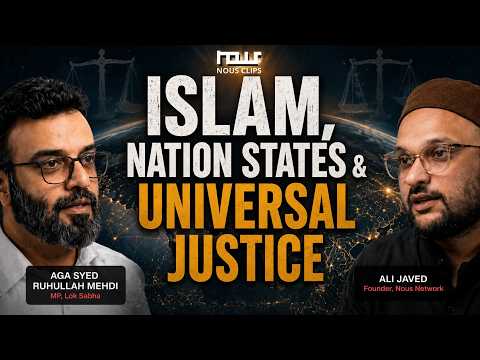
What does it mean to be a Muslim in a modern nation-state? How should Indian Muslims understand their identity, politics, and place in a rapidly changing world? In this wide-ranging and intellectually rich conversation, Ali Javed, Editor of Nous, sits down with Member of Parliament Ruhullah Mehdi…
Companion article
Aga Syed Ruhullah Mehdi, the Srinagar Lok Sabha MP, told Nous that he considers his roughly eighteen months in national politics to have arrived at precisely the moment they were needed, not despite the crises facing Kashmiris, Muslims and Indian democracy more broadly, but because of them. Citing a hadith on how difficulty reveals character, Mehdi argued that challenging times expose the true capacity of both individuals and societies, and that his responsibility in Parliament goes well beyond representing Kashmiri or Muslim constituents narrowly. He said he sees his role as part of a larger effort to help re-imagine India in the spirit its founders intended, at a moment when the country's basic self-understanding, politically, ethnically, culturally and religiously, is genuinely in question.
Reflecting on his first eighteen months of exposure to national political life, Mehdi told Nous he found a significant gap: Muslim politics in India, he argued, has never developed a comprehensive political philosophy of its own, only a reactive one. Accusations levelled against the community, he said, from claims of incompatibility with Indian society to questions about loyalty, have rarely been met with a sustained political or scholarly answer, let alone one grounded in Islamic jurisprudence and translated into a durable political programme. Instead, he said, Muslim public response has clustered around symbolic flashpoints: the Waqf Amendment Bill, lynching incidents, loudspeakers, dress, food. "There is no comprehensive political philosophy," Mehdi told Nous of the community's current politics, adding that this absence has never been seriously addressed since Maulana Azad.
Mehdi argued this gap has a history. India's roughly 70 years since independence, he said, tested the founding claims of the Constitution and of composite nationalism, but Partition's immediate aftermath pushed Muslim politics toward identity-based responses to urgent threats rather than toward building an ideological politics of its own. That deficit, he argued, is now compounded by the fact that Hindutva's own claim, that Muslims are simply incompatible with Indian society, has never been directly and clearly rebutted, either in political discourse or in institutionalised scholarship.
Mehdi argued the resources for such a philosophy already exist within the Islamic tradition, but Indian Muslims have not done the work of developing them. He distinguished sharply between the specific laws applied in Medina under the Prophet's leadership and the underlying principles behind them, arguing Muslims are not required, and were never asked by the Quran, to replicate those laws literally in every context; what carries forward, in his account, is the principle, open to fresh interpretation for a given time and place. On that basis, he argued Muslims could build a political philosophy capable of both complementing and, where necessary, correcting the surrounding political discourse, whether from the left, from liberals, or from the right, rather than simply attaching themselves to whichever camp seems least hostile at a given moment, which he said is what has happened in practice.
Mehdi was equally critical of how little Muslims have interrogated their own instinctive alignment with right-wing politics on cultural conservatism, arguing that alignment has often occurred without any explicit religious reasoning behind it, simply because it isn't labelled as "right-wing" when it happens on religious grounds. He argued that a genuine Quran-based political discourse would need to address economics, market structures and questions of equality with the same seriousness Muslims currently reserve for questions of dress or loudspeakers, rather than being confined to reactive, defensive terrain.
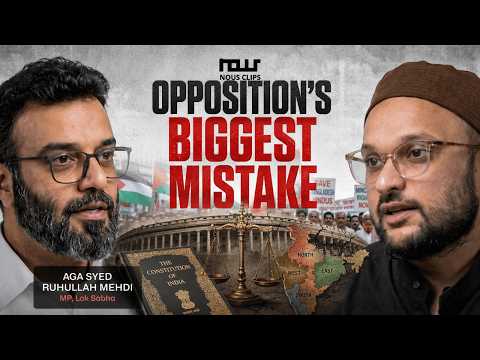
Mehdi extended his critique to India's self-described secular parties, arguing they too have diluted their founding principles for the sake of electoral survival, compromising institutions and federal structures whenever doing so served short-term vote-bank calculations. He argued this erosion, carried out by Congress and its allies over decades, created the vacuum that Hindutva politics ultimately filled. His message to those parties, he said, was direct: stop doing politics for Muslims, and stop doing politics for Hindus. "Fall back to the principles of the Constitution," Mehdi told Nous, arguing that if secular parties recommitted to constitutional federalism, functional democracy and institutional integrity as ends in themselves, most communal grievances would resolve on their own, without needing to be argued community by community.
He held Kashmir up as the most extreme case of the pattern he was describing, arguing federal overreach through governors' offices and central directives has hit no state harder, though he said the same mechanism has recurred across India, including under Congress governments before 2014. Mehdi's closing argument returned to the same formulation on both sides of the debate: not identity politics for any single community, but a shared politics organised around the constitutional contract Indians made with one another at independence, one he believes both Muslim and Hindu political actors have equally allowed to erode.
1:39What should Muslim politics contribute to India’s broader democratic and secular discourse? Full Video: https://www.youtube.com/watch?v=JA83TwVx1DE&t=3363s
 9:03
9:03This is an excerpt from a longer conversation.
 14:27
14:27This is an excerpt from a longer conversation. Watch the full conversation.
 9:30
9:30Has secular politics in India lost its ideological clarity? Why are Muslims often blamed for opposition defeats, and what does this reveal about the deeper crisis facing secular parties?
 1:13:08
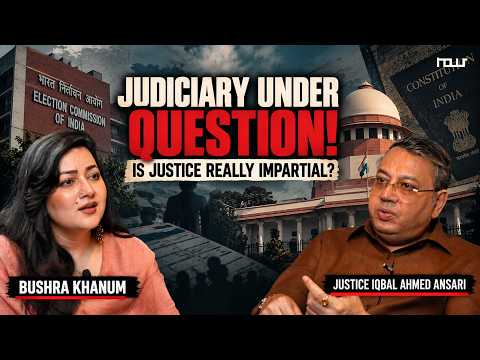
How independent is the judiciary in India today? And what happens when citizens begin to lose confidence in the institutions meant to protect their rights?
 2:44:36
In this conversation, Dr. Harish S. Wankhede joins Ali Javed to examine the political and cultural legacy of Dr. B.R. Ambedkar and the evolution of the Dalit movement. They discuss how Ambedkar imagined Dalits as political subjects at a time when they were denied even basic human dignity, and how…
 3:25:59
What does it mean to renew Islamic thought in an age of modernity? In this conversation, Dr. Waris Mazhari discusses his new book, Fikr-e-Islami Ki Tajdeed (Renewal/ Reconstruction of Islamic Thought), with Ali Javed. The conversation explores the diversity within the Islamic intellectual traditi…
Discussion
0Readers only · Comments are reviewed by the desk before they appear
The journalism is free for everyone — create a free account to join the discussion.