

 5:31
5:31Video· Nous Clips
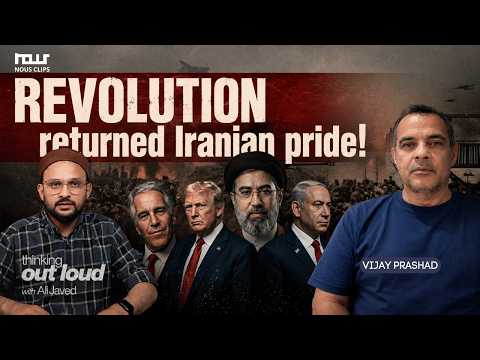
Iran's Long History of Pride in Statecraft I nous Clips
This is an excerpt from a longer conversation.
In this conversation, historian and political thinker Vijay Prashad joins nous to unpack the deeper structures shaping the Iran–Israel–US conflict. Moving beyond headlines, the discussion situates the crisis within longer histories of imperial power, regional restructuring, and ideological contes…
Trump is begging for a ceasefire. He said 15point plan. We're talking to the Iranians. Iranians respond. We're not talking to you. You're talking to yourself. >> What Iran has done [music] yet is at a low intensity site of what it could do. One of the companies in India that has been most um [music] you know benefacted by the genocide is Tata consultancy services and Tata cloud services and all of that. >> We see an ayatah saying that there's a fatwa we can't have nuclear weapons and then there is a country like us which has used nuclear weapons. Shiism has an interesting history, you know, it's a history of sorrow, of suffering, yeah, of struggle, you know, of of of holding it, you know, of taka, holding it within and so on. >> But within all of this, as was the case with Gaza, what was highlighted, what changed was the supremacy of the narrative of the imperial West. As the Gulf Arab states have abandoned the Palestinians, India has been given allowance to abandon the Palestinians. >> Okay? So it's not like Modi's in the lead here. Don't give him that much credit. >> The Jew that has created the vocabulary of the Holocaust, the human rights, the Geneva conventions, the pogram. How does a a sufferer of the Nazis become the Nazis themselves? Welcome to the now podcast Dr. Vijay Prashad. It was a wonderful conversation that we had last time uh in relation to Venezuela and how the imperial regime in US uh you know uh completely took away a sitting president and changed the structure. The regime did not change in a sense that we are talking about Iranian regime. You know, most of the superructure is there, most of the framework is there. But uh what has changed is the leadership, the outlook towards uh America and the western regime, western imperial force. But in that context also we indicated towards something which was brewing up in Iran. The 12-day war had already happened. Uh we you know you indicated on the regime change the methodology the steps you know we we have that kind we had that kind of conversation but now we want to take a deeper dive into the past 20 days and then looking back into the history of the superructures the structures the institutions that really brought forth this kind of world. So beginning with what is happening today in the last 25 days we've seen the ongoing peace talks and US taking away taking out assassinating the not just the head of the state but a theological head of a group of population that's a combination. So these this this head of the state is not just the leader of that nation state, he's also the leader of a group of people living beyond those boundaries. So for example in India and then we saw in that context also the NATO, the European Union, the Arab states distinctively assuring and accepting and appreciating the fact that this kind of regime change operation was taken although they've taken a certain level of distance in terms of actively getting involved that might be due due to their own you know political economy they have seen in the Afghanistan Iraq war but despite that There is no active retaliation to the kind of regime chain operation, the kind of active war that is going on in the Middle East at least for the past 2 years including the Gaza genocide and we also saw the killing of 160 to 180 girls which will we will later come back to in the later uh section. But within all of this as was the case with Gaza what was highlighted what changed was the supremacy of the narrative of the imperial west. That is what specifically changed in the context of Gaza and in the context of Gaza with relation to Israel. The fact that Israel is not impenetrable penetratable there is no iron dome. There is no asymmetric warfare can get to the get within the boundaries of the most powerful nation states and in the context of Iran something similar has sprung out at a at a much larger and greater scale. What kind of hope, what kind of restructuring, what kind of changes in terms of world perception related to the imperial hegemony of the west and the extended hedgemony of this imperial force in the Middle East through Iran through uh Israel? What do you think has happened in the past 25 days? What has changed? >> Well, look, firstly, there was a grave miscalculation by Israel and the United States. They really miscalculated this attack. Um, you know, they went for an old-fashioned regime change war, decapitate the leader, um, blast a large part of the military infrastructure and then sue for peace and and and see if you can get terms. You know, if they will in a sense surrender and say, "Okay, you get to choose the next leader. you get to tell us what to do and so on. They went for what I consider a domination strike, you know, like they did in Iraq. Shock and awe. A domination strike, massive strike, big blow. Yeah. Uh you kill 170 girls in a school, you terrify the population. Basically, it's terrorism. What they didn't realize is Iran has prepared for this for decades. And I'm told that Iran has about eight layers of leadership. So they can tolerate I don't know 8, six, five decapitation strikes and besides they have a series of different kinds of leadership. I mean you know you got to understand that Ali Hami was yes you're right a spiritual leader but but in the world of Shiism there are 56 maras margles >> you know he was by no means a leading mara >> um he only becomes a marjah in 1994 and even then it was contested the leading mara in the world is Ali Sistani in Iraq >> and Ali Sistani came out and condemned M this war and he hasn't blown the Shiite whistle yet. It's very important. Ali Sistani hasn't blown the whistle. The United States can't assassinate him. It's one thing to assassinate Kasim Sulmani in Baghdad. The Iranian general. It's another to assassinate Ali Kami, 86 year old disabled man. Yeah. Was prepared to face death. I mean I mentioned to you last time that that after the kidnapping of Nicholas Maduro Ali Kamani went to visit his old friend Ayat Kmeni's um Mazer you know he he he hadn't been there in in some years they had took photographs of him there publicized it was his way of saying I'm ready to die okay his death is not consequential politically right now you know it's it's important to understand that immediately you know Ali Kamani is dead long live Ali Kamani because his son Mushtaba becomes the next that was a very interesting decision by the leadership in Iran it's snubbing the face of Trump now the new supreme leader is also supreme leader how many you know you it's like the king is dead long live the king >> exactly that came to my mind >> right exactly so it was a very interesting political, but I'm told they have about eight layers of leadership. Yeah. So they can withstand a so-called decapitation strike. Secondly, the Iranians have prepared the population to withstand civilian casualties. You know it's a it's an interesting it's an interesting culture Shiism by itself you know and and you know in India we are well aware of it because India is either the second or third largest Shiite country in the world between Pakistan and India it depends how you count it 40 to 50 million in each country you know one year it looks like Pakistan is a it's a little bit like largest Muslim country in the world Indonesia well what's number two India, Pakistan, Bangladesh each of them vying for the second you know so India has got an experience of Shiism you know we understand that Shiism has an interesting history its history is rooted in in not being there to defend your leader you know and it is it's a it's a history of sorrow that you teach um children you know it's a history of sorrow of suffering yeah of struggle you know, of of of holding it, you know, of taka, holding it within and so on. It's a very interesting culture. So, the Iranian people are prepared to to take a couple of hits. But what the Israelis and the United States didn't recognize that Iran wasn't going to go for domination strikes. It was going to use the old-fashioned escalation ladder. So first Iran fired ordinary missiles. These were intercepted by the Israelis, by the United States. Then they started firing their missiles that had um you know the ability to have cluster munitions. You open up the the head and then you fire a series of munition maybe up to 80. Those were getting through the Israeli defenses. Those were getting through the US defenses. they were hitting radar installations in the Gulf Arab states and so on. The Israelis made a very clear point to the Gulf Arab states that having a US base is not a shield, it's a target. You know, we are striking you not because we want to go to war with Qatar, but why do you have a US base there? Why are you allowing them to hit us from your base? >> So, you are a target now. That was very clear. But look, they they stopped the escalation ladder, for instance. They have about 2,000 small boats that are sitting in caverns underground. They haven't released them yet. Yeah. If they release them, they'll create chaos in the Gulf. Yeah. They'll create chaos in in the Strait of Hormuz. They haven't released them. Ali Sistani hasn't blown the whistle >> to say to, you know, Shiite militias in Iraq, in Bahrain, and other places, go. >> Yeah. Bin the amir who's a Sunni would be gone. He was almost gone in the Arab spring but Saudi army crossed the causeway into Bahin to Manama and killed I don't know how many people because they didn't allow the press in. Yeah. They crushed the rebellion in 2011. That whistle hasn't been blown. Hezbollah is hitting Israel. Israel is going crazy in Lebanon. has in fact gone beyond the Leani River to take the whole bottom half under Beirut and part of Beirut. They have once again commanded that area. One in five Lebanese is now a refugee, you know, and numbers are increasing. So the, you know, Sistani hasn't blown that whistle. It's important to recognize that he condemned the attack on Iran, but he's gone silent. Yeah, there's been one or two rocket firings at US bases in Iraq, but if he blows the whistle, there's a very large population of of militia, >> you know, including maybe the Sarites will rise up in Iraq. We don't know yet. Mtadal Sar has said nothing. Yeah, he is he is quiet till now. All of these quote unquote assets on the escalation ladder have been silent. The United States is dying for a ceasefire. >> The United Trump is begging for a ceasefire. He said 15point plan. We're talking to the Iranians. Iranians respond, "We're not talking to you. You're talking to yourself." >> Trump is asked, "Who are you talking to in Iran?" Yeah. Because Iranians say they're not talking to you. He said, "I can't tell you because if I tell you, they might be killed." By whom? By the Israelis. you can't control the Israelis. What's going on? Israel is in a difficult position. It thought, oh, we'll wipe out all our enemies. But Iran is going nowhere because you know what the Iranians know, and this is very important, Ali. The Iranians know that they have a population of 100 million people. And to conduct a genocide, you know, they've been through the Iran Iraq war. They've seen massive casualties. They know what it takes. that society can tolerate it. This is very important. Can a society tolerate losses? The Iranian society can 100 million people. How many are you going to kill? They will say to the Israelis, how many? And at what point does Israel and the United States decide to escalate to a nuclear exchange? And if they do that, what happens in Japan, close ally of the United States, which has experienced nuclear weapons before, what happens to the right-wing government in Japan? What happens to China and Russia? When do they move? The escalation ladder for Iran, and that's the point I want to make to you, is still pretty low. They are still at the cluster munition missiles. They have a lot of rising. They closed they sort of closed the straight of Hormuz. Didn't close it yet. Yeah, they're letting some ships in and out. It's not true that it's closed. They have filtered the straight of Hormuz, not closed it. But they could close it completely. There would be chaos in Asia. 84% of the oil out of Hormuz goes to Asia. In Santiago today, petrol prices have increased starting today. In about half an hour while we're talking there are going to be mass demonstrations on the streets against the government. So there's going to be a lot of protests around the world on this is the escalation ladder of the Iranians. United States next escalation is nuclear. So when you are stuck on the escalation ladder where one side has options and the other doesn't, the side that has options has won. They've won politically and they've even won militarily, which is why yesterday the spokesperson of the Iranian government went on television and said, "We have won this war." Now you could say, "Well, that's crazy. How can Iran defeat the United States?" Nobody's saying Iran has defeated the United States. The United not surrendering to Iran. But in this battle, the United States doesn't have any more options. Yeah. I mean, and the thing is, let me put something on the table for you. How weakened the US is right now. China can go and just take Taiwan. US can do nothing about it because it's so weakened in this engagement. But the Chinese are not doing that. They are very clever. They are holding everything. This is where we are. >> So Dr. Vijay, what what you're articulating and highlighting is very interesting. What Iran has done yet is at a low inensity site of what it could do given the fact even from its state architecture but also beyond state the uh resistance axis that also has much more potential than has already been activated. So that low intensity has also created a difficulty for US and Israel to respond to and within that context if the escalation goes on further it is not clearly visible given China and Russia's interest in their own localities as you highlighted about Taiwan and also about how Arab states which are also important assets in terms of uh the investments and relationships with the US itself. What is going to happen? But within all of this, what I found interesting from the civil society in the United States is this constant including people like Tucker Carlson is the fact that they're trying to create this [snorts] this rhetoric that it is not the US who wanted that war. So by delineating Trump as an individual rogue actor in what is being done, what is achieved is a relative moral superiority of US as a nation state as opposed to a rogue nature of certain political leaders there and then at the same time articulating it as a religious civilizational war. So it's a double double game that is being played sort of and the second is that I mean all of the global civil civil society including India I don't know how they're taken away with that that it is Israel who is taking the shots now the burden is shifted and of course Israel is interested in that it is uh you know weaponizing the this kind of narrative in its own favor. How do you see that? How do you see is it is not us as a rogue actor but how do you see us as a as not just an actor but somebody who is an active participant but also initiator of that conflict. Why is it that Trump just before the conflict is reducing the forces within the US who could evaluate whether there are civilian casualties or not? Please comment on >> yeah well let's start with the Indian with Indian civil society or media and whatn not India you know has a very old relationship with with Iran I mean going back a thousand years you know you can't understand North India northern India Pakistan cannot be understood without our relationship to Iran I mean you know it's not only linguistic it's cultural as well. Deeply felt cultural. >> Yeah, it's deeply felt cultural. I mean >> uh you know you you can't understand the role of people like Mira Galib and so on without their affinity with Persian literature. You know that's what they read. I mean uh our civilization in in the northern flank of India into Pakistan is marked by our relationship with Iran. It's impossible. It's it's just impossible. Yeah. And and whatever you know Sanskritization happens to Hindi and all that you can't effectively Sanskritize Hindi so much that it gets rid of the Farsy influence. It's it's impossible then you might as well start speaking Sanskrit. Yeah. Because it's impossible. It's in the grammar. It's in everything. It's in it's in too much. Okay. So, so in that sense we are an integral part of each other. It's pretty stunning that India took a a horrible position in the 2000s influenced by the administration of George W. Bush in order to get access to the nuclear suppliers group. India which has an illegal nuclear weapons program voted against Iran in the international atomic energy agency in the ear in 2005. It was a scandalous vote. That's the beginning of India's demise when it comes to being a reasonable voice on the question of the pressure campaign on Iran. And that was the government of Manm Singh. >> That was not Narendra Modi. That was Manm Singh's government. Why that government allowed itself to vote with the United States against Iran is a scandal and it needs to be looked at again. You know there was a lot of disqu in the country. I remember going on the streets to protest the arrival of George W. Bush in India. Okay. Why did we go on the streets to protest that I was then in Madras? Why? Because it was partly to do with the position visa v Iran. India was making a deal to get nuclear equipment >> and the price was to to to sanction Iran which only has a nuclear energy program. So it goes back to that. Okay. So I don't want to put this on the shoulders of Narenda Modi and the Bhartya Jantaa party and the Jan tradition and no it's not true. >> The Indian elite made a decision. >> Okay that was Manm Singh's government. I I I don't want this to be forgotten. Okay. Whatever the Congress says today and so on, let it be remembered >> very important >> that it was Manm Singh who betrays Iran in this way in 2005 and that betrayal continues till today when the Indian government has not come out there forthrightly condemned a war of aggression against an effective neighbor. You know, effectively it's our neighborhood. uh we should have been condemning a war of aggression. Iran faced a war of aggression in 2025 in July the 12-day war and then faced a war of aggression now. Its supreme leader was killed and what did the Indian government say? You know I mean let's let's think about this in religious terms for a minute. Yeah, there's perhaps up to 50 million Shia in India. Okay. >> Ali Kami is not really a spiritual leader. Not really because >> Shiism is not exactly grounded around religious or spiritual leaders. They are emulatable figures. >> Marjah Tak is a figure that you emulate. Not really a religious leader in he's not like a pope. Yeah. He's a figure you emulate but still an important person in the world of Shiism. You got 50 million minimum 50 million people who are Shiites in India. >> What did the government say man? I mean you know did the government say anything about the killing? >> Especially the controversial context in which Modi is a day before in Israel taking the highest honor and the day after that there is this kind of and then the deals with Adani and Amani. All of that context leads to very uh problematic. What did he say? What did he say? He said India is the motherland and Israel is the fatherland. I mean disgraceful comment. Yeah. In what >> what planet do we talk like that about countries? Okay. So the firstly it's the Indian elite has been disgraceful from 2005 onward regarding Iran. >> Mr. Modi's you know as a prime minister has been ridiculous on this. I mean, you know, I'm talking about your fellow citizens, you know, a as as part of this. And again, one shouldn't think in religious terms exclusively, but you have to. This is a reality in the world. Yeah. >> Completely ignored by by the prime minister who's supposed to represent every single Indian. Okay. That was But what about just representing international law? As I said, it's a war of aggression. Yeah. It was imposed on Iran. Iran did not threaten anybody. It was imposed on Iran. India says that Iran should not be striking the Gulf Arab states. I agree. The Iranians agree. They don't want to do it. But they're trying to hit the people that are hitting them, which is the US military bases. When is India going to say India which has no foreign bases? Yeah. For now. When is India going to say there should be no foreign military bases in the in the Gulf area? When is India going to say that? I mean India makes a big point of having no foreign military bases. Yeah. Makes a big point. We have on many occasions said we will not allow overflights. We will not allow um military planes to land in our airports if they are going to a mission. a ceremonial Iranian ship >> is sunk in Sri Lankan waters after being a guest of the Indian Navy and we don't condemn that. I mean in this sense India's independent position in the world has really declined and let it be said that other foreign ministries have watched this and sniff at India's behavior. I mean India invited the Iranians to join the naval exercise. They sent a unarmed ceremonial ship. >> The unarmed ceremonial ship is leaving India to go back to Iran. It's in Sri Lankan waters, not even international waters. A US submarine torpedoes. It kills Iranian sailors. And India part is that the uh from the Indian government side release note, press release note is that we were not part we did not participate in that. We only provided information. Provided information on where to hit. Is it not participation in a sense? >> No, let's even take that. Let's forget all that. Yeah. Let's talk about values. Okay. This is your guest. It's your guest. It's your man. There's got to be some, you know, in in a in a society which has a state, some of your social and cultural values have to come into the way a government behaves. Is this the way a government behaves towards its guests? What are we saying? Should our society start behaving like this? Should we start shooting our guests in the back when they are leaving? you know, should we invite our neighbor to shoot the guest or some other entity to come? I mean, this is about your values, man. This is not even about I'm setting international law aside for a minute. It's a enormous violation of Sri Lankan sovereignty to have shot that shot at that vessel in Sri Lankan waters without permission. But they were a guest of India you know and and the Indian government doesn't condemn this behavior towards their guest. That's what I'm even getting at like let's forget everything else. Let's just talk about cultural values. You know Modi and company talk a lot about you know Indian values Sanskriti this is this your Sanskriti because values are not what you say it's what you do. And if this is what you do then am I to extrapolate from this that you know Bharata Sanskriti is the shoot allowance to shoot your guests in the back you know so so when when one asked you asked a very complicated question and I I'm not going to get to all parts of it I'm focusing in on the Indian government's response and reaction to this because this interests me a lot. >> Yeah. In another world, the Indian government would have condemned number one illegal war on Iran, a war of aggression, a war crime in that sense. Number two would have immediately condemned the killing of a political leader because you know Alik Ham was a political leader. He's the supreme leader based on the Iranian constitution. He they would have condemned that just as they should have condemned the kidnapping of Nicholas Maduro. You know, is this acceptable? If tomorrow something happens to Prime Minister Modi by some foreign power, I will condemn it. I will condemn it. Not because I am a great fan of Mr. Modi, but I think that's a violation of Indian sovereignty. You know, you can't allow some foreign power to come and kidnap your prime minister or to assassinate your prime. That's out of the question. >> Why do you think that that happened? Why do you think that India which has uh you know taken historically including the BJP at various uh you know time and periods taken a relatively moral high ground position in terms of geopolitics in terms of wars. Why do you think that in this context in this present moment Indian government its geopolitical uh affiliations its interactions why do you think that it is structured itself in this way and manner? Well firstly I I want to say I'm enormously disappointed with Mr. J Shankar who you know is typically a very bright person comes from a very very you know educated family his brother Sanjay Subramanyam is one of India's finest historians their father was a very important diplomat and intellectual among diplomats and so on here and there Mr. Jashanker has said some very intelligent and smart things. For instance, we don't believe in the NATO mindset. I very much like that comment. >> But in this case, he has fallen down. He's not saying anything. I mean, when it comes to Israel, >> the Indian government doesn't have a theory. >> What's the Indian government's theory regarding foreign policy? I mean, look, your theory has to start with your own political economy. India is a very poor country. Most of the population cannot tolerate food and fuel price inflation. That means because we live in a modern society have to guarantee decent priced energy coming in. Israel doesn't export energy. Russia and the Gulf Arab states do. So your primary relation has to be with the Gulf Arab states and Russia. India couldn't move to its pro-Israel position until the Gulf Arab states also moved into the Abraham Accords as the Gulf Arab states have abandoned the Palestinians. India has been given allowance to abandon the Palestinians. >> Okay. So it's not like Modi is in the lead here. Don't give him that much credit. Mhm. Mhm. >> India's rightwing is tailing the you know amirs the sultans of Arabia you know when are they going to experience a little taste of democracy frankly. Yeah. I mean there is nothing that says that the Saudi Arabians are wrong. There is nothing that says says that Islam requires a king. >> It's not true. You know why they hate Iran is Iran has proved you can be a Muslim country and a republic at the same time. They hate Iran for that. >> You see, Indonesia is not technically a Muslim constitution. Yeah, it's a it's also a republic, but it's not technically, you know, there are no there are very few countries that say we have a Islamic republic. >> Yeah. Iran is unique in that >> and and this is a standing rebuke to Saudi Arabia to Qatar to all these countries which have continued to argue that republicanism is anti-Islam that's how they fought against Nasser Gamal Abdul Nasser that's how they they argued against Gaddafi and so on they said these people are against Islam and then suddenly the Iranian revolution happens and this Islamic republic arrives on their border borders. They hate it. They don't hate Iran. They don't hate Shiites. They had extremely close relationship with the Sha of Iran. >> As long as it was a kingdom, it was okay. It's not true that this is some Shia Sunni dispute going to the seventh century. If that was the case, how come the the the monarchs of Arabia had such a close tie with the Sha of Iran? No, it's got to do with the nature of of rule. And when these sultans of Arabia started to have close relations with Israel, it opens the door for the Bharatya Jantaa party to go to its Jansen roots which have always been pro-Israel from 1948 despite the fact that MS Gwalker >> is a sympathizer of Nazis and an anti-semite and writes that what the Nazis did was correct. Yeah, in the Holocaust and we should do the same to the Muslims. He writes, "Yeah, in we or our nation would um defined that's golwalker." But nonetheless, the Jansen has this close thing with Israel. But they couldn't open that until the Sultans of Arabia opened the door and said, "Okay, you can go." So you got to understand Modi's you know fratonization with Netanyahu is only made possible by the Abraham Accords otherwise it's impossible because India relies on Gulf Arab oil and the previous sultans of Arabia would have punished India. >> Okay. >> Yeah. So coming back to uh the point that uh about the nature of who controls the war in the sense that this this uh this narrative that is being pushed by the civil society in the west including people who of course you know the democrats and the republicans when it comes to the policy in the Middle East especially with regard to Israel and its aggressions to its neighbors and the greater Israel project we have seen that the foreign policy is almost uh you consistently mapping but then you at least have a layer of moral uh you know articulation and in this context what is happening is that they're they're what they're trying to say is even though US is the you know state that is making these aggressions the logic that they're trying to produce is that it is the Israeld driven US policy so in a way to distance itself and yet reap benefits from it how do you see that is Iraq is Israel the narrative that is being produced everywhere no US is subservient to Israel it's the you know Jewish Zionist lobby which has so much power that control I mean I don't buy that it's also this lobby faright right-wing lobby republican lobby within the US that has far weighty interests in that region and they are the ones who drive the Israeli positions of course that is interlin but who is the big other >> I mean it does it matter I mean they they operate handin glove I was very interested I don't normally listen to podcasts longer than you know an hour maybe yeah that's about all I can take my walk from office to home is about 20 minutes so sometimes there and back I listen to 40 minutes of a podcast and shut it we are just going over 40 minutes now yeah this is about next day. I'm not going to start again with the same one. Yeah, I'll put a different one. But I listened to Tucker Carlson talking to Mike Huckabe, the US ambassador to Israel. I listened to that because it had made news and I thought, "Oh, this is interesting." It was a real It's a real test of will that conversation and I and I recommend it to people. I I mean I'm not you know Tucker Carlson is the furthest thing from my values and and views but it was interesting to listen to them talk because he had Mike Huckabe openly say that the Israeli project is rooted in Genesis in the Bible where it is said that you go from the river Nile to the river Euphrates that means from at least half of Egypt uh to half of Iraq that's a huge swath of land that is, you know, Israel or greater Israel. Okay, that's fascinating. That's something Mike Hakabi seemed to agree on, but said it's not practical right now. Um, didn't say that it's a nonsense idea. He just said it's not pract. These are people who believe in the Bible literally as the literal truth. So, I think one has to accept that that's a large constituency in the United States. There's that. There's also a very very important constituency that believes that Iran is a state sponsor of terrorism and and perhaps the principal one. Now you don't it doesn't matter whether this is true or not because for a long period it was said Iraq was a state sponsor of terrorism. I mean you know which it simply was not. Uh Iraq had all kinds of other problems but it was not a state sponsor of terrorism. I mean it is true that um that Iran uh funds and supplies Hezbollah. It is true that it funds and supplies some of the militia groups in Iraq. It's true it funds and supplies uh some of the groups in Syria. And it is also true that it along with Qatar and Saudi Arabia and other countries provides assistance to various Palestinian charities including to Hamas linked charities. This is true. Um, but is that really a state sponsor of terrorism? Because the question is who are they attacking? You know, I mean, who is Hezbollah is defending Lebanon? It's a de facto army of Lebanon. The Iraqi militias, yeah, they they may be a little more sectarian. Some of them are quite violently sectarian, but they are not the ones being funded by the Iranians. uh those that are very violently sectarian are getting their backing from elsewhere. We don't even know who is backing them. You know, we can have another show about Iraq if you want. That's another story. But there is a population that will say things and you know, you listen to them occasionally on particularly US and British television which say that you know I think Iran is a bad guy and it's a it's a bad actor and we think the regime should fall but not like this. You see, they legitimize the view that Iran is just a bad place, that there were these protests and tens of thousands of people killed. Now, you got to face the fact that even the US government admits it wasn't tens of thousands. You also got to face the fact that the Iranian government has a pretty terrible economic policy. The the finance minister of Iran was trained at the University of Chicago. It is true that he drove an austerity policy last year which raised inflation beyond any level that should have been there and it had nothing to do with the sanctions or with the war in July. I mean they they just ran a really bad policy. Okay, they should have gone to Asian banks. They could have secured different lines of credit. But he is a neoliberal um you know he believes in these ideas and he is the finance minister. Okay, as I said, trained at the University of Chicago, extremely orthodox Chicago. I mean, governments can have bad policies. People were protesting the government. Were they protesting against the whole of the the system? Were they protesting the constitution? I don't think so. They were certainly against the government, against this government, which is a reform government, by the way. It's not a so-called government of orthodoxy. It's a reform government. Um but people were protesting the government and the the the state cracked down. I thought it cracked down excessively. Um you know was there a need to live fire on people who are out there on the streets saying you know why not go and meet them in Cuba you see these protests now you know and the government you know and the communist party goes on the street and talks to people says that look you know we are dealing with an oil blockade. What can we do? Yeah. You know do you want us to surrender? And people are like, "Well, I guess not." So, I'm going going back home now and I'm going to sit in the dark, you know, because but in in Iran, you didn't see people going out on the street and engaging in public assemblies, you know. Also, you got to give it to the government. Some of the protesters from the beginning were violent. So, would you go and face them? These are complexities. But I don't think by and large people were on the streets saying let's overthrow the government. But that's the vision that is there outside the country. There's some people who have a escatological religious vision of of getting rid of the you know Iranians from particularly blocking the Israeli project. Yeah. But others have a straightforward view that you know the Iranian government is authoritarian and and is against women and you know blah blah. So it's so against women that the first thing you do is bomb a an elementary school and kill 180 kids you know girls. Uh how is that for being pro- women? Yeah. >> Also uh Dr. Vijay as was the case with Gaza one cannot contextualize really what's happening if they don't understand the history of it. And it is not a history of 10 20 30 years or the history from 1979 post Iranian revolution. It's a history almost just after World War I restructuring. It is at that time Britain and France are responsible for which region who will control. I mean before United Nations there was a League of Nations almost similar kind of aspirations and almost similar kind of failures. And you know to to the extent that the imperial west it was not just US at the time it was Europe in a way and then later on US takes up that role more prominently. What is this context? What is today's world? How was it made post world war I post World War II? the institutions, the World Banks, the IMFs, the new liberal policies and why did the 79 revolution happen and what did it achieve in the region? Yeah, I mean look, your history is extremely truncated, I'm afraid. Um, unlike India, for instance, um, Iran as a territorial unit was created 2,500 years ago, somewhere around 7th century before the Christian era. Yeah. 2,500 years ago. I mean I think it's it's useful for people to know that the Safavidids were in power from 1500s to the late 1700s. Yeah, that's a very long period of pretty, you know, solid state craft and state structure. And Iranians >> today have a sense of themselves as being heirs of that territory from 2500 years ago. It's true. Kajar dynasty expanded it into Russia and I mean you know when you read about Iran's history Alexander the great you know etc etc. Yeah. Alexander the Great uh who comes into the Kyber region from where my family comes. Yeah. Uh from that Kyber Pass region somewhere up there in the north. Uh yeah. They kept changing borders. You know one you're in this country you you're not in a country you're in a valley. Yeah. you're in a valley. But the Iranians think of themselves as being formed seven centuries the seventh century before the Christian era and those 250 280 years of the Sapphabit dynasty congeal the sense of state craft. It's in that period that their great texts of civics and state craft are written. I mean imagine if India had not been or rather northern India the Mughal Empire had not been defeated by the British. Yeah. You know, you and I would have gone to school and we would have studied modern textbooks about state craft that took the Annie Abari seriously, that allowed us to read the Annie Abari as part of our intellectual and political history, not as something from the past. You see, you never read the any as a living text. You read it as a book, you know, something from the past. But imagine reading the Ani Abari, which is a book of statecraft as a book that refers to the state in which we were born and living. That's the Iranian mentality. Yeah. The Iranians have a very long history of pride in their own structures. This is very important to understand. So for instance, when the coup takes place in 1953 against Muhammad Mosedc and the sha is brought back, the sha are cosac adventurers who come from outside. They they are imposed on the country. And so the sha when this is the return of the sha there was a sha before you know was brought and pllopped. >> So when the sha comes in 53 this was seen as against the great traditions of the Iranian people. Not just the sabak was brutal and the sha was this and that. It was seen as he tried to persianize his rule. brought back a kind of neopersianate architecture and some of the buildings by the way quite beautiful that were built during the shaz era. You know if you go to there are some old buildings are very beautiful. It was a kind of neopersian architecture trying to go back to the Persian culture of of the ancient world. It's very clever on his terms. He tried to persianize the the peacock throne. By the way, Persian is a peacock throne that was taken from India in the 18th century by Nadia. So, it actually doesn't have an ancient history. >> Yeah. >> It was a bloody Nadia that whacked it from India. So, what you have in 79 in a way is a return to the Iranian pride. Yes. Communists were killed, liberals were thrown out, bunny sad and company were thrown. All of that happens. But you got to face facts that a group of people won. >> I have to look how many won a major political battle that went on for about a year. It was very bloody, but they won. And then they established something which is they claim rooted in the long two and a half century history of you know from the Safawids onward history of Iran state craft we're going to have an Iranian system we're going to have guardians and so on but from outside the west has portrayed that as as as an evil >> empire >> and not been able to see that for Iranians Even those who may not like the headscarf and this and that, they may not like aspects and why should they? They are entitled to their opinions. Yeah. >> But it's a struggle within Iran. They are not saying come and bomb and ruin our 2500y year history in order to allow me to take my headscarf off. Yeah, that's not what they are saying. They are saying I'm angry with you know Ali Kami and now Mustava Kamei because they are saying women should have you know there was a debate around the headscarf in the 1970s and Ayatah Kami lost the debate Kumen lost the debate they reinstated the headscarf rule later this is a big debate in Iran it's not a trivial matter it's not only from it's not from outside it's internal conversation let the Iran Iranians deal with it. It's a little bit like the conversation within India. The conversation within India about the CIA, >> the question of who is a citizen of India. That's a legitimate conversation. The the rightwing has a very wrong idea of what citizenship is. And we should have that debate and discussion on the streets, in parliament, wherever. But why should some country come and bomb India? >> Exactly. and say, "No, you have to." That's ludicrous. And so I would like people to reflect on that that we're talking about a country with a very long history where in in the recent period they have felt what it means to have somebody impose something on them. They don't want that anymore. They simply do not want the West to impose upon them a kind of rule. least of all a Los Angeles elite of Iranians who fled Tehran for Los Angeles in the 1980s including the crown prince of so-called crown prince they live in Los Angeles very wealthy Iranians in Los Angeles who are part of this overthrow the government you know they are like the Cubans of Miami it's the Iranians of Los Angeles they are not Iranian ians >> and yeah that's what the Iranians are saying that we can be against policies of the government and yet not want our sovereignty to be compromised and that's a very consistent thing to own and even from the uh you know western tradition perspective the sovereignty of a nation in their own tradition in their own uh you know tradition of academia statethood nationhood that is conceived and defined within that context these are debates that happened in you know uh 17th, 18th, 19th, 20th centuries, the west failure and everything. And it is within that context that the Nazi Germany uh and the European uh you know uh European West it it it does genocide of the Jews and it takes their own problem and rather than solving that problem within their own territories, it puts that into a certain region. And how do you see you know the all of this region including Iran how should it see that how how can it be com even you know when we read the history people say that the early waves the Palestinians celebrated they were like okay these are Jews who want to live in their homeland from the perspective of rel religiosity let them come and then it is only later when the land is being taken away and everything. So how do you see this contradiction? The Jew that has created the vocabulary of the Holocaust, the human rights, the Geneva C conventions, the pogram, the ethnic cleansing. It is here from where we get this literature of being able to identify, define and articulate human rights from the perspective of a subjugated minority and to not see that again and that state with 93% of the population seeing agreeing with what is happening in Gaza. What does a state ethnationalist state like that which also India is taking you know uh in inspiration from from the Nazi Germany why how does a a sufferer of the Nazis become the Nazis themselves and how how does that region respond to it >> this kind of thing happens all the time I mean look frankly let's again you know go back into ethics and into religious traditions I mean you know within In Judaism, this has been a big debate for at least 200 years between messianic ideas of of of liberation and territorial ideas. You know, there there's a very large section of of Jewish intelligencia and and Jewish believers who believe that you don't need a territory. Um, you know, you you you have a messianic understanding of God. In fact, you know, the the the the Jewish spirit is a wandering spirit and and doesn't have to be rooted in a territory with a with a boundary. You know, it's a German idea of blood, soil, etc. You know, um you don't need blood and soil. What you need is you need to have a a consistent um spiritual relationship with God. that that Jewish me messianism that sort of cabala Judaism is a very important part of of the religious faith it's not dead yet it just lost the debate in Israel >> and and that's important I mean one of Walter Benyamin Walter Benyamin was a great writer of the 20th century um you know was German Jewish Marxist intellectual and so on uh he had a a you know important correspondence with um a Jewish writer in Jerusalem and and they wrote to to each other about the idea of of emancipation, messianism and what revolution means, you know, that it has a spiritual content to it and so on. You know, this is a tradition, but it lost the argument to Zionism. it lost the argument to Alexander Hershel's idea that that um the Jews need a place where they can have their own government and so on. And and it's understandable because they were dealing with anti-semitism. I don't want to live in in a place which disrespects me, doesn't allow me to to be a full person. I want to go to my own homeland. I understand that feeling. Yeah. But but here's the problem and this has been articulated by many people. Why would you want to go and displace people and be the person that you don't want to be? You know, why would you want that? Why why would you like that? In fact, there was an opening before the Balffor declaration. There was an opening before 1916 for as you said, you know, Jews who left Europe uh during the pograms of the 19th century. Many of them went to the United States, to South America, to to even to Australia, you know, to flee the pograms of of Europe. That's where anti-semitism has its life. Um, they fled in the 19th century, but they also came to to to the Levant region and they found that there were Jews there, not only in the Levant from Morocco all the way to India. Um and but there was a population that moved to Jerusalem and and its its surrounding and they were indeed welcomed. Why not live together with with with the Christians and the Muslims and the and you know the the nationalists and others you know create your own civilization of of of uh of complexity. Yeah. I mean there was already the history of that that was in the Ottoman Empire the Milath system where every community has a respected form of government and you know as a kind of of of role to play in the society. The Ottomans didn't enforce you know one language one religion you know that comes when the Turks when Turkey is created it's Kamal Ataturk who enforces the religion and the Ottomans had a different idea much more sprawling idea of of life yeah this was available as an idea in in in the the cities of of of the Levant you know whether it's it's it's you know Hifa or or Jerusalem or whatever these cities Beirut root they they experienced the millet system that was available it was not selected what in the argument in the debate what won was the Germanic idea of blood and soil and and that's what prevails in in Israel today it's a blood and soil nation you know the soil is that territory from the Bible from the the Nile to the Euphrates and the blood is those who through their maternal line can can constitute themselves as Jewish. Well, now that's slightly amended that you can also get it from your father. Initially, it was the matrineal inheritance, but you know, now you can get from your father. But look, frankly, there are only what is it five or so million Jews in the world. You know, it's not a very large population. I I I've forgotten the exact number, but it's not an enormous population, you know. Um why have this sort of uh you know enormous belief that that you need to you know take over the the the the planet or this region uh you know it's not 5 million it's about uh maybe 16 million 16 million population Jewish total Jewish population is 16 million in the world yeah in the whole world there's 7 billion people >> okay there's 7 billion. What are we talking about? It's crazy. Yeah. What does I mean because we keep coming back to this idea that violence say for example if remembering the uh Hannah Aaron writing benality of evil or benality of doing evil in that context if we look at what is happening in the region and if we see there are three distinct episodes that have taken root in my memory in the last 2 years. The first was the idea that on 7th October Hamas beheaded 40 children turned out to be a fake news turned the wheel of geopolitical violence state violence against a particular population legitimized it uh turned out to be false. The second is this Iranian 150 160 170 people uh you know students dying which then is legitimized as in 2013 there was a data AI predicted I mean in a country like US like Israel who says that we have an intelligence network within the Mosad within you know every point in Iran we've invested them and you have a data of 13 years ago and you're using AI to use that. I mean, who believes that? And number three, recently yesterday, of course, that has precedent in all of what has happened in Gaza, but yesterday I came across this video before yesterday. There's a 18 year 18-month-old child, a his father, they want to sign on an accusation. And for that to happen they are uh they are putting nails on the knee of that 18-month older child both of those knees and then I I don't want to do that and I'm not like that. I even as a practicing Muslim seeing from the Quranic perspective the Jews and the Christians and everybody they are analyzed with nuance. Some of them are this, some of them are not. There's good in that, there's also bad in that this. So that kind of distinction to for people who want to take that nuance to them, for people who want to reduce that, as you said, there are debates with all within all of the traditions including Marxism. So Marxism would have two kinds of debates. Should we do this? Should we do that? The liberals, the Muslims, the Buddhists, you have a Mayan Buddhist, you have other kinds of monk Buddhist. So all within all of that when we see an ayatah saying that there's a fatwa we can't have nuclear weapons and then there is a country like us which has used nuclear weapons. What does it reveal about the nature of violence embedded within the kind of society that the west has built? >> Yeah. I mean um so I mean this is a very very complicated and big question because it it comes to things like the social structure. it comes to discussions of of the economic um you know role of of the arms industry um in in in this it comes to cultural issues of um where you can say there's an authorization to violence I mean again all human cultures have a tendency to violence of different kinds >> um it's you know I was you know obviously I'm reading like everybody else the Epstein revelations and so on. Every country has about 100 Epstein. There are probably 100 Epstein in in India. We don't know about them. >> You know, rich people that abuse young children, you know. Um there's there's there's an Epstein for every country in the world. It's just that, you know, because this was in the United States, he was able to access far more wealth um than most other Epsteines. you know, I mean, Thailand is is the land where the lowbudget Epstein go to abuse children. Um, so, you know, I mean, it's not like any country is immune from these these this ugliness, you know. Um, this ugliness is there. It's part of the fight we have uh inside the human spirit, you know. We have to fight some of these these these uglinesses that emerge. But um money um and power uh secure some of these uglinesses in the structure so that they are no longer you know merely the the behavior of individuals but they become structural. You know, there's a big difference between me walking down the street getting angry with somebody and starting a fist fight with them and then people can peel us apart and then me amassing enormous amount of wealth having a nuclear bomb in my my office here and firing it at at somebody because I'm angry. Suddenly the structured violence is much greater than merely an act of violence. It's no longer an individual act. You know, it's not Trump that's doing this. You can't say, "Oh, Trump is a crazy guy." That's why the whole structure is going along with it. Yeah. That's why I said to you, it's not Modi. >> Look at Iran and India. >> You know, it was Manmon Singh that votes against Iran in the in the IEA in 2005. It wasn't Modi. >> Yeah. It was Narimaro that that normalized relations with Israel in 1991-92. Narimharo started it. It wasn't L. Krishna Adwani. It wasn't at Bhari Wajpai. Yeah. This is in the structure of the elite. Something there that needs to be understood. It's not just a outcome of Hinduta. Hindutwa found it advantageous because they have a long-term commitment to these politics. But they were not the authors of it. Yeah. The the Congress likes to say, doesn't it, that you are stealing our policies. Yeah. You Hey, that's our policy. You're stealing it. Well, you also stole their pro-Israel policy. >> Yes. >> You also stole their anti-Iran policy. What about taking those up, you know, for for a moment? So, I I I understand the question you're asking. It's just that this is a series of conversations. uh if we want to take this question up you know you'd have to you'd have to start with a kind of psychosocial dimension and then go to the structure >> we will do it in the future but then again to add a certain nuance to it because you are a scholar and you've read it and we we're talking about debates we're talking about so even in the Muslim culture any other culture we've seen violence historically today and that comes with a certain layer of interpretation but the layer of that interpretation requires a certain epis epistemic exercise a certain you know level of metaphysics so in that context do you think the western modernity appearing as a structure in a certain way neoliberalism market economy I'm not talking about all of modernity all of enlightenment that's a rich tradition but do you think that a particular strand of tradition which has been consistently at power and completely rooted in materiality in a sense of the return. Do you think that civilization is breaking? Do you think that justification is not just geopolitical or it's the colonial architecture the imperial art you know once you have certain axioms you're free to trade you're free you know things like that and then you argue then there is algorithmic necessity determinism to certain kinds of structures what do you see in terms of this idea of morality this idea of seeing human in this war playing out do You see there is change. There's going to be a change around. Do you see that there is going to be different expressions of possibilities of understanding order itself, ethics itself? Are we going in that direction? >> I mean, I certainly hope so. Um, and I I think it'll be clearer when some of these um live conflicts start to to to quiet down a little bit because it's very inaccurate to read cultural shifts in the middle of a live conflict. You know, in the middle of a live conflict, people polarize. You also have a larger number of people saying, "I'm against this war." >> Yes. But the question is will they then come out and say I'm against the structure of war making because that's really underneath your question you know when you say something is going to start deteriorating I mean right now >> the richest corporations in the world corporations apart from the digital landscape where the wealth is up and down are the arms manufacturers. Um these are some of the richest corporations in the world, most well-connected um and most dangerous because um if you try to move them, they will move you first. I mean, I get it that you could say the young people in Palestine action, you know, they were doing direct action on Elbit systems and they got very long prison sentences and the British government, you know, for a time banned statements of support for people who were in jail over their, you know, it was crazy. If you said Palestine action, you could go to jail and you did. Okay. So the arms industry used the state to fight back. People continued to protest against Elbit because of the genocide. The weight of the genocide moved them. But it al that example also showed you how much the arms industry fights back and how entrenched they are in systems of power globally. You know in India for instance you may be surprised to know this that yeah yeah yeah Adani Adani and all of that but one of the companies in India that has been most um you know bacted by the genocide is Tata consultancy services and Tata cloud services and all of that. >> Yes >> they have made a lot of money providing the Israeli military with systems to conduct the genocide. So the Tatas who claim to be this liberal sort of corporation are making tons of money. You try to go after the Tatas. I'll give you an example small example. I was invited to the Mumbai book festival was going to speak actually have a conversation with Nom Chomsky about 6 7 hours before the event. Our event was cancelled. Why? Because somebody had written to Chomsky, some guy and asked him how could you go on the platform of the Tatas and Chomsky sent an email I think rather unfortunately saying that Vijay and I have already discussed it. We are going to spend the first half of our conversation talking about the Tatas and Orisa. See where they have a factory and they're displacing people and so on. So this guy stupidly put that online said they are going to be doing this and so the Tatas intervened and we were shut down. Small example nobody got hurt. I'm I was not hurt. He was not hurt. I didn't need to be doing that event. Yeah. It wasn't like I had reputation damage. Nobody got hurt. I'm not saying that. But I'm just saying that even a small thing like that is unacceptable to them. They are so sensitive that they will not tolerate even minor criticism. Imagine, imagine if tomorrow you and I did an episode which was on the Tatas and the genocide. What will come out from your past? What will come out from my past? What things you know I I've forgotten how old you are but you know I'm 58 years old. There's lots of things from my past that, you know, I'm not particularly proud of or I don't really care about, but other people might be horrified. You understand? Suddenly these things come out whatever. I'm not saying they will. I'm just saying they go a long way to close down descent. It is going to take a struggle. When you say these things are fraying or collapsing, they they don't collapse on their own. It's going to take a struggle to bring them to their knees, especially the the kind of integration of the arms industry, communications industry. You know, in the United States, most broadcast television is owned by arms companies. It's very interesting. Westinghouse, General Electric, these are all arms manufacturers. They own the television stations. Okay, I have to leave you soon. >> Yeah. So, let's then wrap it up. uh with one or two questions just to bring back everything together. So few of the things that I've understood Vijay in in my past few years from turning from an academic to somebody like an activist who is trying to bring ideas to public debate, public discourse especially from an Indian Muslim perspective. Uh an Indian Muslim perspective which has been lost in history. this is a population that has had a phenomenal uh role in the shaping of the global Muslim world not and you know India itself both of that and people have forgotten that and so while I'll go through all of that history and contemporary debates it reminds me of the fact that how quickly and how uh in in in like in a two or three generations the whole of history just restructures itself changes itself and what I've understood Of course you guys have been writing for a long time. It is the way the world is manifesting itself in terms of conflict is the systemic nature in which institutions are built from an from ideological positions is it's the neoliberal world order aligned with a certain elite class in which everything bad or good is normalized and we become we because of being part uh of that culture from a lived perspective because we are emerging within that we we might have a past in a very small frame and that can be weaponized against every for example you talking about Chomsky and then the Epstein and Chopsky episode that came out and for me Chomsky has been the single most liberating ideological figure for the longest period of time and then these kind of things emerge and you don't know what to make of it and you go through that you know cycle of churning within all of that that struggle that you argue what what do you think this war is changing underneath in terms of China, in terms of Russia, in terms of local geopolitics, in terms of the kind of new structures that have emerged >> are in what phase are they in because in in a sense it's it's a pyramid that you have a rules-based world order and then you have a monarch above those rules that is US today there was somebody else and then you have people who follow them in in uh requirement for political economy in requirement for safety, security and then you have the people who suffer. It's like a you know every kind of hierarchy mimics that even it's cast hierarchy slavery or a geopolitical world order and that structuring restructuring happens when due to requirement from China as a cheap labor China itself becomes powerful or requirement for Iran to do something Iran itself becomes powerful and then they ask questions and then they build institutions and then they create carders and then they create societies is what shift is happening right now? What transition are we in? And then we can close off. Where do you see that this war can lead to? What is the its minimum impact and what is its maximum impact? >> Yeah. I mean let let me very narrowly take this question because during this war Jurgen Haramas died. Yeah. Very old. one of the leading the basically the philosopher of Europe who who was very much a Zionist you know in in his outlook but he was the leading philosopher of Europe. Okay. During this war Tariq Ramadan um is been you know sentenced to 18 years in prison for sexual harassment. Um one of the leading h >> Nakibulas died just last month. >> Exactly. Yeah. I mean the these are what what I'm we can you know have many more examples and and the fact of the matter is that the I am frustrated personally with a kind of lack of intellectual engagement yes >> with the actual movement of history you know I want I want to see more voices appear you know who who don't taint themselves in the wrapping of power you know What happened with with somebody like Tariq Ramadan or people who get caught up in the chosky you know in the Epstein affair all of that is is intellectuals who get stuck in in in power celebrity fame it that's all bogus the intellectual pursuit is to try to understand what's actually happening in the world and try to explain everything that's really got to be our pursuit explain everything you know I mean wealth fame power over other people. These are not interesting to me. What's interesting to me is try to understand developments in the world. Try to understand everything. Those intellectuals are not being produced today. You you mentioned the world of Indian Islam. you know how there was a time when when the great writers in India in the 18th century 17th century and so on were read outside in the world of of Islam as scholars as as important voices and so on um you know what is produced today that is not inwardlooking you know it's inwardlooking it's defeist looking it's it's it's writing about it's writing from a position of of fear maybe you know um you know even the kind of voices like Hummayu Kabir you know who tried to say you know India is a composite civilization those voices are not really available you know there are people who are trying to catalog catastrophe you know you when you catalog catastrophe you are looking inward you are you are not able to look outward and say what's the future going to look like you know I'm I want to be in conversation with people in Indonesia. I want to be in conversation with people in Africa in in South America. I'm not merely going to catalog catastrophe. Yesterday this happened to somebody, you know, they were lynched in this village and so on. Yes, by all means that needs to be documented. But your philosophy can't start and end there. It has to start and end with the idea of how do we expand the human potential. You know what are what are some of the the lineages and traditions that we come from? You know if if you were to to cast backwards for your own tradition, your own intellectual lineage, what has it taught you today? How has it prepared you for the world today? What can it offer to human civilization? You know, how is it capable of explaining things? I'm a Marxist. I look at the Marxism that I come from. You know, it's very interesting. I I I'm I edited a volume of Ho Chi Min's writings. In Ho Chi Min, he says the most important behavioral aspect for a Marxist for a Carter in a political party is to need to be emulated. When I read that, I thought, my god, Ho Chi Min is a Shia. He's talking about the Marjay. That's very interesting. I agree with that. Intellectuals should um shape themselves not to become leaders of of of people in in a in a crude way. But you got to also think in a way that people say ah okay I can also I can I like the way this person thinks I want to learn to think like that. They don't need to copy my conclusions or your conclusions. You want to teach people a method. That's what teaching is about. I want to teach you how to think for yourself. That's what emulation is. You know, the the tak isn't, you know, follow, you know, live like me. How can I live like like Ayatah? I mean, he spends his whole day reading books and I have to break bricks and and build houses, you know. I can't live like you, man. You was wearing nice clean robes and sitting there. You you always look like you've had a bath. Meanwhile, I look like I've covered in sand from head to toe. Yeah, I'm a worker. Emulation doesn't mean you actually copy them. Emulation means you follow the values and the way of thought. Okay. Where is that intellectual today? Let me ask you this doesn't exist. You know, if we were to say, you know, I I'm now entering your world in a sense. Yeah. If I was to say, who are the five great touch points uh who are drawing from the Islamic tradition to talk about the human condition today? You know who are these thinkers? I I I would have a hard time putting anybody from India or let alone India from Pakistan onto the map. Sometimes I get these little video clips of online uh fellows you know who do the online Quranic lectures and and you know I listen to this is not serious. Okay, this is not serious because these guys are truly fundamentalists. they they truly don't understand uh the the role of humans you know with with with with divinity. They think that humans have to you know just copy divinity or what no if that was the case we would have solved our problems thousands of years ago. The problem for us is hermeneutics is interpretation. Nobody knows how to directly interpret anything. Whether it's the world or it's a it's a book with a divine origin, you know, we don't know how to do that. That's our struggle. Don't pretend that you have the answers. You have to have a method you share with. So, yeah, I I mean, I'm with you. >> This ising issue. On a final note, I uh did a podcast yesterday with one of one of my friends in Iran who is an Indian by origin. And the whole uh podcast was about the tracing of the genealogy of Islamic political thought between Shia's shared genealogy between Shia and Sunnis. I mean it excited me. Why is Ayatni quoting Alama? Alama is not a Shia. Why is Bbal writing in Persian? Why is Sayyat UB reading Molana Mudi? Why is Ali Kami writing a book about freedom fighters in India, Islamic Muslim freedom fighters in India and quoting Azad and Ali brothers and you know this kind of intellectual and then the question for me is why is it not enough today? It is not even from that point of view. So my personal ambition and the way I am working I would reach out to you for for review also. My pursuit is do we have strong metaphysical foundations today in terms of >> but but before you before you say that I want you and your friend to write everything you just talked about and give me this as a 100page book I'll publish it tomorrow in other words >> there's already a book by Alex Krook I will send it to you which which traced that tradition from Jamaluduin Ahani to Hassan Alana to Muhammad Abdu to uh Molana Azad to Hussein to you know Molana Modui to Ali Sharati to Ayatah Humeni there is a strong internet in interconnected tradition in which in 1915 al- Ahar which is a Sunni dominant uh theological school it it gives a fatwa it's grand muti that there are just not just four Sunni school of thoughts and fick there's a fifth called Jaffrey which is the Shia Shia 12 were school and in Lebanon a Shia scholar writes a book in which it says it's not just Jaffrey in Islam there is five schools of thought and exactly what you said that's what I am also interested in what is my shared abstracted value with a Marxist how do we talk about this wealth inequality this structure of economy this this entrenchment of oppression in structures itself and I think is this is a valuable valable goal for today. This is a valuable goal for next you know 10 years, 5 years, next 6 months to actually give the meaning. So I'll send you that book. You will like it. >> Yeah. Yeah. I want to see that. But but let me say to you that the most valuable thing is to actually curate >> serious intellectual lives. >> Yes. Yes. >> Yeah. that are that are that that have an ambition to go beyond the defensive. Yeah. That that are are not merely defensive intellectual lives. Cataloging grief is not sufficient. We have this platforming hope. >> Yeah. >> Yes. You will see this in this platform from this month like we're doing on nakulatas and everybody because people has have lost beyond hope they have lost agency agency to really think you can't act if you're not if you don't have agency if you don't have a mean like you said if you if you can't explain something you will not act upon it so it's all connected in a way so [clears throat] again I enjoyed this conversation with you and I always think that we leave on this and start on another. Uh we uh already have a conversation that we discussed on about uh dignity that needs to happen somewhere down the line. we can keep doing all this exercise as you said that you want to talk to somebody in you know uh Latin America in Indonesia in Malaysia you know somewhere else for that we'll have to dedicate time to all of this to the churning and maybe uh you know next time I can send you a draft on can we think about this can we think about a shared expression of how can two traditions one which is rooted in say Islamic divine tradition what in Marxism material because Ali Sharati was in a way that how can we restart that and thank you very much Dr. Vij you're always uh humble enough to uh you know extend your time uh your there's something I'm reminded of it's called intellectual humility I read about it so intellectual u you know tradition is about being accessible and it's not being about doing armchair intellectualism it is about we uh made it our tagline from metaphysics to masses so if it's not reaching the masses it's not good enough. If it's only going to be elitist in any way, including the Epstein thing, it's it's the uh epitome of what this kind of culture leads to. Things have to be for the upliftment of masses. Thank you very much. >> Thanks a lot.
Companion article
Twenty-five days into open war between Israel, the United States and Iran, the historian and Tricontinental Institute director Vijay Prashad joined Nous Podcast to explain what had actually changed on the ground, and why. Prashad's argument, laid out over the course of the conversation, is that Israel and the US planned for a swift "domination strike" on the model of the 2003 invasion of Iraq: decapitate the leadership, destroy the military infrastructure, and force capitulation. What they encountered instead, he said, was a state that had spent decades preparing for exactly this scenario.
Prashad described the initial assault as an old-fashioned regime-change operation modelled on Iraq: kill the leader, blast the military infrastructure, and negotiate a surrender on the winner's terms. The strike on a school that killed scores of Iranian children, he argued, was not collateral damage but a deliberate act of terror meant to break civilian morale quickly.
It did not work, he said, because Iran was never going to fight the war Israel and the US had scripted for it.
Central to Prashad's account is the structure of Iranian religious and political authority, which he said the war planners misunderstood badly. Ali Khamenei, he pointed out, was never the most senior marja among the roughly fifty-six recognised in Shia Islam; he only became a marja in 1994, and even that was contested. The most senior marja in the world, Ali Sistani in Iraq, condemned the war on Iran but has pointedly not called on Shia militias across the region to mobilise — what Prashad called "blowing the whistle."
Because of this dispersed structure, he said, Iran can absorb what would elsewhere be a fatal decapitation. Khamenei's death, on this account, becomes politically inconsequential: succession passes smoothly, and the symbolism of continuity — the king is dead, long live the king — undercuts the strategic logic of assassinating a head of state.
Iranian society, Prashad added, has a cultural memory built for exactly this kind of endurance. Shiism's history, he said, is one of holding sorrow and struggle inward rather than capitulating, a disposition reinforced by the scale of casualties Iran already absorbed in its war with Iraq in the 1980s.
Prashad's central military argument is about sequencing. Iran began with basic missiles that Israeli and US defences intercepted, then moved to cluster-munition missiles that began penetrating both Israeli and US defences and hitting radar installations across the Gulf. The message to Gulf Arab states hosting American bases, he said, was blunt: a US base is not a shield, it is a target.
Crucially, he argued, Iran has held back the bulk of its escalatory options. He cited roughly 2,000 small boats kept in underground shelters, unreleased and capable of creating chaos in the Strait of Hormuz; a Shia militia mobilisation in Iraq and Bahrain that Sistani has not authorised; and Hezbollah's continuing strikes on Israel from southern Lebanon, which he said has already displaced one in five Lebanese people.
Iran has "filtered" the Strait of Hormuz rather than closed it outright, letting some shipping through while demonstrating the capacity to shut down a route carrying 84 percent of the oil bound for Asia. The asymmetry, Prashad argued, is the whole story: the United States' only remaining escalatory option is nuclear war, while Iran still has rungs left on its ladder. "When you are stuck on the escalation ladder where one side has options and the other doesn't, the side that has options has won," he said — which is why, he noted, Iranian officials have begun publicly declaring victory, not in the sense of having defeated the US militarily, but in the narrower sense that Washington has run out of moves.
Prashad also pressed on what a nuclear exchange would actually cost the United States geopolitically. Iran's population of 100 million, he argued, can absorb losses in a way that makes any genocidal campaign against it a long, costly proposition rather than a quick one — and any move to escalate toward nuclear weapons would force a reckoning in Japan, the one American ally with direct historical experience of nuclear attack, and open space for China and Russia to act. He pointed to Taiwan as the clearest illustration of how stretched Washington already is: China, he said, could move on Taiwan right now and the US would be too consumed by West Asia to respond, yet Beijing is deliberately holding back rather than exploiting the opening.
Before turning to policy, Prashad insisted on a point he considers foundational: northern India and Pakistan cannot be understood, he said, without a thousand years of relationship to Iran — not merely linguistic but deeply cultural. He pointed to Mirza Ghalib's debt to Persian literature as one marker of this, and argued that Hindi cannot be "Sanskritised" past a certain point without losing its Persian grammar entirely. "We are an integral part of each other," he said of India and Iran — which made India's turn against Tehran, in his account, a rupture with its own intellectual inheritance, not only a diplomatic realignment.
Asked about India's response to the war, Prashad rejected the framing that this is primarily a story about Narendra Modi's foreign policy. The turn, he argued, predates the BJP: in 2005, the government of Manmohan Singh voted against Iran at the International Atomic Energy Agency to secure India's entry into the Nuclear Suppliers Group, in what Prashad called a scandalous decision he still remembers protesting in the streets of Madras. Normalisation of ties with Israel, he added, began even earlier, under Narasimha Rao in the early 1990s.
What has changed since, on his account, is not the direction of Indian policy but the scale of its silence. He pointed to Modi's remark calling Israel "the fatherland" and India "the motherland," and to India's failure to condemn either the assassination of Iran's supreme leader or the killing of Iranian sailors aboard an unarmed ceremonial vessel — a guest of the Indian Navy — torpedoed by a US submarine in Sri Lankan waters as it sailed home. Prashad framed this less as a legal failure than a moral one: a government that talks constantly about Indian values failing to observe the most basic norm of hospitality toward a guest.
He linked India's posture to a wider regional realignment: Modi could not move toward Israel, he argued, until Gulf Arab states had already done so through the Abraham Accords. "It's not like Modi's in the lead here," he said. "Don't give him that much credit."
Pressed on the deeper history, Prashad situated the current war against a much longer arc: Iran's sense of itself as a state stretches back roughly 2,500 years, to a Safavid-era statecraft tradition that Iranians, unlike Indians under British colonialism, never lost access to as a living political inheritance. The 1979 revolution, in his reading, was a reassertion of that continuity against a Shah who had tried to impose a foreign-backed, persianised monarchy.
On the question of Zionism, Prashad pointed to an internal Jewish debate, over a century old, between messianic traditions that located Jewish identity in a spiritual relationship rather than a bounded territory, and the territorial nationalism that eventually won out. He invoked the correspondence between the Marxist critic Walter Benjamin and a Jewish contemporary in Jerusalem on the meaning of emancipation, arguing that this messianic strand was never intellectually defeated so much as politically sidelined. He also pointed to the Ottoman millet system — under which Muslim, Christian and Jewish communities in cities like Jerusalem, Haifa and Beirut governed themselves within a shared imperial structure — as evidence that coexistence had been institutionally available before a German-inflected ideology of "blood and soil" prevailed instead.
It was in this context that Prashad posed the question of how the descendants of the Holocaust's victims came to preside over what he described as their own structural version of the violence done to them — not as an act of individual cruelty, he stressed, but as something that becomes structural once it is backed by wealth, weapons and state power.
Prashad extended the argument about structural violence to the political economy of the war itself. He noted that in the United States much of broadcast television is owned by arms manufacturers such as Westinghouse and General Electric, and that opposition to this nexus carries real costs: British activists convicted over protests against the arms manufacturer Elbit Systems received long prison sentences, and public statements of support for them were briefly criminalised.
He offered a personal illustration closer to home. A planned public conversation with Noam Chomsky at the Mumbai literature festival was cancelled hours before it was due to take place, he said, after word spread that the two intended to open by discussing Tata Consultancy Services' business in Odisha and its role, along with Tata Cloud Services, in supplying systems used by the Israeli military. The event's cancellation over a topic that had not even been raised publicly yet, he argued, showed how little scrutiny large Indian conglomerates are willing to tolerate.
Prashad closed by turning to what he sees as a broader intellectual failure, one not confined to any single tradition. He pointed to the same weeks of war having also seen the death of Jürgen Habermas, the prison sentencing of Tariq Ramadan, and renewed scrutiny of intellectuals entangled with Jeffrey Epstein — evidence, in his reading, of how easily public intellectual life gets captured by proximity to power and celebrity rather than sustained explanatory work.
Drawing on a volume of Ho Chi Minh's writing he once edited, Prashad noted Ho Chi Minh's argument that a communist cadre's task is to be worth emulating — a formulation he said maps closely onto the Shia concept of the marja taqlid, a figure followed not by imitation of conclusions but by adoption of method. Real intellectual work, he argued, cannot stop at "cataloguing catastrophe"; it has to expand what people believe is possible, in conversation with movements in Indonesia, Africa and Latin America rather than only documenting loss.
He ended on what he called the standing rebuke Iran poses to its critics in the Gulf: it has shown, for nearly half a century, that a state can be Islamic and republican at once — proof, in his telling, that resistance to Iran has never really been a sectarian dispute, but a dispute over whether monarchy is negotiable at all.
The conversation closed on a genealogy Prashad said deserved to be taken seriously rather than treated as a curiosity: an interconnected tradition of political thought running from the nineteenth-century reformer Jamal al-Din al-Afghani through Muhammad Abduh, Abul Kalam Azad, Abul A'la Maududi and Ali Shariati to Ayatollah Khomeini — a lineage in which a Shia revolutionary could cite a Sunni scholar's writing on freedom fighters in India without contradiction. He cited a 1915 fatwa from Al-Azhar, the Sunni seminary in Cairo, recognising Shia jurisprudence as a fifth legitimate school of Islamic law alongside the four Sunni schools, as evidence that the sectarian frame imposed on the region from outside has always been thinner than it looks.
Prashad closed by returning to a phrase he said should anchor any such intellectual project: not armchair theorising, but a discipline that runs "from metaphysics to the masses." An intellectual tradition that cannot explain the present to the people living through it, he suggested, has already failed at the only task that matters.
 1:13:08
How independent is the judiciary in India today? And what happens when citizens begin to lose confidence in the institutions meant to protect their rights?
 2:44:36
In this conversation, Dr. Harish S. Wankhede joins Ali Javed to examine the political and cultural legacy of Dr. B.R. Ambedkar and the evolution of the Dalit movement. They discuss how Ambedkar imagined Dalits as political subjects at a time when they were denied even basic human dignity, and how…
 3:25:59
What does it mean to renew Islamic thought in an age of modernity? In this conversation, Dr. Waris Mazhari discusses his new book, Fikr-e-Islami Ki Tajdeed (Renewal/ Reconstruction of Islamic Thought), with Ali Javed. The conversation explores the diversity within the Islamic intellectual traditi…
Discussion
0Readers only · Comments are reviewed by the desk before they appear
The journalism is free for everyone — create a free account to join the discussion.