

 9:45
9:45Video· Nous Clips
India's Foreign Policy Challenges Explained I nous Clips
This is an excerpt from a longer conversation.
The US-Israel war on Iran has triggered a major shift in global geopolitics, raising questions about America's credibility, Israel's strategic position, and the emergence of a new world order. In this in-depth conversation, senior journalist Bushra Khanum speaks with Pravin Sawhney, Editor of For…
Companion article
When Iran and the United States signed a memorandum of understanding to formally wind down their war, the document was headed, pointedly, "Islamabad MOU" — a marker, defence analyst Pravin Sawhney told Nous, of how much the balance of power in West Asia has shifted, and how central Pakistan has become to managing that shift. Sawhney, editor of Force magazine, spoke with Nous host Bushra Khanam Fahad about the roughly 40-day war between Iran, the United States and Israel, its unusual terms of settlement, and what he sees as an accelerating decline of American primacy — military and financial.
Sawhney's central claim is unambiguous: Iran, he said, has won the war. The MOU, in his reading, reflects that outcome more than any conventional notion of a negotiated peace between equals. Where a peacetime agreement would typically produce mutual, roughly equal gains, this one hands Iran nearly everything it sought — a ceasefire across every front where Iran-aligned "resistance" forces have been fighting, and a requirement that foreign forces, meaning American troops, withdraw from the region. Israel is notably not a party to the MOU at all; under its terms, Washington alone bears responsibility for restraining Israeli military action, an arrangement Sawhney said explains why Israeli strikes on Lebanon continued even as the broader deal took effect.
Sawhney argued that President Trump accepted such lopsided terms because he had run out of alternatives. Thirty-nine days of air war, he said, failed to dislodge Iran's military infrastructure, much of which is built underground, and a ground invasion was never realistic: it would require several hundred thousand US troops, formal congressional approval, and months of build-up — resources and time Washington did not have, compounded by Gulf summer temperatures exceeding 50 degrees Celsius that make ground operations impractical in any case.
He noted a further complication: Trump, he suggested, faces pressure both to avoid admitting the war went badly and to justify conceding so much in the MOU, tension Sawhney linked partly to unresolved domestic controversies he did not elaborate on, and partly to Trump's own stated ambition to be remembered as a president who delivered peace.
Asked what specifically underwrites Iran's leverage, Sawhney pointed to geography and firepower. Iran, he said, effectively controls the Strait of Hormuz and, through the Houthis, the Red Sea corridor — including the undersea cables that carry internet traffic to large parts of West Asia, South Asia and Europe, meaning Iran could disrupt connectivity well beyond its own borders if it chose to. He also cited Iranian drones and missiles capable of striking targets up to 4,000 kilometres away, reaching across the Indian Ocean and the Mediterranean.
More fundamentally, he argued, Iran is fighting what he called a war of survival, with a clear sense of purpose that, in his assessment, American soldiers deployed to the region largely lack.
Sawhney traced Pakistan's changed regional standing to the four-day India-Pakistan clash known as Operation Sindoor, which he said a 2025 US congressional report judged Pakistan to have handled better than India did. That performance, in his account, helped produce a formal Pakistan-Saudi defence agreement by the end of 2025 and warmer ties with Washington, including a White House lunch between President Trump and Pakistan's army chief, Field Marshal Asim Munir, in June 2025.
Pakistan moved from facilitator to mediator in the Iran-US talks — first hosting preliminary discussions in Islamabad in April, then brokering the MOU itself — a role Sawhney said reflects not only Pakistan's nuclear status and geography but a longer institutional habit, dating to General Jehangir Karamat's rebuff of US pressure during India's 1998 nuclear tests, of its military leadership handling foreign policy directly rather than through civilian diplomats.
The MOU's requirement that American forces withdraw from bases across the Gulf, Sawhney argued, strikes at something larger than Iran policy: the arrangement, dating to the 1970s, by which Gulf oil has been priced and traded in dollars, underwriting the dollar's status as the world's reserve currency. If that arrangement erodes as US military presence in the region recedes, he said, Washington's ability to sustain its roughly 750 military bases worldwide comes into question — a scenario he summarised starkly as one in which the American empire would gradually sink.
He pointed to Japan, a close US ally, selling down its holdings of US Treasury bonds, and to central banks worldwide buying gold, as early signs of exactly that erosion of confidence in the dollar.
Sawhney was critical of New Delhi's response to the war, arguing India missed an opportunity to align itself more clearly with the Global South by declining to condemn the attack on Iran even as Gulf Cooperation Council states did so more forthrightly. He also questioned the government's public account of Indian military losses during Operation Sindoor, contrasting official statements with the later emergence of the names of six officers killed in the conflict.
Both episodes, in his telling, reflect a broader gap between India's diplomatic caution and the more assertive postures being adopted by its neighbours as the regional order realigns.
9:45This is an excerpt from a longer conversation.
9:45This is an excerpt from a longer conversation.
 12:05
12:05This is an excerpt from a longer conversation.
12:06This is an excerpt from a longer conversation.
 2:12
2:12Is the Global South emerging as the biggest winner of the Iran-Israel war? Pravin Sawhney explains why the balance of power is shifting, what Trump's challenges mean for America, and where India stands in the new geopolitical landscape.
 8:22
8:22This is an excerpt from a longer conversation.
8:23This is an excerpt from a longer conversation.
 9:27
9:27This is an excerpt from a longer conversation.
9:27This is an excerpt from a longer conversation.
 56:39
56:39In the first episode of Emerging Perspectives, Sania Ismailee joins Wardah Beg for a conversation about the philosophical questions that lie beneath India’s debate on the Uniform Civil Code. For eight years, through her PhD research, Sania examined the UCC through the questions of secularism and …
 1:13:08
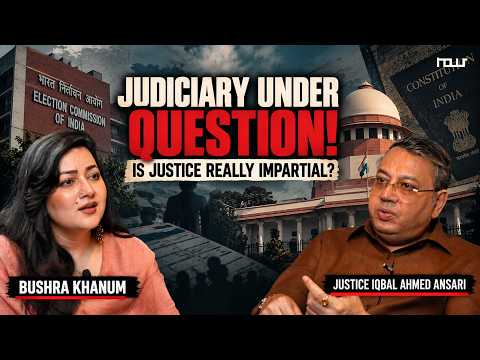
How independent is the judiciary in India today? And what happens when citizens begin to lose confidence in the institutions meant to protect their rights?
 2:44:36
In this conversation, Dr. Harish S. Wankhede joins Ali Javed to examine the political and cultural legacy of Dr. B.R. Ambedkar and the evolution of the Dalit movement. They discuss how Ambedkar imagined Dalits as political subjects at a time when they were denied even basic human dignity, and how…
Discussion
0Readers only · Comments are reviewed by the desk before they appear
The journalism is free for everyone — create a free account to join the discussion.