

 9:45
9:45Video· Nous Clips
India's Foreign Policy Challenges Explained I nous Clips
This is an excerpt from a longer conversation.
The US-Israel war on Iran has triggered a major shift in global geopolitics, raising questions about America's credibility, Israel's strategic position, and the emergence of a new world order. In this in-depth conversation, senior journalist Bushra Khanum speaks with Pravin Sawhney, Editor of For…
Time is on Iran's side. Time is not on America's side. With each passing day, America's credibility in the world is declining. When we look at Iran now, it has shown the entire world how to fight an asymmetric war. It has presented a model of this to the entire world. Pakistan today is a country that has good relations with all three major powers in a multipolar world and is considered a regional power by all. Iran's signature on one side, America's signature on the other, and Shahbaz Sharif's signature in mediation below. How has this changed Pakistan's position? If you look at the MoU signed by Iran, it says "Islamabad MoU." So, is the Indian government, led by Narendra Modi, completely suggesting that we are part of the Global South? But we stand on the side of the Global North. What compulsion is this? America doesn't know why its soldiers are fighting. This makes a huge difference. Iran's commanders know that we are fighting because it's a matter of survival. What are the factors that you believe are completely in Iran's favor? Do you agree with what some experts are saying, that it is the most powerful country in the GC in every way? Well, now the biggest problem for President Trump is that if this base is removed from here, it means that the petrodollar will gradually disappear. There is no country in the world that openly wants to stand with Israel because it has been labeled a genocidal country. So, two major powers are standing with Iran, and I would say that the victory in the Iran war is neither China's nor Russia's. The victory is for the Global South countries because the world order is changing. In NOW, we use data and ground realities to bring to you stories that are often suppressed or misrepresented. We are an independent platform. This means we have no corporate backing. Our true strength lies in you. If you want to continue to see such true and important stories, please share our videos as much as possible. Subscribe to the channel, and if possible, support us through the QR code on the screen so we can continue to bring you stories and continue our work. You are watching Aadaab News Network. I am Bushra Khanum Fahad with you. Should we now consider that the war that began between Iran, the US, and Israel has completely stopped? Should we also consider that Iran has won and has joined the list of world powers that it was perhaps never considered or even imagined before? Consider that an MoU has been signed between the US and Iran. Yet, even after that, we continue to see Israel bombing Lebanon. Furthermore, we're seeing a kind of exchange between the US and Iran. But amidst all this, negotiations are also taking place, and Pakistan has played a significant role in these negotiations. In today's podcast, we'll try to understand how powerful Iran has become after this war. Has the US become isolated? Has the center of world power completely shifted? What is India's role in this? Where does India stand? And what is India's foreign policy telling us right now? Because if you consider the manner in which Iran's Supreme Leader, Ayatollah Ali Khamenei, was martyred, his final journey will now be undertaken, which is considered very important, and India was invited to it. Narendra Modi was also invited. But now the news is that the Governor of Bihar and the Minister of State for External Affairs are being sent. However, Narendra Modi is not going, and even the Foreign Minister has not been sent. What does this mean? How should we view it? I'm joined today by a very special guest, Praveen Sahni, a renowned defense expert from India and the world and editor of Force Magazine. Praveen ji, a very warm welcome. Welcome to the Now Network. Thank you very much for inviting me. Praveen ji, the first question that comes to my mind, and probably to all of us, is that on the one hand, we see that the MoU has been signed. We see that negotiations have begun. A 60-day timeframe has been set. But simultaneously, Lebanon has been attacked. And if we talk about just last night, it's being said that Israel dropped perhaps the heaviest non-nuclear bomb in human history on Lebanon. Among the conditions of the AMU, one of the most important conditions is that bombing or any kind of attack on all resistance fronts will cease. Now, how do you see this moving forward, since Israel isn't relenting in its actions? Negotiations are underway, and exchanges are also taking place between the US, Israel, and Iran. So, how do you see all of this unfolding? The MOU signed is between the US and Iran. Israel is not included in it. The US has been given the responsibility within the MOU to control Israel. The MOU clearly states that it requires a ceasefire on every front. So, this responsibility lies with Trump. First, this is the issue. We're seeing how much control Nitin Yadav is able to exert. What's happening daily? So, Israel has no direct involvement in this. First, we need to understand this. Secondly, as far as the US and Iran are concerned, they have signed an MOU. It provides a deadline of 60 days to sign it into a final deal. But it also states that this is extendable by mutual consent. If both parties wish, they can extend it. President Trump's biggest problem today is that Iran benefits from this MoU. This is because Iran won this war. Look, this MoU could have been signed in peacetime. If it had been a peacetime MoU, both sides would have benefited equally, which is what we call a win-win situation. That's not the case here. The MoU is being signed after a war, in which President Trump has no other military option. If he had any other option, he wouldn't have signed the MoU. So, within this MoU, all of Iran's demands and all of Iran's conditions have been accepted. But what's happening now? There's a lot of pressure on President Trump, asking why he gave so much in the MoU? Because no one in America is willing to accept that America could lose a war, especially with Iran. So, as far as Americans are concerned, their security establishment, policymakers, analysts, and think tanks still believe that the world's greatest power is America. This isn't the case in military terms. They still refuse to accept that the world has changed. It has become a multipolar world. This means there are three major powers, not just one. They believe America is one power. China is the second. Russia is the third. The major power is what we call a Great Power. So, when you consider all these things, it's clear that President Trump is worried about why he has given away so much. So, he sometimes threatens Iran on social media. Now, threatening Iran means Iran need not be scared about it for the simple reason that Iran has wanted war. Iran always has two options. One option is that Iran can shut down the State of Harmony whenever it wishes. Trump can't do anything about it. The second option is that Iran can decide whether or not to participate in the ongoing talks whenever it wishes. It is the winning party. Even today, it has military options. It still has numerous options to put the world under economic pressure. So, when you consider both these things, first, Israel is not directly a party to the MoU. Second, President Trump and the United States are unwilling to accept that we have lost the war. This means that it will take time. The promise of a final deal within 60 days is unlikely to happen. But it's certain that President Trump currently has no other option. Therefore, it seems that at some point, a final deal will be signed. Do you also believe this? People are also afraid because the United States and Israel are two countries that cannot be trusted. Praveen ji, and it's being said that Donald Trump has repeatedly talked about a peace deal; he's said it perhaps 39 times so far, and after that, we've seen that no deal has been reached. This is the first time we're seeing a formal MoU signed. Could this also be the case, Nitin Yau, because Israel has elections in October, and the US has midterm elections in November? I have two questions about this. How powerful do you see the Zionist lobby in America? It's said that almost all the big decisions are taken by this lobby. Do you agree with this? And my second question is, can this same Zionist lobby exert further pressure? Is Donald Trump just biding his time, waiting until the midterm elections, until November, and then we'll see something happen between Iran and the US? Or do you feel that this war has stopped, that this deal could be extended from 60 days to 90 days, four months, or even six months, but ultimately this is what's going to be signed. Look, you've raised some questions, the answers to which are that the Zionist lobby in America is very powerful. But at the same time, we also need to understand that Trump is the President and Commander in Chief. So, if President Trump wishes, he can stand up against this entire powerful lobby. So, we need to understand why he's unable to stand up. Is there a personal reason, or is there some kind of matter regarding the Estin file, that we don't know about? This is your Washington politics. Americans know what's going on inside. Why is President Trump, America's Commander in Chief, unable to stand up and tell you about the aid I'm giving you today, military aid? As you may recall, America's Vice President, J.D. Weiss, was upset and openly told Israel to stop because two-thirds of the military equipment they have is American, manufactured with American money. In other words, if America wishes, they can withdraw, and Nitin Yadav won't be able to do anything. So, that's the first thing. Secondly, as far as President Trump is concerned, this is his second term, and if you look at his National Security Strategy, which the White House releases (usually released in the first year of a new president's term), it clearly states, "President Trump wants to be remembered." President Trump wants his presidency after his departure to be interpreted as "that he was the President for Peace." He wants to leave a legacy, which isn't happening right now, and he's caught up in this whole issue. So what I mean to say is that this matter can drag on, and it's no big deal. This matter can drag on for a long time. But the problem is that time is on Iran's side. Time is not on America's side. With every passing day, America's credibility is declining in the world. The Global South countries, which we call Third World countries, are watching. America's credibility is declining. So, time is with Iran, Iran has already won the war. Time is on Iran's side. So, look at all the cards, Iran has the upper hand. So, you don't see this war triggering again. Don't you think this war can be triggered again? Look, President Trump can try again. As I'm telling you. Look, military options mean that you have something with which you can bring something new to the conflict. So, they even tried air war. Nothing happened. It lasted 39 days. Why didn't it happen? Because the Iranians 'military facilities are all underground. There is no ground operation. Many analysts are even saying they want to launch a ground operation. They will wait, and it's possible that the current weather in the Gulf can't be used for fighting, as temperatures exceed 50 degrees Celsius. This isn't the season for fighting. It's also being said that President Trump may launch a ground war next March or December. To do that, President Trump first needs ground troops. There are approximately 600,000 American troops in West Asia, but at least 300,000 are needed. Look at the 1991 war, which the US and others fought together against Saddam Hussein. They spent six months there, building up their troops, and bringing in approximately 300,000 soldiers. And if you look at the geography of Iraq, it's an open area. Look at Iran, there are mountains and forests, and it's their land. The Iranians know they're ready for that war. So where do you get 300,000 soldiers? First, you have to draft them, and you need Congressional approval. What I mean to say is, the only option they have today is to impose a naval blockade. There's no ground option, no air option. The third option is to impose a naval blockade. And even if they start this war again, they have the capability. Iran has drones and missiles. They can hit targets at very high ranges with great accuracy. So, whatever naval blockade they've created, all their large ships will be targets. And if one large American ship sinks, what respect will America have in the world? So, it means that this is a very difficult time for President Trump. Now, whatever he wants to do is his choice, but nothing will be achieved. Because I was listening to several experts. They were saying that time is being wasted, and as you also indicated, the weather isn't favorable right now. Elections on one hand, and weather on the other. So, we're waiting for a little cooler weather to arrive, and then perhaps something can be done. Israel is a country with its own aspirations. It talks about Greater Israel, the Promised Land, and doesn't stop at Iran. It suffered a setback in Iran. Then it talks about Jordan, Turkey, and beyond, all of which it has drawn up as its own map. This raises the question: is this truly humiliating defeat not just for America but for Israel as well? When a poll was conducted in Israel, 92%of the people said it was a major victory for Iran. So, in a way, it's a humiliating defeat for both countries. So, will they just sit quietly? My second question, Praveen, related to this, is that when we look at Iran now, it has shown the entire world how to fight an asymmetric war. It has presented a model of this to the entire world. It also revealed that sanctions were imposed on it for 40 years. But in 40 days, it showed the world that with preparation, even the world's most powerful power can be brought to its knees. What are the factors that you believe are completely in Iran's favor? Do you agree with what some experts are saying, that it is the most powerful country in the GCC in every way? Look, as far as Iran is concerned, Iran controls the State of Hormuz today. Iran controls the Red Sea. Whenever the Houthis go, they can cut the internet cables that run through the State of Hormuz. The internet will be shut down across West Asia. Some parts of South Asia will also be affected. India will also be affected. Some parts of Europe will also be affected. Furthermore, today they have drones and missiles that can target targets up to 4,000 kilometers. The entire Indian Ocean is covered by the military. So, what's the biggest issue? Iran's fight is what we call a war of survival. The Iranians know why they're fighting. America doesn't know why its soldiers are fighting. This makes a huge difference. Iran's commanders know that we're fighting because it's a matter of survival. Today, many people in America are saying that this isn't our fight. This is Israel's fight, so why are we fighting? So, the one who says that the will and passion that comes from within, that they stand with Iran. So, what I mean to say is that Iran is a dominant power. Now, I'd like to tell your audience one more thing. Saying that Iran is a dominant power and that Iran will dominate everyone is not Iran's intention. If you look at Iran's Foreign Minister, Abbas Araqchi, he has repeatedly stated that we want a regional framework. This means they are looking for a regional solution. If you read the MoU, it clearly states that external forces should leave the region—meaning American troops. And they want to take everyone along. So, if you have to take everyone along, including all the forces in the region, you can't say that you are the most powerful. You can't say that you have to build mutual trust. Only if everyone realizes together that yes, it's in our favor, that we are equals in this. Only then can you create a regional framework. There's no other way. Do you think that the American base in the GCC countries will be eliminated, because Iran initially stated that their goal was to end America's monopoly, especially in this region? Do you see this also happening, even if gradually, with the American base in the GCC, which was used to attack Iran, and in a way, it has been said that these countries actually work as stooges of America and Israel, and the UAE is being called another Israel? Do you think that the American base there could be gradually eliminated, could gradually begin to withdraw from there? Have these countries realized this? How do you see it? Or is it just a need to stop the war for now? We are suffering huge losses. We are unable to sell oil. There is a loss in business. The UAE's image as a safe haven has completely collapsed. The MoU clearly states that all American bases and troops around Iran will have to withdraw. If you look at the current situation, America has 60,000 soldiers in West Asia, spread across 10 countries, across 19 bases. Five of those 10 countries are GCC countries: Saudi Arabia, Qatar, Bahrain, Kuwait, and the UAE. So, they will have to withdraw from there as well. This is clearly stated in the MoU. President Trump himself signed the MoU. If President Trump is signing it, it means he has taken responsibility: "I will complete it. I will take it to the final agreement." So, regarding the UAE, there are three GCC countries: the UAE, Bahrain, and Kuwait, who are still considering their options. "We can do this, we can do that." So, what I mean to say is that you can exercise that option. Consider the problem with this: Regional order means that a region will determine its security region. It doesn't mean that the regional parties will decide who you trade with. So, as far as their trade with Israel and the UAE is concerned, there's no mention of that in the MoU. Now, another major problem for President Trump arises if this base is removed. This means that the petrodollar will gradually disappear. And if the petrodollar disappears, it means America's economy will be completely weakened. This means that if its economy weakens, it won't be able to maintain the approximately 750 military bases it currently has in various countries around the world. This means the American Empire will collapse. First, look at that: America has two strengths. One is their military power, which has already been defeated here in West Asia and their military bases in the rest of the world. Every country is looking at where they are based, wondering what to do for themselves. The second is their reserve currency of the world: the dollar. If the petrol dollar is discontinued or there is a change in their current agreement, they will have problems with that too. It will no longer be a reserve currency. Now, you will see that their closest military ally is Japan. In our region, even the Japanese are selling their American treasury bonds. All countries are buying gold. Because the credibility of the American dollar has plummeted. So, these major changes are taking place. This is not just related to the war. We need to understand what has happened in this war. In this war, what was considered the world's greatest power has been defeated on the battlefield. Along with that, all its associated capabilities have weakened. We need to understand this. Yes. It's a very important point, and perhaps no one would have thought about it before this war began. People were wondering how long Iran would last. Now the question is, how long America will last? How things have completely changed. The entire world's perspective on Iran and America has completely changed. And if there's anyone who's the biggest loser in this, we can clearly see that. We can clearly see both Israel and America as the biggest losers. I have a few more questions, and I want to address them. Before that, Praveen ji, I want to touch on India and the role Pakistan has played in this entire mediation. Pakistan is a country that is friends with China. It is friends with Russia. It is friends with Saudi Arabia. It is also friends with America. Iran is also its friend. That means, if there were four hands instead of two, it would be enjoying all the fruits of its actions. This is the mediation it has done. Iran's signature on one side, the US's signature on the other, and Shahbaz Sharif's signature in mediation below. How has this changed Pakistan's position? Do you think Pakistan has become more powerful than before? And if so, how much of a threat does this pose to India? Let me tell you Pakistan's story, starting with Operation Sindoor. Operation Sundar lasted only four days. But after that four-day war, the US decided, as they wrote in their 2025 report to the US Congress, that Pakistan had handled the clashes that occurred during those four days better than India. As a result, Pakistan and Saudi Arabia signed a defense agreement at the end of 2025. Remember? So, it's not as if Pakistan and Saudi Arabia didn't have military relations before. They've been around since the 1970s. But this is the first time they've signed a formal defense agreement. This means that Pakistan will now have troops in West Asia. After that, you'll see that this war started. What happened as soon as this war started? Pakistan first became a facilitator. Why did it become a facilitator? Because of Pakistan's sindoor, in which sindoor played a huge role. Their relations with America became very good. With President Trump. Remember, President Trump invited Pakistan's Army Chief, Field Marshal Asim Munir, for lunch on June 2, 2025. They had a one-on-one lunch at the White House and a conversation. So, as you're saying, Pakistan today is a country that has good relations with all three major powers in the multipolar world and is a country that all regional powers consider it. Now they have understood its military capabilities and how they are understanding from sindoor that Pakistan is not lacking in military capabilities. Then they also understood that Pakistan has the will to fight, that it fights, and is ready to fight. In all the operations we've conducted with Pakistan over the past 12 years, we've always targeted their terrorist targets. They've always targeted our military targets in return. Military targeting means you're showing the will to fight. Furthermore, it's a Muslim country, and the only Muslim country that possesses nuclear weapons. Furthermore, it's a country where diplomacy is very well-conducted and intelligent. If they need to praise someone, they do it. For example, we didn't give President Trump credit for instigating the ceasefire. Pakistan immediately gave him credit and also said, "Sir, we nominate you for the Nobel Peace Prize." What this means is that Pakistan has achieved three significant things. First, it started as a facilitator. On April 11th, when it was first announced that the two sides would hold talks, it was agreed in Islamabad that the talks would take place. You'll remember that was on April 11th. The meaning of facilitator is simply that you create a space for both sides so that both sides feel safe here. So they are only the facilitators. After that, they become mediators. Mediator means that if both sides aren't talking to each other, you go to one side. Understand their problem. Tell the other side. They will tell you, what is my problem? So you are mediating. What has happened since then? Because I told you about their capabilities, this is the only country that is not a West Asian country. But it has been included in West Asia. And how did it get included? If you look at the MoU that was signed by Iran, it says Islamabad MoU. And the three major powers, the regional powers, that matter. Which are the regional powers? Like Egypt, Saudi Arabia, Turkey, and Pakistan have joined them. So today, Pakistan, a South Asian country, is now integrated with West Asia, so you can understand its reach. Yes, this is a kind of revolution, how it has reached where it has, and you have explained it brilliantly here. My question related to this, Praveen ji, is this something we are seeing suddenly, or was this a long-term strategy by Pakistan, the results of which we are seeing here? Or do you see that its geography suits it very well, or is it a military power, a nuclear power? Therefore, it suits it. Is there a reason for this, whether we talk about America, the Global North, or the Global South? Powers on both sides either want to join forces with Pakistan or stand with it. Look, everything is there: Muslim nations, nuclear weapons, connectivity, geography. But the most important thing we need to understand is that their army generals have become very adept at foreign policy. I'll give you an example: in 1998, when India conducted nuclear tests, the Clinton administration was trying to prevent Pakistan from conducting tests. One of their key representatives, Stroop Dalbert, was the US Deputy Secretary of State. He was trying to contact Nawaz Sharif, the then Prime Minister. No one in Nawaz Sharif's office was answering the phone. Then he called the then Army Chief, General Jehangir Karamat. He said, "Come and talk to us." During the conversation, Jehangir Karamat bluntly told the Americans, "This is our national security. We will not compromise. You should go." So after that they also conducted tests. We know. After that General Jehangir Karamat sent a note to the Foreign Office saying that now Pakistan has become a nuclear weapon state. So now our role has also been created in diplomacy and foreign policy. And now if you are seeing, Field Marshal Asif Munir has taken forward the path started by General Jehangir Karamat. This is being discussed, even Trump talks about it, he says "My favorite Field Marshal." So look at it all, I am not saying that their Prime Minister should not get it, I mean success...he should also get the thing. But the point is that more and more countries want to talk to Field Marshal Asie Munir because they know that these people understand diplomacy, they understand how to talk to them, because this is something they have worked very well, and they are the people who are in power in the GHQ. So, keeping all this in mind, and then looking at a photo, you will understand how the world is changing in diplomacy, especially right now. Our diplomats who formulate our foreign policy, first of all, the government forms our foreign policy. Diplomats don't formulate it. Their job is to carry it forward. But even today, I believe our biggest shortcoming is that our diplomats don't understand military power, which is not the case with Pakistani generals. Because they were responsible for security from the very beginning. When the military line, the Line of Control, was established on January 1, 1949, it became their responsibility. They understand the ceasefire line, and they understand this, and they don't hesitate to tell someone, "Yes, sir, you ordered the ceasefire." In other words, they don't hesitate to take all the credit. They give credit to others if it benefits them. So, these are things that need to be understood. Absolutely, Praveen ji, I think you're the only one in India, and especially as a defense expert, you speak so openly about Pakistan. You've also been labeled as pro-Pakistani, as Pakistan's apple of the eye. So that's always happened to you. But you're presenting the reality here. My question to you, Praveen ji, is how do you view India's foreign policy? We recently saw Rajnath Singh lie in Parliament, saying, "Ask us if any of our soldiers were martyred? If anyone was killed, my answer is no." And so many days later, we are seeing that six of our soldiers, our officers, have been martyred, and we are only now learning their names. This is such a huge betrayal of the country. In a way, you don't even reveal the names of those who sacrificed their lives for the country. What kind of hypocrisy is this? This is my question, and secondly, where is our foreign policy going? Narendra Modi had an opportunity, and he made mistakes. When this illegal war was waged against Iran, he neither paid tribute nor condemned it properly. Instead, he called all the GCC countries and was openly condemning it. The entire world now knows what he did for Israel. We also know how submissive he is to America. But there was an opportunity for him to participate in this historic day, perhaps to correct past mistakes, but he refused. So, is Narendra Modi, the Indian government, completely saying that we are part of the Global South, but we are facing the Global North, and what is the compulsion? Can't he understand that the world has changed after this war? Look, you've raised two or three questions, to which I will answer. First, you've talked about foreign policy. Look, I've been saying for almost four years. I've been saying for at least four years that our foreign policy is wrong, and what's wrong with it is that the world has changed. Today, there's not one major power. Today, there are three major powers. Two major powers are geographically close to us. You should understand this. There's Russia, there's China. They're all deeply intertwined with us. Then what has happened is that the entire geopolitics of what we call trade, connectivity, and the contestation of the Great Pass have come to our region. So we should take advantage of it. What about us? America is a major power. But America is 12,000 kilometers away from us today, and the world is multipolar. So, I'm saying that if we look at our own foreign policy, it means that our poor people, India is a very poor country. You should do something to help them, to improve their lives. So, I have no doubt about that. Foreign policy is wrong. So, now you talked about the Defense Minister. Look, these are things that people remember. Now, let me remind you of 2019, when the Balakot attack took place. If you remember what happened at that time? We shot down one of our own helicopters with our own missile. Remember, six or seven of our people were killed in that incident. The Air Force shot down its own helicopter with its own missile. In the confusion that followed, when they launched the counterattack against us, known as Operation Swift, which Pakistan carried out once we had the Balakot attacks, the government didn't release the report until after the 2019 elections. First, try to understand these things. Secondly, what is the matter now that six people were martyred and Rajnath Singh made a statement in Parliament? This isn't the only thing. There's more to it than that. Because we still don't know whether any of our aircraft were shot down during the air war that took place on the night of May 6th and 7th? Were any of our pilots injured or what happened to them? We don't know that. So, it's not like that. More will be revealed. The truth will emerge later. What I mean to say is that it's the government's responsibility to deal with what happened to you. For example, in the case of America, it's known that so many people were killed in that war. So many of their planes were shot down. We can't find out about all this. So, that's another point I'm making. Now, let me talk about Pakistan. I started smiling a little bit and said, "I'm the apple of the eye of Pakistan." That's wrong. That's not true. What is true is that I mean, that's not my claim. I just say that you are called that way on social media. Yes, that's not the point for me. The most important country is India. This is my country. This is my motherland. But I know what connectivity means. I know what geopolitics is, and I also know that Pakistan and we belong to the same civilization. I also know that today, if we have to talk to any country, to be friends with it, it's Pakistan. This doesn't mean that what Pakistanis think of me is a different matter. But I believe that Pakistan is extreme towards India. Pakistanis are strong; we should have strong ties with them. We are one people, two countries; we need to understand this. This is what I want to say. So, is this why this track of diplomacy, or conversation, has been started, in which the government has completely stated that it has nothing to do with what some former officer is saying and that this is not official? Such statements were made, although Ram Madhav was also present, MM Naravani was also present, and this meeting took place in Colombia. So, should it be seen in this light? The RSS also advocated a few days ago for talks. So, this kind of soft corner, especially from the RSS, is visible. Do you think this is happening without the government's consent? And how do you view it? Because you brought up Pakistan once again, I thought I should bring this to fruition. Look, as far as the Modi government is concerned, I have no doubts. You can pursue Track 2, Track 3, Track 4, invite foreign countries to hold talks. Our relations with Pakistan will not be normal. As long as this government is in power, there's no doubt about it. And let me tell you further, many people keep asking me how relations with China will be normalized. So I tell them, look, the foreign policy that this government has decided is that we should look at competition with China. We will not partner with China, and China will not. And as far as Pakistan is concerned, I am the first person who would be very happy if our relations with Pakistan were normalized. Normalization means that you must first bring both our High Commissions to full strength; that is the first requirement. These Track 2 and Track 3 discussions are meaningless. As far as the government is concerned, what is the RSS saying now? Regarding Ram Madhav, he himself clarified that he wasn't part of Track 2. It was a composite dialogue, with people from other countries present. I don't know if it took place in Colombo or elsewhere. He simply clarified there that there was a session where he spoke and then returned. And as for the RSS General Secretary, he had just returned from the Hutson Institute, after visiting the United States. The Americans want India and Pakistan to begin talks, and Prime Minister Modi doesn't need RSS clearance. No matter how much pressure the Americans exert, I don't think Prime Minister Modi will normalize relations with Pakistan. It's the same thing as President Trump's insistence on getting credit for the ceasefire, which he contributed to. He did. There's evidence for that, but we didn't agree. This government's foreign policy is completely fixed. Normalizing relations with Pakistan is not included in it at all. There should be no doubt about it. Now, you can keep talking about normal relations, normalizing relations with China, that's also not included. Because we won't be. Their Foreign Minister keeps saying repeatedly that India and China should not be rivals, we should be partners, but we want to be seen as rivals of China in the region, so those normalized relations won't happen. Now our flights have resumed, economic relations have started, but investment won't come from there because there's no mutual trust. Unfortunately, this foreign policy is wrong. I've been saying this for a long time. So, given our close ties with Israel and the US, especially with Israel, we were known as the country that first spoke out in the Two-Nation Three on the issue of Gaza, advocating for it. The recent UN report clearly states that Israel carried out the targeted killing of 20,000 children. So, why are we seen as so friendly and friendly with such a genocidal country, or with their head, Nitin Yahoo? What is our compulsion? Does our ideology, the RSS and BJP, match that of Israel? Is this one reason, or are there other reasons behind it? At a time when America itself seems to be saying, "We are the only country standing with you," if we pull our hand from Israel, "you are nothing." There is no other country in the world that openly chooses to stand with Israel. Because it has been tagged as a genocidal country. So why is India standing with it? Why is Narendra Modi standing with it? This is definitely a big question. Look, the ideological problem we have with Pakistan is the same ideological alignment problem we have with Israel. It's a matter of ideology. Because the BJP is an ideological party. It operates on ideology, and the Prime Minister himself has climbed the ladder of the entire RSS. So you know, and I know, that's why relations with Pakistan cannot be normal. That's why we will strengthen our friendship with Israel. We will not weaken it. And as far as my personal relationship is concerned, JD (S) clearly said, "We are the only country standing by you." That's why I forgot to mention India in that. SFS Nitin: Yahoo is a concern, and the Zionists are a concern. These are the people who are committing genocide. These are the people who are criminals. They're killing people, killing children, killing women, and the medicine that's available isn't reaching them. Well, in Gaza today, there are 2 million people in open prison. And since the ceasefire last year, Israel has killed over 1,000 people. This is all on record. What does that tell you about these people, about the Zionists? This is their mindset, you can't do anything about it. I was looking somewhere, and someone rightly said, I don't know who, that if you want to find a solution to Israel, tell Israel to go live in Greenland. Leave it. This is Palestine. And look, when you brought this up, we started with this. Until the Palestine issue is resolved, the Israelis and Israelis will not give up their Israeli dream. And as far as Iran is concerned, Iran is in that situation today. The world has become multipolar. America has lost the war. And both major powers also want the Palestine issue resolved. So it can happen. There is hope. Okay. I have two or three last quick questions for you. First, people are very interested to know how important you consider the role of China and Russia in this entire war. And second, I was just looking at the Mangla Port, the 112 acres of land that India received, I think, when the Prime Minister of Bangladesh met China, that project has been completely handed over to China. So, in this way, you see that not only Pakistan is treated like an enemy country. It is considered an enemy country. But relations between Bangladesh and Pakistan are strengthening, as are relations between Bangladesh and China. And how the relationship between Bangladesh and India has not only weakened, but also projects that were quite aspirational, but no work had even begun, were handed over to China. All of that is happening. So, how can China's continued strengthening be a matter of great concern for India? And my first question was, how do you view the role of China and Russia in this war? Is their power greater than before? Look, as far as China and Russia are concerned and the Iran war is concerned, their role has been very significant. Their role has been very significant. The role they have played in the UN, in terms of military and economic terms, is the amount they have contributed to Iran. Look, Iran has won. But you should also understand that in May, remember, he first went to Russia. He spoke with President Putin for an hour and a half. From there, he went straight to China, spoke with his counterpart, Wong He. Returning to Tehran, he announced, "What will we do? We will create a post-war regional framework." So, two major powers are standing with Iran, and I would say the victory is neither China nor Russia's in the Iran war. The victory is for the Global South countries because the world order is changing. You should understand this, and the other thing is that, as I was telling you, the world has changed. India's foreign policy doesn't understand this. Look, the world changed around 2017. Some people say it, like John Mayer Schwarz of America; I say it changed in 2013, but that's a different debate. What I mean to say is that after the Modi government came to power in May 2014, the world became multipolar. So, it's still ingrained in our minds that we are the food providers, the greatest power in South Asia. What we don't see is that all the countries in South Asia, except India and Bhutan, are connected by the Belt and Road. So, today, China isn't a power outside South Asia. China is part of South Asia. You understand, that's why the Prime Minister of Bangladesh (President, sorry, the Prime Minister was there) met with Shiji Ping and told him that we would also discuss the Teesta border issue and sort it out. What I mean to say is that this hegemonic notion of being a colonial power was passed on to us by British India, that South Asia is our property, not yours. The world has changed. China is not a common power. We have to work with China. We have to work with Pakistan to see how we can strengthen our country. Strengthen it in terms of prosperity and development. Strengthen it in terms of military deterrence. For that, you need peace. Peace will only come if you seriously consider and resolve these two major countries with which we have military lines. Yes, are you also noticing that Israel's friendship with India, especially with America, is that they stab us in the back and then sing the praises of friendship? Because, if we look at recent times, there's not a single thing the US has done for India that we can say has been a true friendship. The friendship seems to be a one-sided love, with the lover going crazy, and that love is clearly visible. That's Narendra Modi's relationship with Donald Trump and America. Look, as far as America is concerned, America is a country that won the Cold War, won the Second World War, was the breadwinner of the unipolar world, was the sole power. They don't understand partnership. Even today they are not ready to accept that the world has changed. So they say that we are equal to India, but they treat India like a servant. We have no problem with that. The problem is this. When we have the option that I was telling you, why are we not exercising it? Instead of being their servant, whatever word you want to use as a vessel state. Whatever they are doing, we are serving them in everything of America because they do not consider us their equals. We, China, Russia, South Asia, Global South countries, New World Order, we can play a very big role here. We do not want to do that. Just look at the example of that right now. This was your Supreme Leader, who was assassinated, Khamenei Sahib; Now, their President has extended a personal invitation to the Prime Minister, but the Prime Minister is not going there because he would anger America, Israel, and we won't go. So, our foreign policy, as I was telling you, won't change. It won't change. Some people keep hoping it will change because it's ideologically fixed. Ideology has come into play. When ideology comes into play, the country's overall development takes a back seat. It gets left behind. My last question: is the country suffering the consequences of this foreign policy, and could it suffer even more in the future, as citizens and as a country? That's quite obvious. That's obvious. As long as this government remains in power, this foreign policy will remain in place. If we expect this foreign policy to lead to global progress or that our voices will be heard, nothing like that is going to happen. Yes, thank you so much, Praveen. Thank you for being a part of this podcast, for giving your time. Thank you so much. Thank you so much for joining. Thank you very much. Thanks a lot for having me.
Companion article
When the United States and Iran put their names to what has come to be called the Islamabad MoU, much of the commentary treated it as one more chapter in a long sequence of stop-start diplomacy. In a conversation with the host Bushra Khanum Fahad, the defence analyst Pravin Sawhney, editor of Force magazine, argued for a different reading: that this is a document written by the side that came out of the fighting with more options, and that it should be read as a record of who could afford to keep going.
Sawhney's starting point is the structure of the agreement. The memorandum is between Washington and Tehran; Israel is not a party to it. But, as he reads it, the text puts responsibility on the United States to restrain Israel, because it calls for a ceasefire on every front. That matters because Israeli strikes on Lebanon have continued even as talks proceed. In his account, those strikes are a test of President Donald Trump's control over an ally, not a breach by Iran.
The memorandum sets a 60-day window for converting it into a final deal, extendable by mutual consent. Sawhney does not expect the deadline to hold. He does expect the direction of travel to survive it. "Time is on Iran's side," he said, and he argued that every additional day of delay costs Washington credibility among what he called the Global South.
The core of Sawhney's argument is that a peacetime memorandum would have been a bargain between roughly equal winners, whereas this one followed a war in which, he says, Trump found no military route left. "If he had any other option," Sawhney said, he would not have signed. He also described strong domestic pressure on the American president over what was conceded, since few in the American security establishment, in his telling, are prepared to accept that the United States can lose a war.
He walked through the options one by one. The air campaign lasted 39 days and, in his assessment, achieved little, partly because Iran's military facilities are underground. A ground war would need something on the order of 300,000 troops, he said, against roughly 60,000 American soldiers now spread across ten West Asian countries. Assembling that force would take months, as it did before the 1991 Gulf War, and would need Congressional approval. Iran's terrain of mountains and forests is also, he noted, far less forgiving than Iraq's open ground. The Gulf summer, with temperatures above 50 degrees Celsius, is a further constraint.
That leaves a naval blockade, which Sawhney sees as risky in its own right. Iran's drones and missiles, he said, can strike at long range with accuracy, and a single large American ship lost would be a blow to Washington's standing far out of proportion to the military value of the vessel.
Sawhney described Iranian leverage in geographic terms. Iran, he said, effectively controls the Strait of Hormuz and, through allies, exposure in the Red Sea. He argued that undersea internet cables passing through those waters are vulnerable, with consequences reaching well beyond the Gulf, and that Iranian drones and missiles can reach targets up to 4,000 kilometres away. Some of these are large assertions and they come from one analyst's assessment, not from an independent audit.
The more interesting point is psychological. Iran's fight, he said, is "a war of survival," and Iranian commanders know why they are fighting in a way that American soldiers, he suggested, do not. Many Americans, he added, now describe this as Israel's fight, not theirs.
Yet Sawhney cautioned against reading Iranian strength as a bid for domination. He pointed to Foreign Minister Abbas Araghchi's repeated calls for a regional framework, and to language in the memorandum that he reads as requiring external forces, meaning American troops, to leave the region. A regional arrangement, he argued, only works if all parties believe they are equals in it. Nobody can build mutual trust while claiming to be the strongest.
The most consequential of Sawhney's claims concerns the American military footprint. By his count the United States has about 60,000 troops in ten countries in West Asia, across 19 bases, five of them in Gulf Cooperation Council states: Saudi Arabia, Qatar, Bahrain, Kuwait and the UAE. He says the memorandum obliges Washington to withdraw them, and that Trump, by signing, took on the responsibility for delivering that. He described the UAE, Bahrain and Kuwait as still weighing their options. He was careful to add that a regional order means the region decides its own security arrangements; it does not, he said, dictate whom Gulf states trade with, and the memorandum is silent on their commerce with Israel.
From there, Sawhney drew a line to the dollar. If the bases go, he argued, the petrodollar arrangement will gradually erode, and with it the strength of the American economy and its ability to sustain around 750 bases worldwide. He described American power as resting on two pillars, military strength and the dollar's status as the world's reserve currency, and argued that the first has been dented on the battlefield and that the second is being questioned. As evidence he pointed to Japan selling American Treasury bonds and to countries accumulating gold. These are contestable readings, and Sawhney offered them as his own judgment on where the trend is heading, not as settled fact.
A large part of the conversation concerned Pakistan, whose role in the talks Sawhney called a significant diplomatic gain. He traced it in stages. After the four-day conflict with India, he said, Washington concluded that Pakistan had handled the fighting better, and Islamabad and Riyadh signed a formal defence agreement at the end of 2025. Pakistan then became a facilitator, hosting the first talks on 11 April, and later a mediator, carrying each side's concerns to the other. The fact that the document is known as the Islamabad MoU is, for Sawhney, the sign of how far this has gone. He counts Pakistan alongside Egypt, Saudi Arabia and Turkey among the regional powers that now matter.
He attributed this partly to geography and nuclear status, but mainly to the fluency of Pakistan's military leadership in foreign policy. He recalled General Jehangir Karamat telling American officials in 1998 that Pakistan's national security was not negotiable, and described Field Marshal Asim Munir as continuing that tradition. Pakistani officials, he added, are also unembarrassed about flattering Washington when it serves them: they credited Trump with the India-Pakistan ceasefire and nominated him for the Nobel Peace Prize, while New Delhi declined to.
Sawhney was blunt about India's position. He said he has argued for about four years that Indian foreign policy is built on an outdated picture of a unipolar world, when three great powers now matter and two of them, Russia and China, are next door while the United States is 12,000 kilometres away. India's foreign policy, he said, is fixed by ideology as much as by interest: the same ideological gap that keeps relations with Pakistan from normalising, in his view, also draws the government toward Israel.
He was sceptical of backchannel diplomacy with Pakistan, calling Track 2 and Track 3 discussions meaningless. The first real step, he said, would be restoring both countries' High Commissions to full strength. He was equally pessimistic about relations with China: flights and trade may resume, but he expects little investment without mutual trust, because India has chosen to see China as a rival. He also noted that China's Belt and Road links now reach every South Asian state except India and Bhutan, which he took as a sign that China is now part of South Asia, not an outsider to it.
The cost, he told the host, falls on ordinary Indians, and he expects the policy to persist as long as the present government does. The conversation ended without a prediction that anything would change, only a claim that the world already has.
9:45This is an excerpt from a longer conversation.
 12:06
12:06This is an excerpt from a longer conversation.
 2:12
2:12Is the Global South emerging as the biggest winner of the Iran-Israel war? Pravin Sawhney explains why the balance of power is shifting, what Trump's challenges mean for America, and where India stands in the new geopolitical landscape.
 8:23
8:23This is an excerpt from a longer conversation.
 9:27
9:27This is an excerpt from a longer conversation.
 56:39
56:39In the first episode of Emerging Perspectives, Sania Ismailee joins Wardah Beg for a conversation about the philosophical questions that lie beneath India’s debate on the Uniform Civil Code. For eight years, through her PhD research, Sania examined the UCC through the questions of secularism and …
 1:13:08
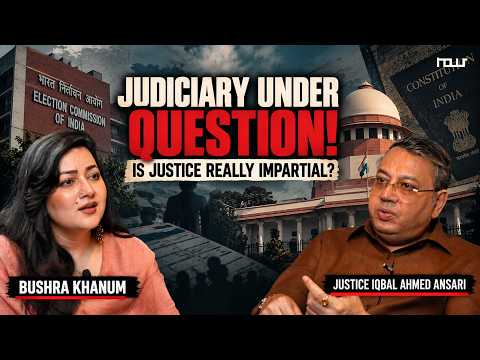
How independent is the judiciary in India today? And what happens when citizens begin to lose confidence in the institutions meant to protect their rights?
 2:44:36
In this conversation, Dr. Harish S. Wankhede joins Ali Javed to examine the political and cultural legacy of Dr. B.R. Ambedkar and the evolution of the Dalit movement. They discuss how Ambedkar imagined Dalits as political subjects at a time when they were denied even basic human dignity, and how…
Discussion
0Readers only · Comments are reviewed by the desk before they appear
The journalism is free for everyone — create a free account to join the discussion.