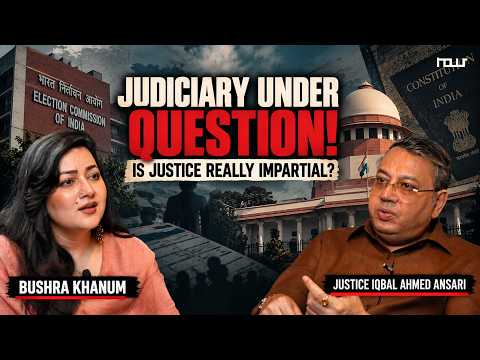
Every August 15, a familiar question resurfaces for India's Muslims: were you really on the right side of 1947? Eighty years on, host Bushra Khanum put a sharper version of that question to Dr. Shamsul Islam — a political science professor of four decades, author of more than thirty books, and a longtime chronicler of the RSS's own historical record — on the Nous Podcast. His answer, drawn from his book "Muslims Against Partition of India," inverts the question entirely: rather than asking Muslims to keep proving a loyalty no one else is asked to prove, he asks what role Hindu nationalist organisations themselves played in the freedom struggle they now claim to define.
A Question Turned Back
"This is a horrendous, a very dangerous situation," Islam says of the recurring demand that Muslims demonstrate patriotism, "that this country's Muslims are made to stand in the dock over whether they love India." His response is not defensive but confrontational: "Ask the reverse question of the RSS people, the Hindutva people — what role did you play in India's freedom?" The RSS was founded in 1925, the Hindu Mahasabha slightly earlier. Between then and 1947, India lived through the Non-Cooperation Movement, the Khilafat Movement, the Salt Satyagraha and the Quit India Movement — the last of which, Islam notes, was in its 84th year at the time of the recording. "Quit India" was Congress's call, voiced by Gandhi and by Maulana Abul Kalam Azad, by Subhas Chandra Bose and by Sardar Patel. "The RSS did not give that slogan," Islam says. "The Hindu Mahasabha did not give that slogan."
He offers a specific, documented irony: on August 14, 1947, an English-language newspaper aligned with Hindu nationalist opinion published an editorial objecting to the tricolour itself, arguing that a flag with three colours would never be respected by Hindus and would produce a poor psychological effect on the nation. "The word three is in itself an evil," the editorial said, according to Islam — the same organisations, he argues, that today instruct Muslims to prove their love of country by waving that flag never accepted it themselves when it was adopted. Subhas Chandra Bose, he notes, understood how divisive the slogan "Vande Mataram" had become — rooted in a novel that depicts the mass killing of Muslims — and for that reason gave the Azad Hind Fauj the slogan "Jai Hind" instead, with two of its leading commanders themselves Muslim.
Whose Vote, Whose Representation
Islam's most pointed factual challenge concerns a claim now treated as settled history: that the Muslim League represented India's Muslims in 1946 because it won the majority of Muslim seats that year. He argues this framing conceals a basic fact about who could vote at all. Under the Government of India Act of 1935, the franchise was restricted to income-tax payers, lawyers, degree-holders and large landowners — fewer than eight percent of the population nationally, and in provinces like Bihar and the United Provinces, where Muslims were overwhelmingly poor, only an estimated four to five percent of Muslims held the vote. "My own family, weavers, ironsmiths — people like that were not voters," he says. The Muslim League's electoral mandate, in his account, was drawn from a narrow, propertied slice of the community, not from the weavers, artisans and labourers who made up its overwhelming majority — a point he says vanishes from the way that mandate is retold today.
Set against this is the Azad Muslim Conference, held in Delhi over four days in late April 1940 — an event Islam says has been almost entirely erased from public memory, including by scholars who claim to research Muslim history. Organised jointly by the All India Jamiat-ul-Ulama, the All India Momin Conference, the All India Majlis-e-Ahrar, the All India Shia Political Conference (marking, Islam notes, one of the first times Shia and Sunni organisations formally united), the Khudai Khidmatgar, the Krishak Praja Party and several smaller Muslim bodies, the conference drew delegates from every major province — 357 from the United Provinces alone, 155 from Punjab, 125 from Bihar, 105 from Bengal, 82 from Sindh, and more from Delhi, Assam, Bombay and the princely states — alongside an unplanned surge of 20,000 women in attendance, against an initial estimate of 5,000. Wilfred Cantwell Smith, a leading contemporary scholar of communal politics, concluded that the gathering represented the majority of Muslims. Its resolutions rejected the two-nation theory outright and warned, with striking prescience, that a Pakistan split across two wings nearly 2,000 miles apart could not hold — a warning borne out in 1971.
Among its most prominent voices was Allah Bakhsh Soomro, a Sindh political leader whose speeches Islam reads from at length, arguing they belong in university curricula alongside the pamphlets the Jamiat-ul-Ulama published against the two-nation theory. Bakhsh's writing addressed communal division and caste prejudice within the Muslim community itself — including the practice, in parts of eastern Uttar Pradesh and Bihar, of denying burial or desecrating the graves of Muslims from lower-caste backgrounds, and the imposition of a discriminatory "arzal tax" on them — decades before such caste critiques became mainstream. Allah Bakhsh was assassinated on May 14, 1943; Islam draws a direct parallel to Gandhi's assassination four years later, arguing both men were killed for standing against communal politics from within their own communities.
Where the Two-Nation Theory Actually Began
Islam's most substantial claim is genealogical: the two-nation theory, routinely attributed to Jinnah, has a documented history in Hindu nationalist politics that predates the Muslim League's own adoption of it by decades. He points to Bhai Parmanand — a Congress leader who later led the Hindu Mahasabha and, still later, the RSS — who in his 1909 memoir proposed that Sindh and the provinces beyond it be joined with Afghanistan and the North-West Frontier Province into what he called a "great Muslim kingdom," with Hindus moving east and Muslims in the rest of India moving into that territory. "This is the first partition plan for India," Islam says, "and Bhai Parmanand is the one presenting it." He traces the same idea through Lala Lajpat Rai, who in a 1924 Tribune series proposed carving out four separate Muslim states — a Pathan province, western Punjab, Sindh and eastern Bengal — years before Jinnah's Lahore Resolution. He cites B.S. Moonje, a Congress leader and Central Legislative Assembly member closely associated with founding the RSS and with Savarkar's rise, who argued that India belonged to Hindus just as England belonged to the English — apparently unaware, Islam notes dryly, that England's national identity was never defined by religion in the way he was proposing for India. Historian R.C. Majumdar — a figure often invoked by Hindutva commentators as an authoritative "Indian" historian — himself documented, in Islam's account, that the Hindu Mahasabha had adopted a partition agenda fifty years before the Muslim League caught up with it.
Savarkar's own contribution, in Islam's telling, was to declare in 1937 — as he formally assumed leadership of the Hindu Mahasabha and, despite an earlier undertaking to stay out of politics, entered it directly — that Hindus and Muslims were "two antagonistic nations," and that anyone who believed otherwise was "infantile" and foolish. B.R. Ambedkar's 1940 book on Pakistan, written in the same year as the Azad Muslim Conference, is one Islam urges listeners to read directly: Ambedkar concluded that Savarkar and Jinnah, for all their public antagonism, agreed on the essential premise of Muslims as a separate nation — differing only in that Savarkar wanted Muslims kept under Hindu dominance rather than granted a separate state, a condition Jinnah would not accept.
Partition as Administrative Accident, Not Popular Will
Pressed on whether responsibility for Partition can fairly be placed on the Muslim League alone, Islam widens the frame rather than narrowing it — implicating the Hindu Mahasabha in the same architecture of division, and the British administration for executing a division neither community had genuinely been consulted on. He describes the boundary-drawing itself as a rushed and almost accidental process: Sir Cyril Radcliffe was reportedly handed maps roughly fifty years out of date and given seven weeks to divide a subcontinent, with the poet W.H. Auden's poem on the episode describing Radcliffe departing England having "never been there" and settling the boundary "in seven weeks" before sailing home to forget the whole affair — a decision Islam calls one of history's cruellest jokes. The consequences of that haste were severe and specific: Gurdaspur, meant for Pakistan, was assigned to India; the town of Pritnagar changed hands three times within days; and violence displaced and killed people, in Islam's account, on both sides of the new border, including the widely documented abduction and rape of more than a hundred thousand women during Partition's chaos.
1857, Not 1947, as the Real Reference Point
Islam repeatedly redirects the conversation to 1857, arguing that the war fought then, not the independence of 1947, is where Muslim participation in India's freedom struggle is best measured — and where he says the record is least contested and most deliberately forgotten. Citing what he describes as government data, he says Muslims made up roughly 25 percent of India's population at the time, yet accounted for some 40 percent of those martyred in the 1857 uprising. He names Azimullah Khan, a multilingual strategist who also represented Rani Lakshmibai's case in London, as the author of a widely circulated 1857 rebellion anthem declaring, in Islam's rendering, that "Hindu, Muslim, Sikh are our brothers" and that the land belongs equally to all who defend it. He argues that the same upper-caste elites — both Muslim and Hindu — who collaborated with the British after 1857 are the intellectual ancestors of the Muslim League and the Hindu Mahasabha alike, pointing to Sir Syed Ahmad Khan's later insistence that no "respectable" Muslim had taken part in the revolt, and to prominent Bengali Hindu intellectuals of the era who made the same disavowal on behalf of Hindus.
Congress's Betrayal, and an Unanswered Question
Islam's account of Congress is unsparing: he says the party used Maulana Azad's presence and prestige to move the Partition resolution — a resolution Azad, in Islam's view, should have refused to carry — while denying the Azad Muslim Conference's leadership any real hearing, despite the size and geographic spread of the movement it represented. Sardar Patel, worried about administrative chaos as communal violence spread city by city, ultimately accepted Partition as the price of stability; Gandhi resisted longer but was eventually brought around. Two of the Conference's own leaders, Islam says, refused to accept the resolution to the end.
Islam closes without offering a tidy resolution, and the interview itself runs long enough that Bushra Khanum defers several lines of questioning — including a fuller discussion of 1857 and of Nehru, Patel and Gandhi's individual roles — to a possible future conversation. What Islam leaves standing, instead, is a reframed historical ledger: a freedom movement in which Muslim participation was disproportionate and organised through bodies like the Azad Muslim Conference that history has largely dropped, set against Hindu nationalist organisations whose own partition proposals predate the ones they now blame entirely on the Muslim League. "If we don't know this heritage," he says, of the shared literary and civic history he describes across the conversation, "this country would have been saved too." Eighty years later, in his account, the ledger has simply never been read back to the public in full.


 1:13:08

Discussion
0Readers only · Comments are reviewed by the desk before they appear
The journalism is free for everyone — create a free account to join the discussion.