

 12:22
12:22Video· Nous Clips
How Uttar Pradesh Shapes Indian Politics? nous Clips
This is an excerpt from a longer conversation.
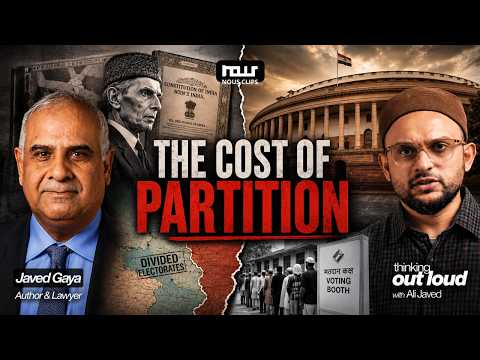
In this thought-provoking conversation, Ali Javed speaks with Javed Gaya about his new book, Heartland Rising: The Making of Majoritarian India. They unpack the contested history of Partition, examining the roles of Congress, the Hindu Right, and the Muslim League in shaping the subcontinent's fu…
Companion article
Javed Gaya's book on the making of majoritarian India begins, he told Nous, with a philosophical choice he believes India's constitutional framers never fully reckoned with: the tension between liberty and equality. In the 1930s, as the shape of an independent India was debated, colonial-era protections such as separate electorates gave minorities some structural guarantee of representation. Once those guardrails were dismantled after independence, Gaya argued, an unrestrained liberty to vote however one wished — including along communal lines — meant that raw numbers alone would decide outcomes. He pointed to Uttar Pradesh chief minister Yogi Adityanath's description of elections as a contest of "80 versus 20" as a contemporary illustration of exactly the dynamic he says the framers left unguarded against.
"Majority being really it's a thing of numbers, it doesn't give legitimacy," Gaya said, paraphrasing a passage he attributes to Jonathan Sumption, the former UK Supreme Court judge. He also invoked the constitutional lawyer Ivor Jennings, who argued decades ago that a country as religiously and socially layered as the Indian subcontinent could not simply rely on one-man-one-vote without some counterbalancing protection for minorities.
Gaya's account of Partition puts unusual weight on federalism as the road not taken. He argued that Punjab and Bengal — the two major provinces that ended up divided by the Partition line — had been governed before 1947 by parties rooted in regional and economic identity rather than religious majoritarianism: the Unionist Party in Punjab and the Krishak Praja Party in Bengal. Had those provinces remained intact and strong within a genuinely federal India, Gaya suggested, they might have diluted the concentration of power that instead flowed to a Congress apparatus centred on the Hindi heartland of Uttar Pradesh and Bihar.
That regional counterweight never had the chance to develop, he said, partly because Congress itself was less a unified ideological bloc than a coalition in which culturally conservative, UP-based leaders coexisted uneasily with pluralist figures — Jawaharlal Nehru and Tej Bahadur Sapru among them — who valued the sub-continent's syncretic Mughal-era inheritance.
Much of the conversation turned on Gaya's reading of Jawaharlal Nehru. He described Nehru as a believer in what he called "economic man" — a broadly Marxian conviction that Soviet-style central planning, industrialisation and rising prosperity would, within a generation, dissolve communal identity into a shared civic citizenship. Gaya called this Nehru's most charitable possible motive for not building stronger constitutional protections for minorities after 1947. He raised, without fully endorsing, a more cynical alternative explanation: that Congress's Hindi-belt leadership had its own interest in preserving a strong, unitary centre rather than the more federal structure minority protections might have required.
Gaya was equally direct about Congress's political failure after the 1937 provincial elections, in which the Muslim League performed poorly. Rather than using that moment to reassure Muslim opinion, he said, triumphalist Congress politicians alienated Muslim League sympathisers further — a failure of accommodation he sees as a hinge point on the road to 1947.
Perhaps Gaya's most provocative claim is that a meaningful section of the Hindu right was not unhappy to see Pakistan created. "A lot of the Hindu elite were not unhappy with Pakistan," he told Nous. "They were actually saying that look, um... this was the best thing that could happen for the Hindus." He cited a recent book, written by an author he described as strongly RSS-aligned, whose title he summarised as arguing for the benefit Jinnah brought to the Hindus by seeking a separate Muslim state — freeing a Hindu-majority India, in that reading, from the need to accommodate a large and politically organised Muslim minority.
Gaya described Muhammad Ali Jinnah himself as "a gambler" who staked everything on the 1946 Cabinet Mission Plan — a federal arrangement that would have kept India united while giving Muslim-majority provinces significant autonomy — because, in Gaya's account, Jinnah had no real fallback plan. It was Congress, he argued, that ultimately torpedoed the Cabinet Mission Plan, closing off the one route that might have avoided both Partition and full independence for a separate Pakistan.
Gaya recounted an exchange he attributes to Sir Stafford Cripps and the Hindu nationalist leader Syama Prasad Mookerjee, in which Cripps told Mookerjee that safeguards for a minority are not something the minority can simply demand — "it was for the majority to give. It was not for the minority to take." He used the episode to underline his broader argument: that minority protection depends on a majority's willingness to concede it voluntarily, which is precisely what he believes India's constitutional settlement failed to secure.
He also cautioned against reading too much certainty into the record of who actually wanted Partition. The 1935 Government of India Act extended the franchise to only fourteen percent of the population, he pointed out, which makes it hard to treat any pre-independence election as a genuine referendum on Pakistan. Of roughly seven million people who crossed the new border in either direction, he said, the individual motivations — fear of violence, family ties, economic calculation — are largely unrecoverable and cannot be reduced to a single ideological choice.
Gaya's closing point was also his bleakest: that Partition came to be treated by many in the Hindu right as a gift already given to Muslims, after which no further political accommodation was thought necessary. That framing, he said, "has frankly bedevilled the Muslim question to the present day."
12:22This is an excerpt from a longer conversation.
 12:22
12:22This is an excerpt from a longer conversation.
12:22This is an excerpt from a longer conversation.
 1:13:08
How independent is the judiciary in India today? And what happens when citizens begin to lose confidence in the institutions meant to protect their rights?
 2:44:36
In this conversation, Dr. Harish S. Wankhede joins Ali Javed to examine the political and cultural legacy of Dr. B.R. Ambedkar and the evolution of the Dalit movement. They discuss how Ambedkar imagined Dalits as political subjects at a time when they were denied even basic human dignity, and how…
 3:25:59
What does it mean to renew Islamic thought in an age of modernity? In this conversation, Dr. Waris Mazhari discusses his new book, Fikr-e-Islami Ki Tajdeed (Renewal/ Reconstruction of Islamic Thought), with Ali Javed. The conversation explores the diversity within the Islamic intellectual traditi…
Discussion
0Readers only · Comments are reviewed by the desk before they appear
The journalism is free for everyone — create a free account to join the discussion.