

 11:35
11:35Video· Nous Clips
Salman Khurshid on Gyanvapi and Babri I nous Clips
This is an excerpt from a longer conversation.
In this thought-provoking conversation, senior Congress leader Salman Khurshid reflects on some of India's most complex political and constitutional debates. He discusses the relationship between secularism and personal law, questioning how philosophical and religious belief systems interact with…
Companion article
Salman Khurshid has occupied more front-rank cabinet portfolios than almost any Muslim politician in independent India's history, holding the law, external affairs, commerce and minority affairs ministries under Congress-led governments. He now heads the India Islamic Cultural Centre. In a long conversation with Nous, he was asked directly whether India's Muslims are being reduced to second-class citizens. His answer reframed the question. The country's real crisis, he said, is a crisis of democracy itself, and minorities feel it earliest and most sharply because the Constitution singles them out for particular protection precisely because they are outnumbered.
That protection, Khurshid argued, is routinely misdescribed as appeasement. It is not a privilege but a compensation built into the constitutional design to offset the arithmetic disadvantage of being a minority in a majoritarian democracy. He was careful not to present this as a narrowly communal grievance. If the constitutional promise of equality and fraternity is failing Muslims today, he warned, the same erosion will eventually reach everyone else, because it is the structure of democracy itself, not the fate of one community, that is under strain.
Much of the conversation turned on the 2019 Ayodhya judgment, which Khurshid argued is widely misunderstood, including by many who invoke it. He laid out the structure of the case: the Babri Masjid dispute contained an outer courtyard, the so-called Ram Chabutra, which Muslim litigants themselves conceded had been in Hindu possession and use for centuries, and an inner structure that was the mosque proper, under Muslim possession and use for prayer until it was forcibly disturbed in 1949. Because it was a title suit, the court had to decide ownership on the balance of possession and evidence, and on that inner portion, Khurshid said, the court effectively found in the Muslim litigants' favour, acknowledging that they had suffered an injustice.
Where the verdict became controversial, he said, was in its remedy. Having found the mosque site vacant of any surviving structure, the court invoked its special Article 142 power, available only to the Supreme Court, to do "complete justice," and awarded five acres of alternative land elsewhere in Ayodhya rather than the disputed site itself. The Sunni Waqf Board, on whose behalf the case had been argued, declined to accept that land at the time; a plot was eventually taken roughly twenty-five kilometres away, where no mosque has since been built. Khurshid suggested this refusal was a strategic misstep: had a mosque risen opposite the temple on the offered land, it would have stood, in his words, as a symbol of Indian secularism, rather than leaving today's lopsided landscape in Ayodhya.
He drew a sharp distinction between that case and the more recent disputes at sites such as the Kamal Maula mosque in Dhar, where petitioners approached the court through a writ petition against an Archaeological Survey of India permission rather than a title suit. That, he argued, was a tactical choice: a title suit would have forced years of evidence-gathering on possession, during which prayers were still continuing at the site, a fact that would have worked in the Muslim side's favour. By avoiding a title suit, he said, petitioners denied themselves the very framework that had produced a partial vindication in the Babri case, even as they invoked the Babri judgment's language. The deeper unease, he added, is that laws like the Places of Worship Act of 1991, which was meant to draw a line under disputes predating independence, are now being tested and reopened through this kind of case.
Khurshid pushed back firmly on the idea, common in debates over a uniform civil code, that personal law and India's secular constitutional order are separate and competing systems. Legal pluralism, he said, is not a modern secular invention imposed on religious communities; it is embedded within the secular constitutional framework itself, just as it is embedded within Islamic jurisprudence. Personal law is not a rival to secular law, in his account, but a protected component of it, explicitly safeguarded by the Constitution's guarantees to every citizen and, in addition, to minorities.
Pressed on where personal law should yield to general law, Khurshid argued the test should be concrete harm, not discomfort. Communities routinely accommodate one another already, he said, pointing to Muslims pausing sermons for the azaan and reciprocal courtesies around religious processions and prayer timings. Restrictions on personal practice are legitimate, in his framing, only where there is an identifiable injury to someone else, and he suggested that much of the current friction over practices like cattle sacrifice or loudspeakers is manufactured rather than rooted in real harm.
Khurshid offered an extended defence of the traditional structure around talaq that he said is misunderstood by both critics and, he suggested, sometimes by Muslims themselves. Divorce under the classical system is not a single instantaneous act, he explained, but a graded process: an initial pronouncement that is revocable, allowing reconciliation, followed by a second that is likewise revocable, and only a third and final pronouncement that closes the matter. During the intervening waiting period, or iddah, a husband retains obligations toward his wife, including residence and maintenance. He called this system "a very modern" mechanism precisely because it builds in a cooling-off period before an irreversible step, in contrast to caricatures of talaq as an instant, unilateral repudiation.
On the broader constitutional architecture, Khurshid stressed that Directive Principles of State Policy, such as the aspiration toward a uniform civil code, do not automatically override Fundamental Rights; courts have repeatedly held that the two must be read together and harmonised rather than one being assumed superior. What counts as a "reasonable restriction" on a right, he said, is not fixed but contextual, shifting with circumstance the way permissible speech differs between peacetime and emergency. He returned throughout to a single thread: India's Muslims and its secular parties alike have too often gone quiet in the face of majoritarian pressure rather than mounting a substantive constitutional answer, and it is that silence, more than any single verdict or law, that he believes has let the crisis deepen.
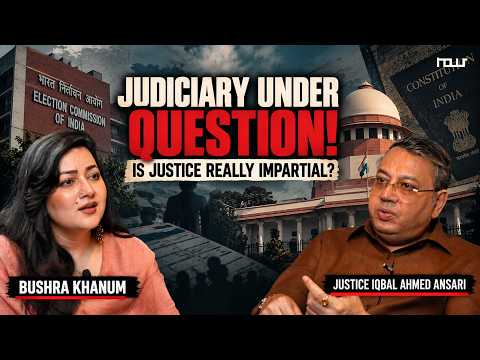 1:13:08
How independent is the judiciary in India today? And what happens when citizens begin to lose confidence in the institutions meant to protect their rights?
 2:44:36
In this conversation, Dr. Harish S. Wankhede joins Ali Javed to examine the political and cultural legacy of Dr. B.R. Ambedkar and the evolution of the Dalit movement. They discuss how Ambedkar imagined Dalits as political subjects at a time when they were denied even basic human dignity, and how…
 3:25:59
What does it mean to renew Islamic thought in an age of modernity? In this conversation, Dr. Waris Mazhari discusses his new book, Fikr-e-Islami Ki Tajdeed (Renewal/ Reconstruction of Islamic Thought), with Ali Javed. The conversation explores the diversity within the Islamic intellectual traditi…
Discussion
0Readers only · Comments are reviewed by the desk before they appear
The journalism is free for everyone — create a free account to join the discussion.