

Fifteen Days to Demolish a University: Inside the Notice to Bulldoze Azam Khan's Jauhar University
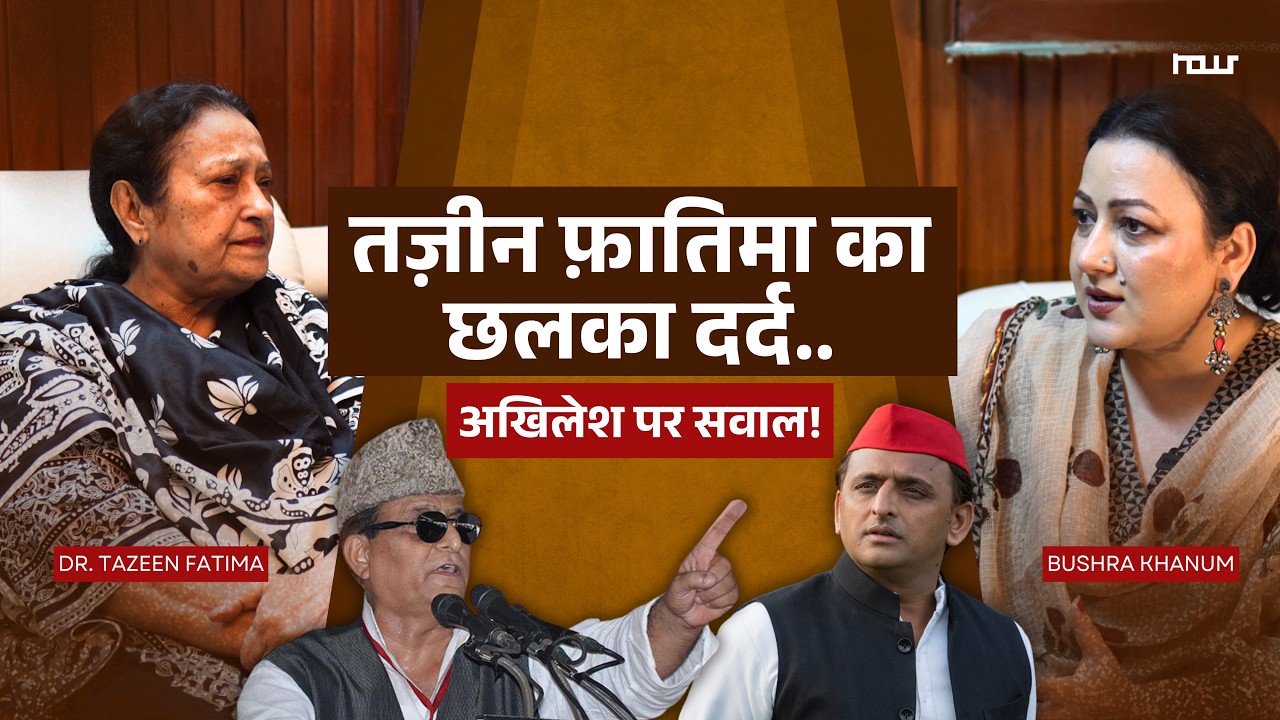
Tanzeen Fatma, wife of the jailed Samajwadi Party leader Azam Khan, speaks about the demolition order threatening the Rampur university he built, and the silence she says has met it from her own party's leadership.
Contents · 5 sections
A fifteen-day notice
In Rampur, Uttar Pradesh, the Rampur Development Authority has issued demolition notices for 38 of the 40 buildings at Maulana Mohammad Ali Jauhar University, declaring them illegal and giving the institution fifteen days to tear them down itself or have the authority do it at the university's expense. The university, founded by veteran Samajwadi Party leader Azam Khan and built up between 2006 and 2017, currently educates more than 3,000 students. Azam Khan, a ten-time MLA from Rampur, a former Lok Sabha member, and a three-time state minister, has been in jail on a string of cases; his wife, Dr. Tanzeen Fatma — herself a former Rajya Sabha MP and MLA who has served roughly eighteen months in jail across two terms — has been speaking publicly on the family's behalf, including in an interview with Nous.
Fatma's first reaction to the notice, she says, was disbelief. "I never even imagined the university would be demolished," she says, adding that her confidence rests first on faith and second on the university's own foundations: it was built, she insists, honestly and transparently, funded by public donations rather than family wealth. Students themselves, she says, laid bricks and mixed cement in the summer heat as volunteer labour, a detail she offers as evidence against the suggestion that the buildings represent misappropriated funds. The donations, she is careful to note, did not come only from Muslims. "Our Hindu brothers, our Sikh brothers, and people of every community made a big contribution," she says, collected through public fundraising rather than government money. When it is put to her that the campaign is sometimes summarised as "Azam Khan's university," she pushes back: it is a minority university that serves everyone, she says, and neither she nor her husband nor any family member draws a salary or benefit from it, since no one in the family currently studies there.
A pattern with a name
Fatma places the demolition notice inside a wider pattern she has watched unfold across Uttar Pradesh since the current state government took office — bulldozers used against mosques, homes, and now, she argues, educational institutions. "This is, in a way, an attempt to change the very structure of the country," she says, "to crush our Constitution." She calls it something other than democracy. "Democracy is supposed to be the people's government, for the people. Today children are being beaten with lathis, they're going to Jantar Mantar and the police are hitting them, blood is flowing — this is not democracy, that you beat your own people."
Asked whether the notice is retaliation, she does not hedge. "Yes, it is being done out of revenge," she says, pointing first to her husband's status as an opposition figure and, separately, to a public suggestion that renaming the university might spare it — proof, in her reading, that the target is not really the buildings but the name itself. She finds this especially galling given who that name honours: Maulana Mohammad Ali Jauhar was a freedom fighter who said he would not even want to be buried in a colonised India. "If a university built in the name of such a freedom fighter is being targeted only because of its name," she says, "that is shameful for us."
She also links the demolition notice to an earlier episode involving Rampur Public Schools, a network of institutions Azam Khan built on reclaimed government land during his years as a minister, serving children of daily-wage workers, orphans, and the poor for a token monthly fee she puts at twenty rupees. Those schools, affiliated with the CBSE board, were taken over by the state government, their students displaced, after what she describes as a reversal of the original cabinet decision that had permitted the buildings' use for education. She sees the same mechanism — an administrative reversal invoked years after the fact — behind the university notice: a body that did not even exist when the university was founded, retroactively applying its authority to condemn it.
What she says jail is actually like
Much of the conversation turns on the conditions of Azam Khan's imprisonment, which Fatma frames as a deliberate campaign of humiliation rather than ordinary incarceration. On the day of his arrest, she says, officials refused to let his belongings be sent into the jail wrapped or packed normally, insisting instead they be bundled loosely in a sheet — a detail she reads as a calculated indignity. Azam Khan, she says, refused to eat or drink until his belongings were properly delivered.
She describes him sleeping on the floor without a bed, tormented by mosquitos, and initially without a Western-style toilet seat, which he eventually had installed at his own expense; she notes his advanced age makes these hardships harder to bear, and that there has been no cooler or similar relief arranged despite the summer heat. She contrasts this with a public perception that politicians in custody enjoy hidden comforts — good food, air-conditioning, a proper bed — and insists this is not what she has witnessed. Azam Khan, she recounts, once described his own imprisonment not as going to jail but to a "reformatory," a turn of phrase she declines to interpret further, saying only that it reflected his private feelings at the time.
A complaint about her own party
Pressed on why Samajwadi Party leaders such as Akhilesh Yadav and Dimple Yadav — whom she describes as visibly active elsewhere, including at protests over student issues in Delhi — have not shown a comparable presence in Rampur, Fatma initially deflects, saying such questions are best put to the party's own MPs and MLAs. Pushed further on whether she personally has a grievance, she first says she does not, then, asked "but why," acknowledges she has "seen and felt this before, on other occasions too" without elaborating. She notes that a local MP did once reach the university gate before being stopped by police, and declines to say whether that counts as a genuine effort, invoking her husband's own description of his imprisonment as a "reformatory" as a kind of parallel — a public gesture that may or may not reflect the underlying reality.
She goes on to note that the party leadership has told her MPs and MLAs will join the protest, and that Akhilesh Yadav himself is expected to visit — while wondering aloud why that visit has been so delayed, given that the university lies well within reach of Lucknow. She speculates, half sardonically, that the party's ambitions may currently be pointed toward the national stage rather than the state one. Asked directly whether the situation "suits" the current party leadership — since a functioning, high-profile Azam Khan would command a stature that would need to be accommodated — she says only that the leadership "has mostly stood by us" during this period of trouble, even if that support has not always been visible. She does add that party leadership has never played favourites in withholding support and that dissatisfaction with the pace of visible solidarity is something "almost anyone in Rampur" would voice if asked.
What the family has and has not lost
Asked whether the political legacy she and Azam Khan built — including their son Abdullah Azam's own career as an MLA — has now been entirely dismantled, Fatma resists the framing that all she has left is the hope of her husband and son's release to a quiet retirement. "He will certainly look toward the university," she says. "He is not the kind of man who will sit quietly at home." The institution to which he devoted his life, she says, will remain his focus and his labour, whatever else has been taken from the family in the meantime.
She rejects, too, the suggestion that Azam Khan's arrogance or overreach when in power invited what has followed. "No one can say he did not work," she says, arguing that his record of building roads, water infrastructure, hospitals, and colonies for the poor in Rampur speaks for itself — precisely the kind of visible development, she implies, that made him a target rather than a protection against becoming one.



Discussion
0Readers only · Comments are reviewed by the desk before they appear
The journalism is free for everyone — create a free account to join the discussion.