

Have India's Secular Parties Abandoned Their Muslim Voters?
Former Rajya Sabha MP Mohammad Adeeb argues that decades of tokenism by Congress, the Samajwadi Party and other self-styled secular formations, not just Hindu nationalist politics, have left Indian Muslims without a real political voice — and proposes a drastic remedy: sitting out the next election.
Contents · 10 sections
- A Life Inside the Socialist Current
- How the JP Movement Fed the Organisation It Was Fighting
- Partition's Unfinished Argument
- Tokenism and the Leaders Who Never Grew
- A Double Standard on "Communal" Politics
- The Case for Sitting Out an Election
- Hindutva as a New Religion, and a Judiciary Gone Quiet
- A North-South Divide Rooted in Education
- Big Rallies for Some Causes, Silence for Others
- Iran, Kashmir, and a Refusal to Be Frightened
A Life Inside the Socialist Current
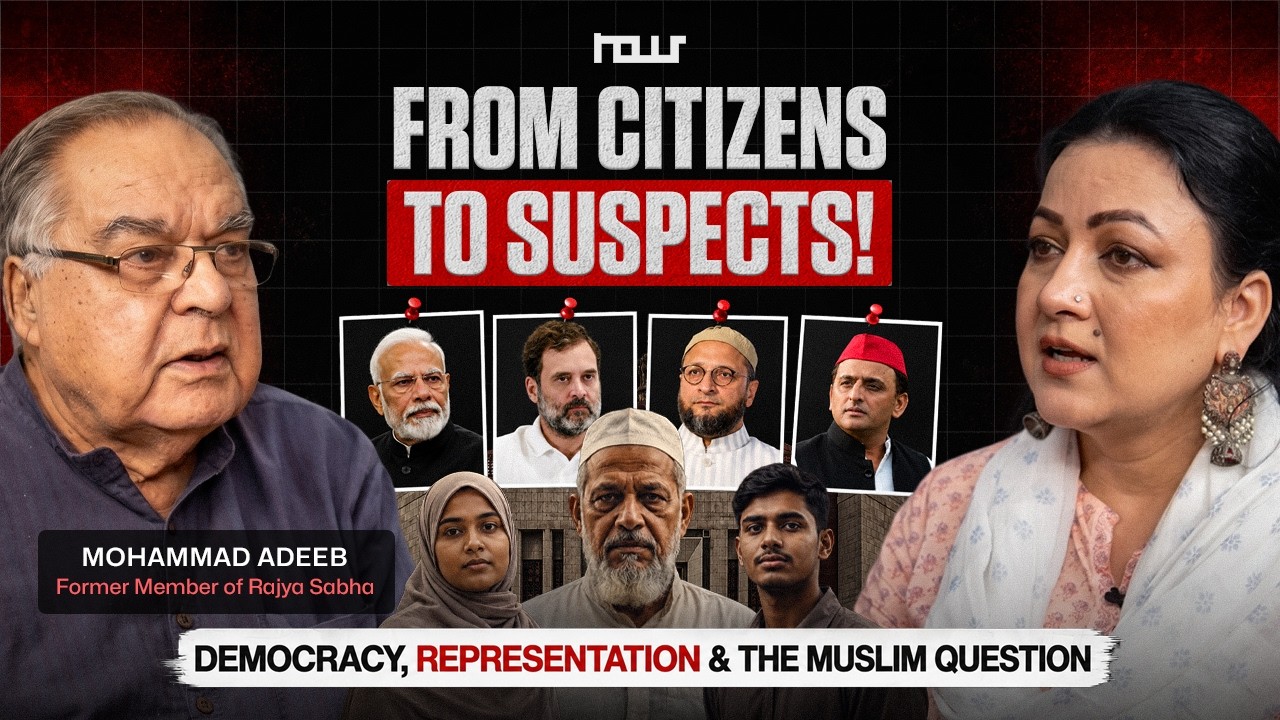
Mohammad Adeeb has spent more than half a century inside the machinery of Indian politics without ever fully belonging to a party. A former president of the Aligarh Muslim University students' union, he was elected to the Rajya Sabha as an independent candidate in the early 1990s with the combined backing of the Congress, the Rashtriya Lok Dal and the Samajwadi Party, and he served until 2014. He now heads a small organisation called the ICMR and has repeatedly tried to launch an English-language newspaper. In a conversation with journalist Bushra Khan Fahad, he traced how the country he describes as a shared national project with Hindus, Sikhs and Christians arrived at a point where, in his words, governments are formed by "torturing and oppressing a particular community."
What makes Adeeb's account distinctive is where he places the blame. He does not let the Rashtriya Swayamsevak Sangh and the Bharatiya Janata Party off the hook, but he reserves some of his sharpest criticism for the parties that have long claimed the Muslim vote as their own — the Congress, the Samajwadi Party, the Rashtriya Janata Dal and the Trinamool Congress among them — arguing that their transactional relationship with Muslim voters helped produce the very marginalisation those parties now claim to oppose.
How the JP Movement Fed the Organisation It Was Fighting
Adeeb was a founding participant in Jayaprakash Narayan's movement of the mid-1970s, which he still describes in socialist terms. He recalls warning JP that Jan Sangh activists — the RSS's political wing at the time — had joined the agitation in disproportionate numbers, and JP's reply that the Sangh's cadre discipline made it indispensable to the movement's organisational strength.
The consequence, in Adeeb's telling, arrived later. After the Emergency, when the Janata Party briefly held power and then splintered into the regional formations that produced Lalu Prasad Yadav, Mulayam Singh Yadav, Nitish Kumar and others, he says Hemwati Nandan Bahuguna — the former Uttar Pradesh chief minister who had sheltered him from arrest during the Emergency — told him directly that the anti-Congress agitation had been a mistake: it had let RSS members, who had until then hidden their organisational identity, "become deeply entrenched." When the Janata Party, the Jan Sangh and the Left united behind V.P. Singh's government, Adeeb argues, the RSS gained a legitimacy it had not achieved in two centuries, even as the socialist parties that emerged from the same movement went on to weaken Congress without displacing Hindu nationalist politics. He credits only Lalu Prasad Yadav, among the movement's major figures, with refusing later to compromise with the Sangh; he is far more scathing about George Fernandes, whom he accuses of staying silent through the 2002 Gujarat violence while serving in the Vajpayee government.
Partition's Unfinished Argument
Much of the conversation returns to a dispute that Adeeb frames as still unresolved: the argument between Muhammad Ali Jinnah and Maulana Abul Kalam Azad over Partition. Adeeb argues that Jinnah offered Muslims a slogan without a plan — he says Jinnah's own first speech in Lahore, Pakistan described the new country as secular, which for Adeeb makes the logic of a religious partition incoherent from the outset. Azad, by contrast, warned that dividing the subcontinent would not divide communities so much as trap the Muslims who remained behind under permanent majoritarian pressure — a warning Adeeb says was ignored and that Indian Muslims are still paying for.
He locates his own political identity in that unresolved argument. Growing up in the 1950s, he recalls classmates asking him why he had not left for the new country across the border, a question he could not answer as a child and that he says has never really stopped being asked. His reply to Hindu nationalists making the same suggestion today is that Muslims did not simply choose to stay: independent India was built on Jawaharlal Nehru's 1952 election mandate for a secular republic under the Constitution B.R. Ambedkar had drafted, and it is that constitutional bargain, not sentiment, that he says gives Muslims their claim to full citizenship. If the country's rulers now want something else, his challenge is characteristically blunt: hold a referendum on turning India into a Hindu nation and ask Sikhs, Christians, south Indian Hindus and Ravana-worshippers whether they consent.
Tokenism and the Leaders Who Never Grew
Adeeb's central charge against the secular parties is that they converted Muslim political support into a fixed, symbolic quota rather than real power. He points to the pattern by which Muslim representation in government has narrowed over decades into a single, largely ceremonial portfolio — Minority Affairs — occupied, he notes pointedly, by a minister who does not himself observe basic religious practice. He cites the 2013 Muzaffarnagar riots as the sharpest illustration of the pattern: sixty-six Muslim members of the Uttar Pradesh legislative assembly held seats at the time, and in his account not one spoke out publicly against the violence, because none had been given the standing or the courage to do so.
He extends the same critique to Azam Khan, the Samajwadi Party's most prominent Muslim leader for decades, who Adeeb says was once given a helicopter to campaign for the party among Muslim voters but, in the two elections since Narendra Modi's rise to national power, has not even been allotted a bicycle or a place on stage. For Adeeb this reflects a deeper failure: Muslim leaders who reached positions of influence, going back to Maulana Azad, largely failed to cultivate successors, leaving the community without the kind of multi-generational political bench that other groups built. He is careful to describe this as a shared failure — of Muslim leadership as much as of the parties that used and discarded it.
A Double Standard on "Communal" Politics
One of Adeeb's more pointed arguments concerns the language used to describe Muslim political organisation. He asks why a party built around caste — the Bahujan Samaj Party's appeal to Dalits, or the smaller Scheduled Caste and Scheduled Tribe parties that exist across states — is never described as communal, while a party organised by and for Muslims, such as Asaduddin Owaisi's AIMIM, is treated as inherently divisive. He argues that Muslim voters themselves have internalised this double standard: they decline to vote for Owaisi's party not because they reject its politics but because they have concluded it cannot win, leaving them locked into supporting parties that, in Adeeb's phrase, have made them feel like "mental slaves."
He offers the historical counter-example of Dr Abdul Jalil Faridi, the Uttar Pradesh Muslim leader whose party attempted an alliance with Dalit voters in the 1960s but managed only two or three percent of the vote — a coalition Adeeb says the Bahujan Samaj Party's founder, Kanshi Ram, later told him he had tried and failed to revive. Adeeb's conclusion is that the Muslim community has largely forgotten this history, and with it the possibility of building independent political leverage through alliances with other marginalised groups rather than dependence on Congress or the regional parties.
The Case for Sitting Out an Election
Adeeb's most provocative proposal is that Muslims should collectively withdraw from voting in an upcoming election — not permanently, but as a demonstration of leverage. His reasoning is that Muslims function as what he calls "catalysts": their votes decide close contests in states like Uttar Pradesh and Bihar, yet the parties that depend on those votes take them for granted between elections. He argues that a deliberate boycott would force parties such as the Samajwadi Party and the Rashtriya Janata Dal to negotiate real power-sharing rather than simply assuming Muslim support out of fear of the BJP.
He connects this to what he describes as an ongoing assault on the electoral process itself, referring to the Special Intensive Revision of voter rolls as a mechanism aimed at removing names, including those of long-settled citizens, under the pretext of catching undocumented immigrants. He is also unsparing about the Congress party's current approach, arguing that Rahul Gandhi's rhetoric — including his Bharat Jodo Yatra and his direct criticism of the RSS — has not translated into the kind of sustained, district-level mobilisation Adeeb says the moment demands. He singles out Digvijay Singh's mixed messaging around a yatra to Ayodhya, and the party's habit of citing Rajiv Gandhi's decision to open the locks of the Babri Masjid site as a defensive talking point, as evidence of a Congress still uncertain of its own position.
Hindutva as a New Religion, and a Judiciary Gone Quiet
Adeeb argues that the RSS's decades-long project achieved two things simultaneously: it instilled what he calls an inferiority complex in India's roughly twenty percent religious-minority population relative to the Hindu majority, and it manufactured a homogenised, majoritarian "Hindutva" identity that he insists is distinct from — and newer than — the plural Sanatan Dharma tradition he says actually accommodates multiple deities and interpretations. He points to displays such as sword-brandishing processions on mosque rooftops during Navratri as evidence that this newer identity has little to do with classical Hindu religious authority, which he says would more properly be represented by the Shankaracharyas.
He is equally critical of the judiciary, arguing that courts have failed in their constitutional duty to check this trend, citing controversial remarks by judges who framed rulings on contested religious sites in terms of divine guidance rather than law. For Adeeb, the erosion runs from the street — lynchings that draw no political response — to the demolition of mosques under administrative pretexts, to a Parliament where, he says, opposition MPs are now routinely suspended in blocs of a hundred at a time when they attempt to speak.
A North-South Divide Rooted in Education
Adeeb draws a sharp distinction between Muslims in south India and those in the Hindi-speaking north, arguing the two communities have had fundamentally different post-independence trajectories. He cites Tamil Nadu, where Muslims make up roughly four percent of the population but hold close to ten percent of government jobs, as evidence that a community without the trauma of Partition and its aftermath fares markedly better. North Indian Muslims, by contrast, he says have lived in a defensive crouch since 1947, a psychological legacy he traces to his own childhood experience of being asked why he had not emigrated.
He locates part of the explanation in education. Sir Syed Ahmad Khan's reform movement, which began with an English school in Ghazipur in the 1860s and led to the founding of Aligarh Muslim University, once produced a network of modern Islamia schools across nearly every district of Uttar Pradesh and Bihar. Adeeb says that network fell into disrepair after 1947 and has never been rebuilt to a standard comparable with the convent and missionary schools that now educate the community's own elite, including, he notes, his own family.
Big Rallies for Some Causes, Silence for Others
Adeeb is candid about his disappointment with Muslim religious and community organisations, including the Muslim Personal Law Board, of which he has long been a member. He observes that issues such as the Waqf law or the hijab have drawn mass gatherings of hundreds of thousands, while lynchings, demolitions and the erosion of voting rights generate no comparable mobilisation. In response, he says he has been organising a smaller platform of retired judges, retired military officers, professors and lawyers, and that around 150 people were due to convene later in the month to decide on a collective course of action, since he believes the era of single charismatic leaders — figures on the scale of Maulana Azad or the Ali brothers of the Khilafat movement — is over and only collective leadership can now respond to organised hostility.
Iran, Kashmir, and a Refusal to Be Frightened
Toward the end of the conversation, Adeeb points to Iran's endurance under decades of international sanctions and isolation as a model of strategic resilience he believes Muslim communities elsewhere have failed to study, while acknowledging that Iran's circumstances as an Islamic state differ sharply from India's constitutional secularism. He also breaks a silence he says has settled over the community regarding Kashmir, arguing that Indian Muslims outside the region avoided speaking up after the 2019 revocation of Article 370 for fear of being branded separatists, even as the promised restoration of statehood has not materialised.
He closes by turning to his own example. He says he has faced an FIR over his public statements and has taken disputes to the Supreme Court, and that he tells his own family, who worry about his age and health, that he will not be silenced by figures as powerful as Amit Shah, Yogi Adityanath or Narendra Modi. His message to the wider community is unadorned: those who have done nothing wrong have nothing to fear, and prayer and ritual observance, in his reading of Islamic obligation, are not a substitute for the duty to speak against oppression.


Discussion
0Readers only · Comments are reviewed by the desk before they appear
The journalism is free for everyone — create a free account to join the discussion.