

How Delimitation Shrinks India's Muslim Vote
An analysis of Lok Sabha and assembly constituency boundaries shows how India's delimitation process, combined with reservation policy and geography, keeps Muslim political representation far below the community's share of the population.
Contents · 7 sections
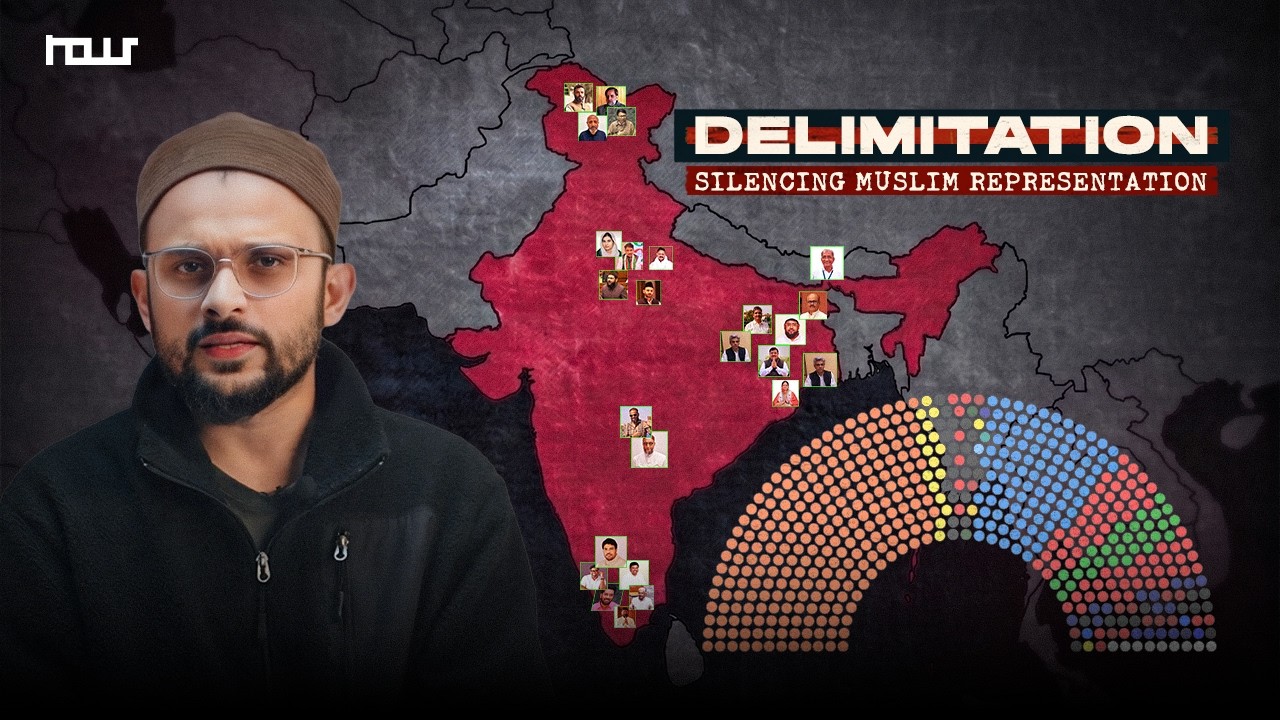
A Vote Share That Never Matches the Population
India's Lok Sabha has 543 seats, and by the count offered in this analysis, only 24 of them are held by Muslim MPs. That works out to 4.4 percent of the chamber, against a Muslim share of the population estimated at 14.2 percent. The gap widens further up the chain: the Union Council of Ministers, the executive body that runs the government, currently has no Muslim member at all.
The shortfall traces back to the ticket stage. In the 2024 general election, the analysis notes, the ruling BJP-led NDA alliance fielded just two Muslim candidates out of a Muslim population of roughly 170 million. The opposition INDIA bloc, a coalition of 28 parties that campaigned on the slogan "jitni aabadi utna haq" (rights in proportion to population), fielded only 78 Muslim candidates nationwide, many of them in states where Muslims form a sizeable share of the electorate.
This is not a one-off. Since the first general election in 1952, Muslim representation in the Lok Sabha has consistently trailed the community's population share. The only exceptions came in 1980 and 1984, when Muslim MPs briefly reached 9 percent and 8 percent respectively, as the Congress party expanded ticket-giving to new social groups after the Emergency. The bump did not last, and the pattern of underrepresentation has held in state assembly elections too.
The Mechanics Behind the Deficit
The analysis lays out several structural reasons for the gap. Parties, it argues, often hesitate to field Muslim candidates out of concern that doing so will alienate non-Muslim voters. Where multiple Muslim candidates do contest the same seat, their votes tend to split, a dynamic the analysis says was visible in Uttar Pradesh and Bihar in the 2014 Lok Sabha election.
India's first-past-the-post system compounds the problem, since a candidate can win with a plurality far short of an outright majority, leaving minorities of every kind under-rewarded for their votes. Reservation of seats for Scheduled Castes and Scheduled Tribes adds another constraint: constituencies with a large Muslim population are sometimes reserved for SC or ST candidates, closing off the seat to Muslim contestants regardless of local numbers.
The most decisive factor, the analysis suggests, is geography. Muslims are spread thinly enough across most constituencies that they rarely form a decisive bloc. Roughly 60 districts in India have a Muslim population above 30 percent, but when district boundaries are translated onto the parliamentary map, only about 40 constituencies retain that 30-percent threshold — and of those, eight are reserved for SC or ST candidates, leaving just 32 seats where Muslim voters could plausibly be decisive. One line from the analysis, drawing on survey data from the Centre for the Study of Developing Societies, put it starkly: Muslims, it said, "never were, and never will be, a vote bank."
Who Draws the Lines, and How
Constituency boundaries in India are not drawn by geography alone. Assembly constituencies are built from clusters of smaller administrative units, and parliamentary constituencies are in turn built from whole assembly constituencies — an assembly seat can never be split across two Lok Sabha seats. The body responsible for setting these boundaries is the Delimitation Commission, which operates at both the national and state level under Article 82 of the Constitution, following each decennial census.
The Commission is meant to weigh contiguity, ease of communication, and linguistic and cultural homogeneity when deciding constituency limits, and it also determines which seats are reserved for SC and ST candidates. Delimitation exercises took place in 1952 (494 seats), 1962 (522), 1972 (543) and again in 2002 — the last of which held the total number of seats fixed, so that northern states with faster population growth, such as Uttar Pradesh, Bihar, Madhya Pradesh and Rajasthan, would not gain additional seats at other states' expense. That 2002 exercise had earlier been postponed altogether, from 1977 to 2001, after states such as Andhra Pradesh and Tamil Nadu worried that their success in controlling population growth would cost them seats.
Cracking, Stacking and Packing
The analysis argues that delimitation can be used to blunt the electoral weight of Muslim-majority areas through gerrymandering, the practice — named for Massachusetts governor Elbridge Gerry, who redrew district lines to his own advantage in the early 1800s — of drawing boundaries to favour one group over another. It identifies three techniques at work: cracking, which splits a Muslim-majority area across several constituencies so its votes never accumulate; stacking, which folds the leftover pieces of a cracked area into constituencies where Muslims are already a minority or already a majority, diluting their influence either way; and packing, which concentrates Muslim voters into the fewest possible seats so that a bloc large enough for two seats yields only one.
Bihar's Purnia and Kishanganj districts offer one example. Purnia is about 38 percent Muslim and Kishanganj about 68 percent; blocks such as Amour and Baisi, where Muslims exceed 60 percent, have been folded into Kishanganj, pulling Purnia's Muslim share down to roughly 23 percent. In Uttar Pradesh, Bareilly district — over a third Muslim overall — is split across the Aonla, Pilibhit and Bareilly seats, none of which exceeds 30 percent Muslim population, because high-Muslim blocks within the district have each been paired with lower-Muslim ones. Similar patterns recur in Balrampur and Shravasti, and in Bahraich and Kaisarganj, where roughly 60 percent of Kaisarganj's population is drawn from lower-Muslim Gonda district, leaving the seat about 25 percent Muslim.
West Bengal and Assam show the same shape. Uttar Dinajpur district in West Bengal is roughly half Muslim, but it is split across the Raiganj, Darjeeling and Balurghat seats, reducing the Muslim share in each to 14.4, 29.5 and 41.7 percent respectively — all three currently held by BJP MPs. In Assam, where Muslims are about 34 percent of the population but hold only one of the state's 14 Lok Sabha seats, the Guwahati constituency combines Muslim-majority assembly segments from Nalbari and Kamrup with the much larger, largely non-Muslim Kamrup Metropolitan district, pulling the seat's Muslim share down to 26.9 percent; the neighbouring Mangaldoi seat shows a comparable dilution, down to 32.8 percent.
Reservation and 'Affirmative Gerrymandering'
A second pattern the analysis flags involves what some scholars call affirmative gerrymandering — the practice of drawing SC- or ST-reserved seats around areas with substantial Muslim populations. Seats are reserved chiefly by the size of the local SC or ST population, but SC reservations carry an additional requirement of geographic dispersal, intended to ensure SC communities are represented even outside their areas of concentration. That same dispersal rule, the analysis argues, gives the Delimitation Commission latitude to place reserved status in ways that also happen to remove Muslim-majority seats from contention.
Nagina in Uttar Pradesh, at 43 percent Muslim and 21 percent SC, is reserved for SC candidates; Bahraich, 33 percent Muslim and 15 percent SC, is reserved too. In Jharkhand, Rajmahal — 33 percent Muslim, 29 percent SC — is reserved for STs. In West Bengal's South 24 Parganas district, Jainagar, at 36 percent Muslim and 30 percent SC, is SC-reserved, while nearby Bolpur, roughly 30 percent Muslim and 31 percent SC, is reserved as well. Assam's Karimganj, over 50 percent Muslim, was SC-reserved until last year. The analysis is careful to note that reservation itself is not the injustice — plenty of unreserved seats, including Azamgarh, Dhaurahra, Mirzapur, Unnao and Bankura, also carry large SC populations without being reserved. The concern is with how the Commission's discretion is exercised, not with reservation as a principle.
Assam and Jammu & Kashmir's 2023 Redraw
The most recent delimitation exercises, carried out in Assam and Jammu and Kashmir in 2023, have drawn accusations of bias. In Assam, the number of reserved seats rose from 24 to 28, Karimganj lost its reserved status, and the Barpeta constituency was reconstituted so that its Muslim-majority villages — despite being geographically distant — were folded into Dhubri, turning Barpeta itself into a Muslim-minority seat. Critics, the analysis notes, have accused the Election Commission of drawing lines along a Muslim-versus-non-Muslim and Bengali-versus-non-Bengali axis.
In Jammu and Kashmir, the Anantnag constituency was redrawn to include the Muslim-majority districts of Rajouri and Poonch, previously part of the Jammu seat. As a result, the Jammu constituency's Hindu population rose from 61 to 84 percent while its Muslim population fell from 32 to 7 percent; Anantnag, meanwhile, now stretches across more than 100 kilometres, with a population well above the national average and local grievances over terrain and culture left unaddressed. The net effect, the analysis argues, is to consolidate non-Muslim votes in some seats while diluting Muslim influence in others, along religious and ethnic lines.
What Comes Next
The stakes extend beyond the present map. Development economist Jean Drèze has suggested that the delay in conducting the 2021 census may itself be strategic, allowing the government to time a fresh delimitation exercise — legally due after the next census — to its own advantage, potentially by holding the census in 2026 while still in power. Because population growth is expected to be concentrated in the Hindi heartland of northern India, any resulting reallocation of seats could favour the BJP, though the analysis stops short of naming a single, certain beneficiary: Muslim vote consolidation or splintering could just as easily help secular parties, new entrants or independent candidates, and Muslim voting patterns interact with non-Muslim voting behaviour in ways that complicate any simple prediction.
What is less ambiguous is the outcome so far. Of the 24 Muslim MPs in the current, 18th Lok Sabha — fewer than 5 percent of the House — only three represent constituencies where Muslims are below 15 percent of the population; the other 21 come from constituencies that are roughly 30 percent Muslim or more, and at least 15 of those are majority-Muslim seats. Yet there are some 32 unreserved constituencies nationwide where Muslim voters exceed 30 percent of the electorate — meaning that even where the demographic potential exists, it converts into effective representation in barely two-thirds of those seats. The consequence, the analysis concludes, is not only a headcount problem but a deeper political marginalisation: when a community's electoral leverage is this constrained, its concerns are more easily left out of party manifestos and parliamentary debate altogether.


Discussion
0Readers only · Comments are reviewed by the desk before they appear
The journalism is free for everyone — create a free account to join the discussion.