

Inside the Machine That Turns Local Disputes Into Anti-Muslim Violence
A water-balloon fight that killed a young man in a West Delhi slum became the latest run of a century-old system for converting ordinary friction into communal expulsion, one built on a colonial census, a prison manifesto, and a franchise of street organizations that no longer needs anyone to give the order.
Contents · 7 sections
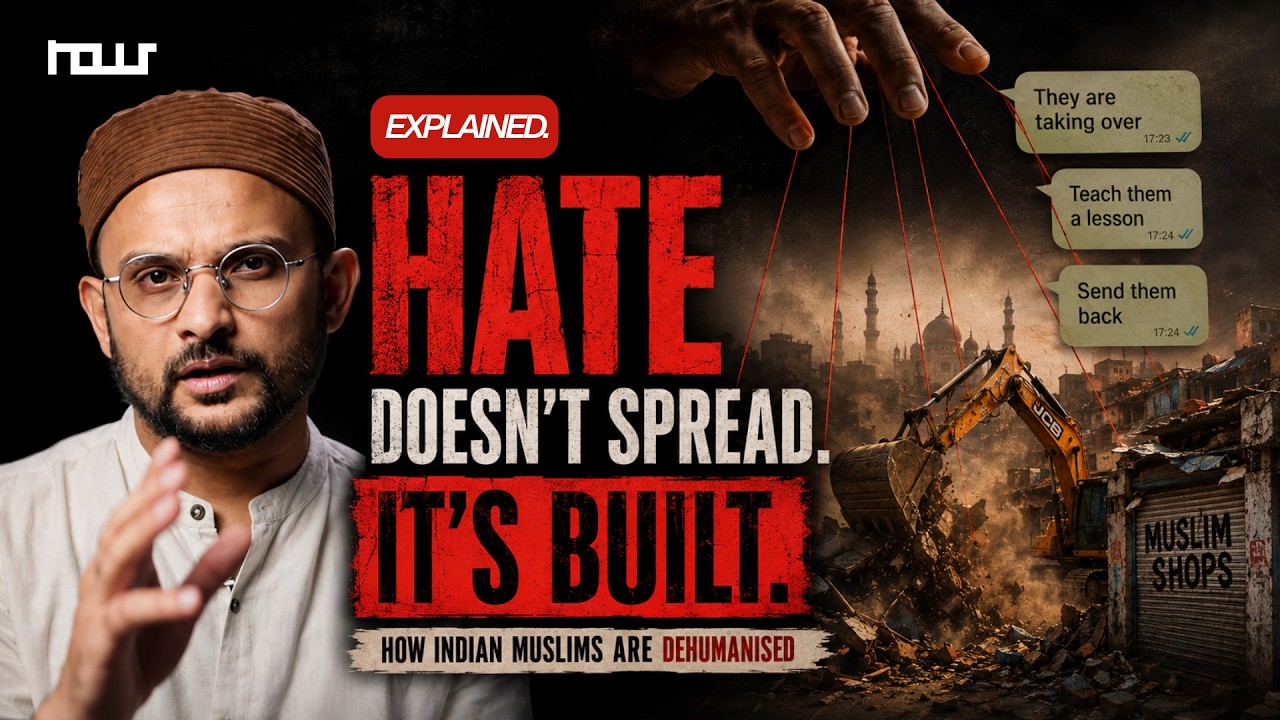
A Water Balloon, a Death, and Five Accounts
On Holi in early March, in a lane in the Hastsal colony of West Delhi, a water balloon thrown from a terrace struck a Muslim woman below. By the next morning a 26-year-old man named Tarun Kumar was dead, killed in the brawl that followed. Within days 14 people from the neighbourhood's Muslim community had been arrested, part of an accused's home had been demolished without a court order, and 70 shops had had their fronts bulldozed in what authorities called an anti-encroachment drive. Within a week, Muslim families who had lived in the colony for fifty years were packing up and leaving.
What actually happened that night is still disputed. Tarun's family says a child accidentally dropped the balloon, the woman it hit gathered a mob, and Tarun was beaten to death when he arrived at the scene. A relative of the accused named Shaheen gives a different account: that the balloon was thrown by an adult, that drunk young men had been harassing her aunt, and that the blow which killed Tarun came not from her family but from one of his own companions in the chaos. Police and long-time residents describe it as an ordinary dispute between two families who had coexisted for decades. Right-wing Hindu organisations called it a targeted, retributive attack. Civil rights groups called it a neighbourhood brawl deliberately communalised by outside political actors. The criminal investigation is still ongoing — and that, this account argues, is the point. Nothing that followed the killing depended on anyone establishing the truth. What the system that took over that week needed was not clarity. It needed only a violent dispute and a cross-community incident to attach itself to.
Manufacturing an Ancient Enmity
Jhuggi-jhopri colonies like Hastsal are informal settlements housing tens of millions of Delhi's working poor around shared water taps and courtyards, where resource scarcity makes conflict constant — not usually religious conflict, just conflict between neighbours. What turns an ordinary fight into a civilisational one is a frame that was built, deliberately, about a century ago.
The idea that Hindus and Muslims are ancient, irreconcilable enemies is not itself ancient. It emerged after the British began counting Indians by religion in the late 1800s and tying political representation to those counts, making a community's headcount a measure of its power for the first time. A newly countable Muslim population, alongside a Hindu elite advantaged by colonial institutions, made religion and economic precarity fuse into a single political category — a combination that fed riots over disputes as small as a cow slaughtered near a temple.
That template found its clearest articulation in 1922, when Vinayak Damodar Savarkar, writing from a British prison, argued that a true Indian must hold India as both fatherland and holy land — which made Hindus, Sikhs, Jains and Buddhists native but rendered Muslims and Christians, whose holy sites lie elsewhere, permanent guests. He paired that exclusion with a claim of injury: that Hindu civilisation had been invaded, humiliated and dispossessed under centuries of Muslim rule. Historians who have examined that narrative describe medieval India's record as one of accommodation as much as conflict, with many rulers patronising temples and employing Hindu administrators — a mixed history selectively read for political use. But a victimhood narrative does not need to be accurate. It needs to be felt, and it turns exclusion into restoration and aggression into justice.
From Ideology to Organisation
That ideology needed a vehicle, and the Rashtriya Swayamsevak Sangh, founded in 1925, became it. Its longest-serving chief, M.S. Golwalkar, ran the organisation for three decades and turned it from a fringe group into a movement with over a million members and a network of affiliates known as the Sangh Parivar. Golwalkar wrote that minorities had two choices — full absorption into Hindu culture or life at the majority's mercy — and pointed to Nazi Germany's treatment of Jews as, in his words, a lesson worth learning. That was not rhetorical flourish; it was an operational template.
The Sangh Parivar functions less like a chain of command than a franchise: the RSS builds ideology and trains cadre, the BJP converts it into electoral power, and street-level units like the VHP and Bajrang Dal are the ones who show up in neighbourhoods after incidents like the one in Hastsal. Nobody needs to call headquarters. The ideology itself is the instruction set, which is what makes the pattern so difficult to interrupt.
The Institutional Riot System
The political scientist Paul Brass spent decades studying communal violence in northern India and concluded that large-scale riots are not spontaneous outbursts but produced events, run through what he called an institutional riot system. Informants alert political actors when a sensitive incident occurs; propagandists reframe it; local media report the frame as news; posters and rumour carry it further; and recruiters assemble crowds to wait for a signal. Two roles matter most: a 'fire tender' who keeps grievances warm between incidents so animosities never fully cool, and a 'conversion specialist' who takes a local dispute and reframes it as a communal attack demanding response.
What Brass could not fully anticipate in the 1990s is the speed digital media adds to that machinery. A reframed narrative now travels by WhatsApp to local, city and national groups within minutes, is picked up by local cable news within hours, and is amplified nationally by nightfall — long before a journalist can publish a correction reaching a fraction of that audience. The method, step by step: find a fracture, assign it a communal frame from a pre-loaded vocabulary, mobilise outside actors within hours, and amplify before contradiction is possible.
A State That Responds on One Side
The riot system's most dangerous stage is what follows: the state acting asymmetrically. In Hastsal, fourteen arrests of Muslim residents were unremarkable given an actual death under investigation. But a mob was then allowed to enter an accused's home chanting slogans, unchallenged by the police present, before bulldozers arrived — a portion of that home demolished on March 8th with no court order, and seventy shops sealed and demolished on March 14th, also without conviction or trial.
Demolition as extrajudicial punishment was pioneered publicly, with television cameras invited, by Uttar Pradesh's chief minister Yogi Adityanath, and has since been replicated across BJP-governed states as a political symbol — the state as avenger before any court has spoken. The government's underlying legal argument, that these are illegal structures on public land, is not baseless: jhuggi-jhopri colonies exist in a state of tolerated illegality that authorities exploit whenever the land beneath them becomes valuable, and researchers have long documented that such demolitions fall disproportionately on Muslim, Dalit and lower-caste settlements even without a triggering riot. What has changed is not the discrimination but its timing and openness — enforcement arriving within 96 hours of a public demand, specifically against Muslim structures, after India's Supreme Court had ruled in 2024 that demolitions require notice, a hearing and a written order. The shops targeted were the economic spine of the colony's Muslim section; clearing them served a political and material interest at once, sending an unmistakable message that residence there is conditional and revocable.
A newer layer of law extends the same logic. Gujarat's Disturbed Areas Act restricts property sales in designated neighbourhoods in ways that entrench segregation, trapping communities that cannot sell out of a mixed area and excluding them from buying into a new one. The Citizenship Amendment Act goes further, encoding religious discrimination into citizenship law for the first time in the republic's history. None of this requires amending the constitution. It requires only that constitutional guarantees be reread until their secular commitments mean something else.
Why the Neighbours Leave
The system's final step needs no order from anyone. After the arrests, demolitions and unpunished rally speeches in Hastsal, Muslim families calculated that the cost of staying now exceeded the cost of leaving, and left — not because they were expelled, but because they read the situation correctly. If violence recurs at the next festival, the same machinery repeats; if it passes quietly, a rival current inside the movement argues the state was not Hindu enough and pushes further. Either outcome moves public opinion the same direction, which is why Hastsal is one instance of a recurring template rather than an aberration: a mundane disputed incident, outside actors within 24 to 48 hours, a shift from personal to civilisational language, arrests concentrated on Muslims while Hindu perpetrators largely go uncharged, demolition or displacement, and unpunished incitement, followed over months by a demographic shift.
That template is visible at scale in the 2002 Gujarat violence, in which over a thousand Muslims were killed and tens of thousands displaced with documented state involvement, and whose chief minister at the time, Narendra Modi, became prime minister in 2014; and in the 2020 Delhi riots that killed 53 people, most of them Muslim, after BJP leader Kapil Mishra issued open threats hours before violence began. The friction the system exploits is often genuine — the scarcity in Hastsal, the six decades of disputes between two families, the real grief of Tarun Kumar's relatives — and the system's power lies in redirecting that anger rather than inventing it, attaching it to a story residents have already absorbed from their WhatsApp groups and YouTube feeds long before any single incident occurs.
A Pattern With Global Company
The claim that a demographic threat justifies exclusion is empirically false in India — Muslim and Hindu population growth rates have nearly converged, with no evidence of an organised conversion campaign — but it borrows a structure common to ethnonationalist movements elsewhere, from the 'great replacement' theory associated with the European and American far right to the logic that let Nazi Germany's persecution of Jews serve as an admired model for Golwalkar. Precarious residents in a colony like Hastsal are offered a story that turns their unresolved grievances — unreliable water, competition for scarce government jobs, an economy that has left them behind — into chapters of civilisational restoration rather than symptoms of political neglect, a story capable of absorbing Dalit anger, which shares the same economic tier as Muslim neighbours, and redirecting it outward rather than upward against caste hierarchy.
The comparison to twentieth-century Europe is not a claim that India in 2026 is Germany in 1938: constitutional protections persist, courts intervene, and civil society still functions. But the structural elements recur — a scapegoated minority cast as a civilisational threat, legal mechanisms operating alongside extralegal violence, and the gradual normalisation of acts that were once shocking. Those parallels sharpened this year when Narendra Modi made his second visit to Israel, addressed the Knesset, visited the Yad Vashem Holocaust memorial, and declared unconditional solidarity with Israel while saying nothing about Gaza, days before joint US-Israeli strikes on Iran; India has since become Israel's largest arms buyer. The affinity is not incidental — as one observer of the movement put it, a chosen-people theology sits comfortably alongside a caste system built on the same premise. A movement founded on the claim of Hindu civilisational injury has, in embracing that alliance, aligned itself with a state whose conduct a war-crimes body has found meets the threshold for genocide — a reminder, this account argues, that historical victimhood does not inoculate a people, or a movement invoking their history, against becoming a perpetrator in turn.


Discussion
0Readers only · Comments are reviewed by the desk before they appear
The journalism is free for everyone — create a free account to join the discussion.