

Iran's Ten Conditions: Inside the Ceasefire That Ended the 40-Day War
War historian Amrish Mishra tells Aadab News Network how Tehran's terms, Pakistan's mediation and a failed American gambit to seize enriched uranium reshaped the Middle East in forty days.
Contents · 6 sections
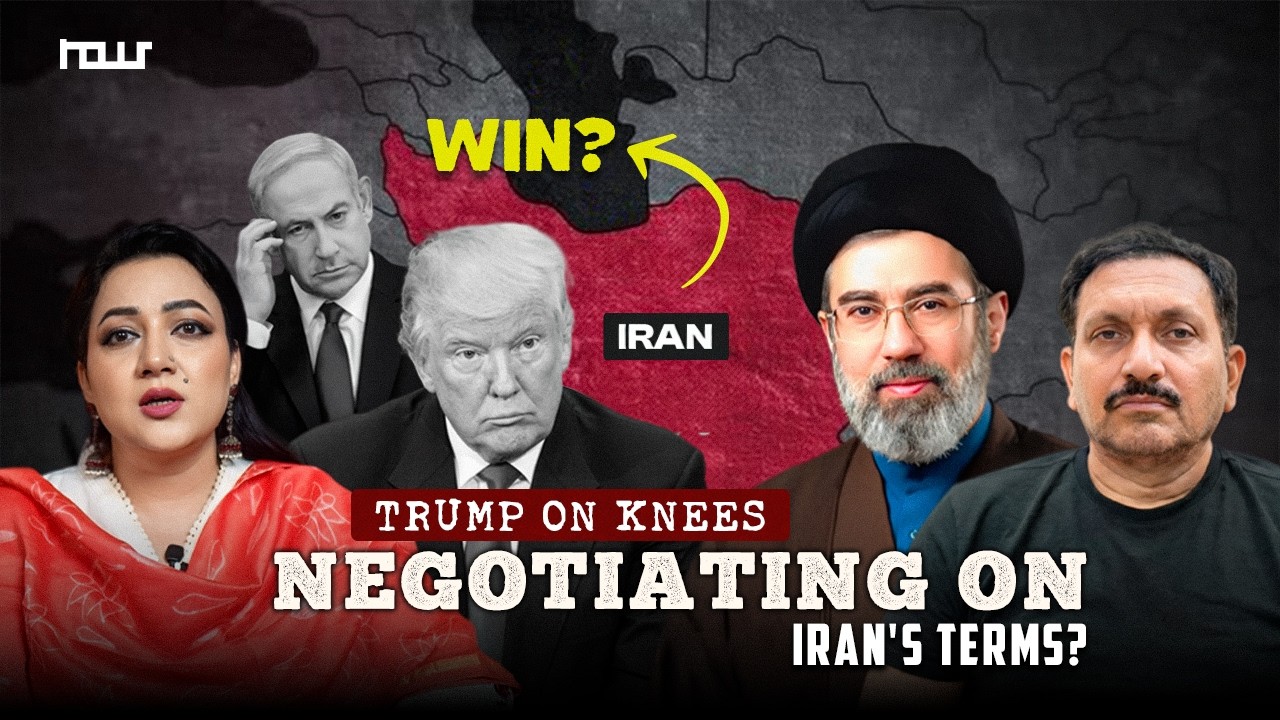
When Iran, Israel and the United States traded fire for forty days this year, most capitals had braced for the war to widen further, not end abruptly. Instead, on the morning a fresh American strike on Iran's power infrastructure was widely expected, news broke instead of a ceasefire — a two-week truce struck, notably, on terms Tehran itself had set. War historian and defence-affairs commentator Amrish Mishra, speaking to Aadab News Network host Bushra Khan Fahad, argued that the shape of that truce amounted to one of the more consequential diplomatic reversals of the year, one that reordered assumptions about American power in the Middle East and left India's regional standing looking diminished by comparison.
Ten conditions, and an American climbdown
According to Mishra, the ceasefire rests on ten conditions that Iran placed before Washington — terms he said Donald Trump effectively accepted and posted about on social media. As read out in the conversation, they include a US commitment not to strike Iran again; continued Iranian control over the Strait of Hormuz; permission for Iran to keep enriching uranium; the removal of both primary and secondary sanctions; the withdrawal of related United Nations Security Council resolutions and International Atomic Energy Agency Board of Governors proposals; compensation to Iran for war damage; the withdrawal of American forces from the region; and a ceasefire extending to every front, including Hezbollah's confrontation with Israel in Lebanon.
Mishra framed the fact that Washington entertained these terms at all as remarkable, given Iran has lived under sanctions for decades and had, in his telling, its top military leadership targeted during the war. “This is the biggest surrender the world has seen,” he said, adding that in an earlier century such an outcome would have meant a formal capitulation; in the present era of hybrid warfare, it instead takes the form of a negotiated statement. He pointed in particular to Trump's own language on the Strait of Hormuz — that its future control would be discussed — as notably short of the earlier US position that the strait would not remain in Iranian hands.
A war fought with assassinations and a war fought back
Much of the conversation turned on why, in Mishra's reading, Israel ended up “out of the equation” despite an assassination campaign he said had killed more than a hundred Iranian military commanders, IRGC officials and politicians. The premise behind those killings, he said, relayed to Trump by Israeli Prime Minister Benjamin Netanyahu, was that removing figures such as Ali Larijani would trigger the kind of unrest last seen in Iran in January and topple the regime. Instead, Mishra argued, government-supporting crowds — not protesters — filled the streets, including gathering outside power plants that Washington had reportedly threatened to bomb, with musicians performing to the assembled crowds. He cited a mobilisation campaign in which some 14 million people registered within hours to pledge themselves in defence of the country.
Mishra described this as a hybrid war in a fuller sense than the term usually carries: missile exchanges running alongside civil mobilisation, a psychological and narrative contest, and diplomacy continuing in parallel with combat — a combination he said had no real precedent in a major twentieth-century war. He pointed to Trump's press-conference claim that 155 aircraft had been deployed to rescue a single downed pilot as a boast that, in his view, was read by many as evidence of failure rather than strength, tied to what he described as a failed American attempt to retrieve Iran's enriched uranium stock. Seizing that material by special forces, he argued, was not realistic without a ground invasion on the scale of three to four hundred thousand troops — an option he said Washington was not prepared to take, given weak domestic support for the war among the American public, including within the Republican base.
The economics of a forty-day war
Mishra put the daily cost of the war to the United States and Israel at roughly a billion dollars, against what he estimated at a tenth of that for Iran, which he said fought a comparatively low-cost campaign built around domestically produced drones and missiles. He also pointed to Iran's finances being cushioned by the roughly 178 million barrels of oil Trump allowed to be released onto the market during the war, which Mishra estimated brought Iran close to fourteen billion dollars, on top of tolls Iran had already begun charging on Hormuz shipping traffic — funds he said effectively covered its war expenses.
On the mechanics of the strait itself, Mishra said the emerging arrangement involves Oman and Iran jointly administering Hormuz and sharing toll revenue from ships passing through, with US involvement excluded and China and Russia positioned in the background. He linked this to a broader claim he has been making for several days: that Iran, China and Russia would use their position on the strait to challenge dollar-denominated oil payments, in favour of a basket of currencies including the yuan, the rouble and the rupee — an idea he associated with a framework Vladimir Putin has floated for BRICS nations.
Two choke points and sixty percent of world trade
A recurring theme was Iran's leverage over global shipping lanes. Mishra noted that closing the Strait of Hormuz alone affects roughly a fifth of world trade, and that Iran had signalled it would also close the Bab-el-Mandeb strait — under Yemeni control — if the United States struck Iranian infrastructure directly. Together, he said, closure of both chokepoints could affect some 60 percent of global trade, cutting off European goods from Asian markets entirely. He described this as Iran running a trade war alongside its military one, using allied forces as a bargaining chip against Washington.
What two weeks might become
Asked whether the truce would hold beyond its stated two weeks, Mishra said he expected the timeline to keep extending rather than collapse back into the intensity of the war's earlier weeks, since renewed fighting on the previous scale would require a ground offensive the US is not ready to mount. He suggested the pause itself functions as leverage on Israel — keeping it “desperate” and easier to pressure into concessions in Lebanon and Gaza — while cautioning that talks alone will not prevent military manoeuvres, localised skirmishes, or instability in Gulf states during the interim. He pointed to an incident in which a US missile fired from Kuwait struck Basra in Iraq and killed civilians, prompting crowds to pull down the Kuwaiti flag at its consulate there, as a sign of how exposed Gulf capitals such as Kuwait, Bahrain and the UAE now are; he described Oman, by contrast, as already on comparatively good terms with Tehran.
Mishra also raised the possibility that Israel, which he characterised as internally divided with domestic protests against the war mirrored by similar sentiment in the United States, could still act unilaterally out of what he called desperation — including, he said, the risk of a tactical nuclear strike. He noted Israel's stated refusal to honour a separate ceasefire with Hezbollah in Lebanon, where he said more than a hundred Merkava tanks had been destroyed, and said Hezbollah was now positioned to push Israeli forces out of southern Lebanon if fighting there resumes. On Gaza, he said Hamas has emerged strengthened from the war and has refused Israeli and American calls to disarm.
On the withdrawal of US troops from Gulf bases — one of the ten conditions — Mishra said he expected Washington to accept the principle even if the logistics stretch over months. He framed a reduced American military footprint in the Gulf as symbolically significant, given that regional bases have long underpinned US dominance over Middle Eastern oil markets, and predicted Gulf states long dependent on Washington and Israel would have to recalibrate their relationships with Tehran.
Pakistan's opening, and India's absence
The conversation closed on the ceasefire's diplomatic authorship. Mishra credited Pakistan with emerging as a credible mediator, with further talks expected in Islamabad on April 10, and said Islamabad had scored an unambiguous diplomatic win. He contrasted this with India, arguing that New Delhi had a comparable opening to act as a neutral broker — consistent, he said, with its aspirations to lead the Global South and its place in BRICS — but instead was seen visibly aligned with Israel and the United States through the war, including a visit to Israel on February 26 that he cited as illustrative. He said Iran had not regarded Indian mediation, reportedly floated through contact between Narendra Modi and Trump during the war, as credible, and argued this should prompt a rethink of India's foreign policy posture toward Iran, Russia and China. Host Bushra Khan Fahad closed the discussion by thanking Mishra for his time and analysis as the segment wrapped.


Discussion
0Readers only · Comments are reviewed by the desk before they appear
The journalism is free for everyone — create a free account to join the discussion.