

Is Himanta Biswa Sarma Losing? A Congress Lawyer's Case Against Assam's Chief Minister
Days before Assam voted, human rights lawyer and Congress spokesperson Aman Wadud argued that delimitation, a shrunken NRC exclusion list and unmet promises have left Himanta Biswa Sarma more vulnerable than the hate rhetoric suggests.
Contents · 5 sections

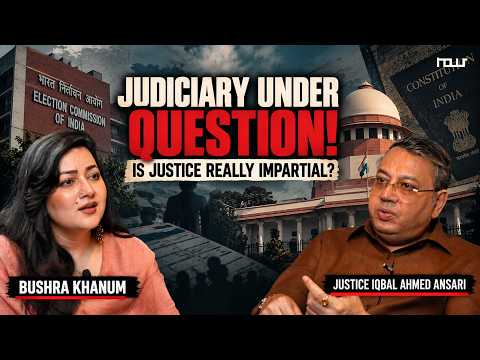
Hours before Assam's polls opened on 9 April, Nous Network's Bushra Khan Fahad put the state of the race to Aman Wadud — a Gauhati High Court lawyer, former Supreme Court practitioner, Fulbright scholar with a law degree from the University of Texas, and now a Congress spokesperson in Assam. Wadud's central claim was blunt: in a free and fair election, he said, Himanta Biswa Sarma would lose. His caveat was equally blunt — he was not confident the election would be free and fair.
"The most corrupt chief minister"
Wadud's opening argument was about money, not religion. He said Congress leader Pawan Khera has alleged the Sarma family holds undisclosed properties worth roughly ₹52,000 crore in Dubai and the United States, and challenged the chief minister to deny it. "Where does the money go, and whose money is it? It's people's money," Wadud said, arguing that even BJP-sympathetic voters privately know Sarma to be Assam's most corrupt chief minister — pointing to broken promises of one lakh jobs a year, of which only about 1.43 lakh materialized across five years, mostly filled vacancies rather than new positions, and a long-unfulfilled pledge of Scheduled Tribe status for six Assamese communities, first promised in 2014 and repeated in 2016 and 2021 without action.
He also raised the death of singer Zubeen Garg as a live governance issue: he said the state's chargesheet in the case is weak, that frozen accounts tied to an accused have since been unfrozen, and that Congress has made delivering justice in the case within 100 days a headline manifesto promise. Sarma, he said, had responded to Khera's corruption allegations by threatening him with a lifetime in an Assam jail rather than answering the substance of the claims.
Delimitation as "communal gerrymandering"
Asked whether communal polarization or governance failures were driving the election, Wadud pointed first to Assam's 2023 delimitation exercise. Muslim-representable constituencies, he said, fell from roughly 31–34 to 21–22 — a loss of about ten seats — even though the total number of assembly seats didn't change. Delimitation is constitutionally the Election Commission's job, he said, but in Assam "everyone will tell you" it was effectively led by Sarma himself, working with a minister, Ashok Singhal, widely understood to be close to him. Wadud used the English term "gerrymandering" directly, comparing the logic — sorting voters by religion into or out of constituencies — to the same communal-bloc thinking he attributed to the historical Muslim League, now, he said, weaponized by the BJP in reverse. "Representation is a constitutional right," he said, calling the redrawn map a violation of the political justice promised in the Constitution's preamble — while adding that he still believed the resulting seat losses would not be decisive if the vote itself were fair.
A shrinking NRC exclusion list
On citizenship, Wadud drew a distinction between Assam's ongoing voter-roll "Special Revision" and the full National Register of Citizens exercise the state completed in August 2019. That NRC — executed by the Sarbananda Sonowal government and monitored by the Supreme Court — excluded roughly 19 lakh people, with a smaller share of Muslims than the BJP had anticipated; the party, he said, had expected 50–70 lakh exclusions, and when that number fell short, began pushing for re-verification instead — evidence, in his reading, of a standing goal to remove Muslims specifically from the citizenship rolls. In the newer Special Revision process, he said, an initial draft excluded around 10 lakh voters; the final list cut that to roughly 2.43 lakh. He argued this makes limited practical difference to the outcome, since Supreme Court orders bar coercive action against those excluded — they keep their voting rights and are not rendered non-citizens — though he acknowledged the process has disproportionately reduced rolls in Muslim-population constituencies.
Eviction, land loss and "the biggest propaganda"
Wadud pushed back hardest on the framing of Muslims as Bangladeshi "infiltrators" subject to eviction from government land. He cited a 2015 figure from the late BJP leader Arun Jaitley, who estimated 30 crore Indians — about 20% of the population — as landless, a number he noted exceeds India's total Muslim population. Landlessness, he said, cuts across religion and caste, but eviction in Assam is selectively enforced against one community. He pointed to river erosion as a structural driver largely absent from the public conversation: by his figures, Assam has lost roughly 8,000 hectares of land a year to the Brahmaputra since 1950 — about 7% of the state's total land mass — displacing families, disproportionately Muslim migrants who originally settled fertile riverbank land from the mid-1800s, onto government land they had nowhere else to go.
He argued this displacement discredits the government's own case: when officials evict a community and then relocate or compensate it — he cited roughly 700–800 families rehabilitated after a court-ordered response to the 2021 Darrang eviction, and evictees in Bhuragaon paid ₹50,000 each simply to relocate — that is proof those families are not, in fact, being treated as Bangladeshi nationals, since "no one is going to pay Bangladesh" to take them. "This bogey of infiltration," he said, "has been the biggest propaganda in India's history," one he said his own reporting and data work over the past decade has been aimed at dismantling. He added a further observation on communal temperature: despite the rhetoric, he said, no Muslim has been killed by a fellow citizen in Upper Assam during this campaign — evidence, in his view, that ordinary Assamese are not absorbing Sarma's messaging the way the BJP's own organized supporters do, and grounds for his repeated insistence that this is not, at bottom, "a polarized election."
"Election Commission and BJP versus the people"
Pressed on whether tweets and press conferences amount to a real fight for Muslims facing daily humiliation, Wadud said Congress has taken concrete legal steps — an FIR after Sarma's "pay four rupees instead of five" remark, another after a video he said was too vulgar to describe in civil language, and a High Court petition by the leader of the opposition that led to the Darrang rehabilitations. But he was candid that the deeper fight is institutional, not just electoral: police, the Enforcement Directorate, the CBI and, he argued, the Election Commission itself no longer function as neutral referees. "The election that's happening is Election Commission and BJP versus the people of India," he said, pointing to Haryana and Maharashtra as recent examples where ground reporting suggested a Congress win before results diverged sharply — outcomes he attributed to an unlevel playing field rather than to voters changing their minds. Even so, he closed by insisting that if the election were genuinely free and fair, Assam's most corrupt chief minister, in his description, would not survive it.
Fahad pressed him on whether that confidence was self-serving for a party spokesperson. Wadud didn't dispute the conflict of interest, but pointed to the scale of the ground operation Congress had mounted — district, block and mandal-level workers he said were outworked only by BJP's money and administrative reach, not by enthusiasm. Where BJP could book venues and dominate television with a war chest Congress could not match, he said, Congress volunteers still turned out meeting after meeting on a fraction of the resources. Whether that commitment would be enough against what he described as a captured institutional playing field was, by his own admission, the one question no one — pollster or party spokesperson — could answer before votes were counted.


Discussion
0Readers only · Comments are reviewed by the desk before they appear
The journalism is free for everyone — create a free account to join the discussion.