

Israel's 'Death Law': Inside the Knesset Bill That Could Send Palestinian Prisoners to the Gallows
A new Knesset law making capital punishment the default sentence for Palestinians accused of "terrorism" has drawn accusations of state-sanctioned killing, arriving as the destruction in Gaza reaches historic scale.
Contents · 4 sections
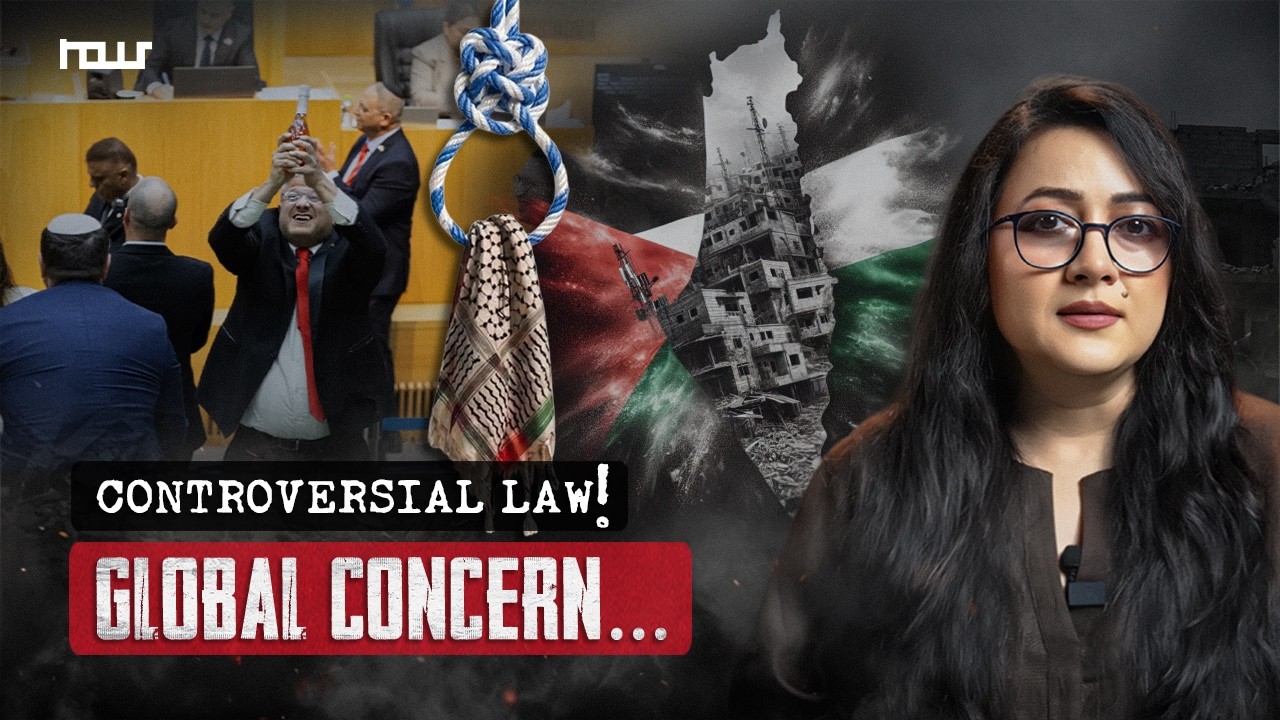
The bill's formal name has already receded behind the label attached to it by critics: the "death law." In this Nous Explainers segment, presenter Bushra Khanum walks through what the legislation actually authorises, who it is likely to be used against, and how its passage fits into a broader pattern she traces back to the war in Gaza that began in October 2023.
A Bill Celebrated With Champagne and a Noose
Israel's parliament, the Knesset, has passed a law that human rights groups and critics abroad are calling nothing less than a licence to kill. Presenting the explainer for Nous, Bushra Khanum describes it as the most extreme step in the country's history, a bill that makes capital punishment available for Palestinians and has already been nicknamed the "death law." The images that accompanied its passage were, in Khanum's telling, as disturbing as the law itself: lawmakers celebrating with champagne and wine, smiling for cameras on the night a bill making it easier to send people to the gallows cleared parliament. Photographs from the chamber showed National Security Minister Itamar Ben-Gvir and allies with mock nooses draped around their necks, not a stray gesture, Khanum argues, but a declaration that any Palestinian could now be branded a terrorist and hanged. Television carried the celebrations live, and Ben-Gvir followed with a comment Khanum calls more frightening than the law itself: hanging, he said, is only one option, "we're also looking at the electric chair and lethal injection." It was not a fringe voice, Khanum stresses; it was a sitting minister's.
Officially, the law is framed as targeting "terrorists" who threaten Israel's existence. In practice, Khanum argues, it is aimed squarely at Palestinians. She poses the pointed question of whether the statute would ever be applied to Jewish settlers who carry out daily violence against Palestinian communities in the occupied territories, and answers it herself: no. With the bill's passage, she says, the death penalty has become close to the default sentence in the occupied West Bank.
Behind Bars: A 96 Percent Conviction Rate
Khanum situates the law against the reality of Israel's prison system. By her account, roughly 10,800 Palestinians are currently held in Israeli jails, including 450 children and 87 women, with thousands detained without charge or trial. Convictions in military courts run at close to 96 percent, a rate she says has long been linked to allegations that verdicts rest on confessions extracted under duress; more recent reporting, she adds, points to execution facilities being readied inside Israeli prisons. Rights organisations, Amnesty International among them, have described the law not merely as legislation but as a mechanism for killing at the level of the state, an open breach, in their reading, of basic human rights, using the law as cover to eliminate Palestinians.
The Gaza Backdrop the Law Doesn't Mention
Khanum insists the law did not emerge from nowhere. She sets it against the toll in Gaza since October 2023, citing figures of more than 75,000 Palestinians killed, over 18,000 of them children, roughly one child every hour, along with more than 171,000 wounded and 11,000 still missing beneath rubble; she notes some researchers put the true death toll above 100,000. The destruction is total, in her telling: 78 percent of Gaza's buildings destroyed, 94 percent of hospitals damaged or ruined, leaving just 19 hospitals and around 2,000 beds for a population of two million. She cites 658,000 children shut out of school entirely, with 92 percent of school buildings reduced to rubble, 70 percent of the population drinking contaminated water, and 361 deaths from malnutrition, 130 of them children. Gaza's economy, she says, has contracted by 84 percent, and the World Bank has put direct damage at $55 billion. Khanum frames this not simply as a war but as the erasure of a people, pointing to international courts that have raised the question of genocide, against what she describes as a world response of statements without action.
A Question Left Hanging
Since the law passed, Khanum notes, protests have spread worldwide and pointed questions are being asked of the United Nations, the European Union and the broader international community about whether they will act. But she closes the segment by turning that question back on itself: two and a half years into what she calls a genocide in Gaza, have protests stopped it? Will the law be withdrawn, or will demonstrations continue while, in her words, Palestinians keep going to the gallows? For Khanum, the death law and the siege of Gaza are not separate stories but a single continuum, one legislative and one military, both aimed, in her framing, at the same population, and both met so far by statements from the international community rather than steps that change anything on the ground.



Discussion
0Readers only · Comments are reviewed by the desk before they appear
The journalism is free for everyone — create a free account to join the discussion.