

Mohammad Adeeb on Secular India's Unpaid Debt to Muslims
The former Rajya Sabha MP tells Nous that the socialist parties born of the JP movement fractured the anti-BJP vote, handed the RSS a legitimacy it could never have won alone, and left Muslims without a genuine political voice of their own.
Contents · 7 sections
A Veteran of the Total Revolution
Mohammad Adeeb has watched Indian politics from unusually close range for half a century. A former independent Rajya Sabha MP elected with backing from the Congress, the RLD and the Samajwadi Party, he now heads IMCR and has repeatedly tried to launch an English newspaper. He told Nous host Bushra Khanam Fahad that his political education began as student union president at Aligarh Muslim University, where he personally brought Jayaprakash Narayan to campus, made him a life member of the union, and hung his photograph beside Jawaharlal Nehru's — a gesture rooted, he said, in his own conviction that the socialist current running through Nehru's Congress was the country's best hope.
A Confession From a Dying Chief Minister
That conviction curdled into regret, Adeeb said, and he traced the moment precisely: a visit years later to former Uttar Pradesh Chief Minister Hemvati Nandan Bahuguna, who had sheltered him from arrest during the Emergency out of personal affection. Bahuguna, by then out of power, told Adeeb he had committed the biggest sin of his life by fighting Indira Gandhi through the JP movement. "Bhatije, tumhaara kya hoga?" Adeeb recalled him asking — nephew, what will become of you. The Jana Sangh cadre, Bahuguna explained, had used the movement to embed themselves at the grassroots while never publicly claiming credit — a foothold, in Adeeb's telling, that recognition under V.P. Singh's later coalition converted into legitimacy the RSS could not have won in two hundred years on its own.
The Parties the Movement Produced
Adeeb argues that the socialist lineage born of the JP movement — Mulayam Singh Yadav, Nitish Kumar, Lalu Prasad Yadav among them — fractured the anti-Congress, and later anti-BJP, vote so badly that it handed the RSS room to grow. He draws one sharp exception: describing a visit to Lalu Prasad Yadav in Ranchi jail, where he told Yadav plainly that he wasn't visiting because he'd been an especially good railway minister or chief minister, but because Yadav had never struck a deal with the RSS. He recalled Yadav's eyes filling with tears at that, and his vow never to compromise with the organisation in his lifetime. Others, Adeeb said, offered no such exception — reserving particular contempt for George Fernandes, who he said sat comfortably inside the Vajpayee government through the 2002 Gujarat violence without objection.
The Right to Even Protest
Adeeb's sharpest grievance concerns what he sees as Muslims being denied even the dignity of protest. He calls the Shaheen Bagh anti-CAA sit-in one of only two genuinely Gandhian mass movements independent India has produced — the other being the farmers' agitation — yet notes that participants jailed without trial for years afterward go unnamed even at rallies held by ostensibly secular politicians. He recounted a public debate with Justice Markandey Katju, whose secular credentials he says are not in dispute, in which Katju nonetheless dismissed Shaheen Bagh as simply "a Muslim movement." Has even this right been taken from us too, Adeeb said he asked in response. He extended the point to Asaduddin Owaisi's popularity, arguing it reflects less an embrace of Owaisi himself than the fact that no secular party has ever nurtured a Muslim leader capable of articulating the community's concerns on its own terms.
Old Friends, New Suspicion
Pressed on whether India's communal polarisation is a recent development or something latent all along, Adeeb pointed to his own social circle rather than to data. He described meeting decades-old friends in the United States — people from families he said were once thoroughly secular, among whom he had never even registered as a child which of them was Hindu or Muslim — who now, he said, openly dream of a Hindu Rashtra. "Mera kaleja phat gaya," he told Fahad — it broke his heart. He attributed the shift to fifty years of patient, deliberate work by the RSS rather than to any sudden event.
Two Sins, and an Invented Religion
Adeeb accuses the RSS of two deliberate strategies. The first, he says, was manufacturing an inferiority complex within the Hindu majority — convincing 80 percent of the population that a 20 percent minority threatened to overwhelm it. The second was hollowing out what he calls a historically tolerant tradition, in which Hindus honoured multiple deities without contradiction, and replacing it with what he insists on calling a distinct and newly invented religion: Hindutva, which he says is built on a foundation of hatred. Anyone wanting to engage genuine Sanatan or Vedic tradition, he argued, should turn to the Shankaracharyas, not to organisations like the Bajrang Dal. He also punctured the claim that India was ever historically a unified Hindu nation, arguing the country's shape was substantially consolidated first under Mughal rule and then codified by the British, and that its precolonial history was one of competing kingdoms rather than democracy of any kind.
Courts That Chose Not to Intervene
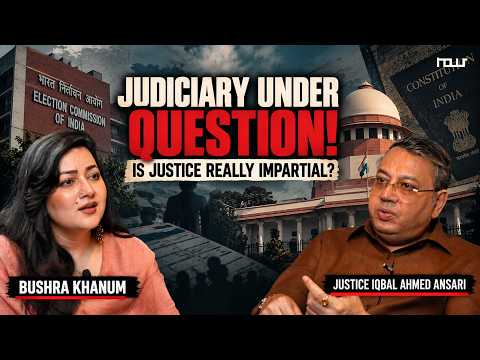
Adeeb reserved some of his harshest words for India's judiciary, arguing courts meant to guard the constitution have instead enabled its erosion — pointing to a steady stream of mosque demolitions and judicial statements he says have emboldened rather than restrained the pattern. He described the escalation as following a grim internal logic: after lynchings drew no sustained response and after demolitions of homes drew no sustained response, targeting Muslim places of worship directly became, in his account, the last resort left to provoke any reaction at all — and even that, he said, had failed to produce one.


Discussion
0Readers only · Comments are reviewed by the desk before they appear
The journalism is free for everyone — create a free account to join the discussion.