

One Awakening, Many Names
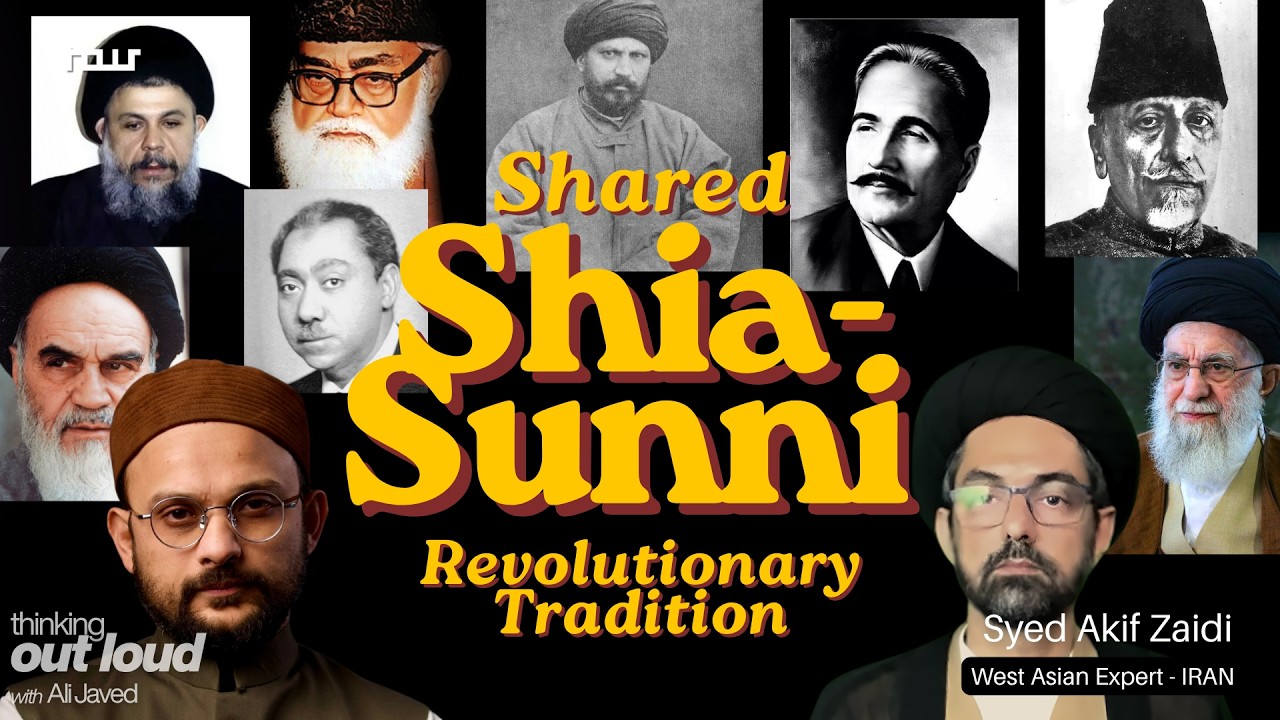
In a conversation about Iran's Islamic Resistance Axis, scholar Syed Akif Zaidi traces a single line of ideas — running through Sunni and Shia thinkers alike — from a nineteenth-century itinerant preacher to the Islamic Republic's Supreme Leader.
Contents · 9 sections
- Two Worldviews, One Older Argument
- The Man Everyone Claims: Jamaluddin al-Afghani
- Cairo's Response: Abduh, the Brotherhood, and Al-Azhar's Opening
- Beirut's Book: The Five Schools Under One Cover
- India's Branch of the Same Tree
- Najaf and Tehran's Parallel Awakenings
- Khomeini's Singular Achievement: From Idea to State
- Khamenei, Iqbal and Qutb: The Thread Made Visible
- Recovering, Not Inventing, a Shared History
Two Worldviews, One Older Argument
Most conversations about Iran, Hezbollah, Hamas and the network they anchor treat the subject as pure geopolitics: alliances, missiles, sanctions, proxies. Syed Akif Zaidi, an Indian-born scholar who has lived and taught in the seminary city of Qom for two decades, argues that this misses the deeper current running beneath the politics. Zaidi, who was born and raised in Mumbai and now teaches fiqh, legal theory and history at Qom's Hawza, frames the present moment as a contest between two worldviews — one that makes the human being the measure of right and wrong, and one that keeps God at the centre of that judgment. That framing sets up the conversation's real subject: a single current of ideas, incubated across two and a half centuries, that runs through Sunni and Shia thinkers alike and eventually crystallised as the Islamic Republic of Iran.
What makes this genealogy worth tracing on its own terms is that it refuses to sit inside the sectarian boxes it is usually read through. The thinkers, books and institutions Zaidi walks through move constantly between Cairo, Beirut, Najaf, Delhi and Tehran, and between Sunni and Shia scholarship, long before anyone speaks of an "axis of resistance." Recovering that thread is the purpose of this piece.
The Man Everyone Claims: Jamaluddin al-Afghani
Zaidi's account begins in the second half of the nineteenth century, after the Muslim world's political and military defeat before European colonialism was more or less complete — a defeat he dates symbolically to the British East India Company's 1757 victory at Plassey over the Nawab of Bengal, and consolidated by the time of 1857. Out of that despair emerged, in Zaidi's telling, the pivotal figure of the entire modern awakening: Sayyid Jamaluddin, known variously as al-Afghani, al-Asadabadi and by several other nisbas. Every community wants to own him, Zaidi notes — Afghans call him theirs, Iranians call him theirs, Shias and Sunnis each claim him as their own.
Over roughly four decades of ceaseless travel — Istanbul, Kabul, Cairo, London, Paris, and by his own account three separate visits to India, where he spent time in Mumbai, Hyderabad and Calcutta and interacted in Delhi with the household of Shah Waliullah Dehlavi — Afghani pressed three arguments that Zaidi treats as the seeds of everything that follows. First, that the real adversary was not one Muslim court against another but the encroaching civilisational force of Western modernity itself. Second, that the contest was fundamentally intellectual before it was military: no alliance or army would matter, Zaidi paraphrases him, if Muslims had not first renewed themselves in the world of ideas. Third, that sectarian and communal division among Muslims was, in his own word, a cancer — and that unity across schools of law was the precondition for meeting the challenge at all. Afghani rejected equally the option of retreating into pious isolation and the option of accommodation with colonial power; both, he argued, were paths to erasure. His journal, al-Urwat al-Wuthqa, circulated widely enough that British customs authorities maintained a dedicated unit just to track its readership in India.
Cairo's Response: Abduh, the Brotherhood, and Al-Azhar's Opening
In Egypt, Afghani's most direct disciple was Muhammad Abduh, who studied under him for years in Cairo and, in Zaidi's account, revived the teaching of philosophy and irfan (mystical/rational theology) at al-Azhar after that tradition had fallen into stagnation there. The line continues through Hassan al-Banna, who founded the Muslim Brotherhood on the same soil a generation later — one more link, Zaidi says, in a chain that keeps tracing back to Afghani's original template.
The clearest institutional expression of that template's ecumenical ambition came from al-Azhar itself. In 1950, Sheikh Mahmoud Shaltut, later Sheikh al-Azhar, established Dar al-Taqrib bayn al-Madhahib — an institution whose explicit purpose was bringing the Islamic schools of law closer together. In 1959, shortly before his death, Shaltut issued a fatwa declaring that just as Sunni Muslims may follow any of their own four schools of jurisprudence, they may equally follow the Ja'fari school — Shia law — in matters of fiqh. For Zaidi, this fatwa, arriving from the historic hub of Sunni theology, is direct evidence that the current running through Afghani had, within a century, reshaped the highest institutions on both sides of the sectarian line.
Beirut's Book: The Five Schools Under One Cover
Lebanon supplies Zaidi's favourite illustration of how thoroughly intertwined this history is. Sayyid Sharafuddin al-Musawi, working at a time when French and Christian dominance over Lebanon was at its height, built unofficial parallel institutions — in education, welfare and eventually economics — inside the Shia areas of the country. Zaidi traces today's Hezbollah-run school and economic networks, including the informal channels that broke an Israeli-imposed fuel blockade on Lebanon, directly back to that foundation.
Alongside al-Musawi, Sheikh Muhammad Jawad Mughniyya wrote a book, al-Fiqh ala al-Madhahib al-Khamsa ("Jurisprudence According to the Five Schools"), which set out every major legal question across all four Sunni schools and the Ja'fari school together — something, Zaidi says, no one had done in this form before. He calls Shaltut's 1959 fatwa and Mughniyya's book "mirror images" of one another: a Sunni authority in Cairo affirming the validity of Ja'fari law, and a Shia scholar in Beirut placing that same law inside a shared five-school framework, at almost the same historical moment, without any coordination between them.
Zaidi pushes the genealogy back further still, past the nineteenth century entirely: Imam Ja'far al-Sadiq, the sixth Shia Imam and the eponym of Ja'fari fiqh, is also recorded as a teacher of Imam Abu Hanifa, founder of the largest Sunni school of law, with Imam Malik counted among his indirect students. "It's not new interconnectedness — its roots are very old," is how he frames it. The image of Shia and Sunni scholarship as two sealed, mutually hostile streams, he argues, does not survive contact with this history.
India's Branch of the Same Tree
Afghani's Indian travels seeded a distinct, prolific branch of this same awakening. Allama Iqbal, whom Zaidi insists on calling a thinker rather than merely a poet, produced more verse in Persian than in Urdu — notable, Zaidi says, because Iqbal's own graduate research was in Persian metaphysics, and the philosophical vocabulary he absorbed there gave his Persian poetry a depth some readers find missing from his Urdu work. Maulana Abul Kalam Azad, whatever one makes of his later political positions, shows in his Quranic commentary and other writing what Zaidi calls a startling intellectual solidity within the same current.
Maulana Maududi, founder of Jamaat-e-Islami, sits in the same lineage: his central argument that individual moral effort achieves little without just political structures shaped decades of subsequent Islamist thought. Maududi died in 1979, only months after the Iranian revolution's success, and his final message on the subject described the revolution as a fulfilment of his own life's aspirations; his close associate Mian Tufail Muhammad, later head of Pakistan's Jamaat-e-Islami, travelled to Tehran within weeks of the revolution and stayed an extended period, later reporting what he had witnessed there. Indonesia's Muhammadiyah movement, Zaidi notes, was likewise founded by people who had studied directly under Afghani.
Zaidi draws one further Indian parallel: Shah Waliullah Dehlavi, he says, belongs to the same rare category as Iran's Mulla Sadra — scholars who were simultaneously jurists, philosophers, mystics and strategists in one person, rather than specialists confined to a single discipline. That comprehensiveness, present on both the Sunni and Shia sides of the tradition well before the colonial encounter, is itself evidence for Zaidi that the interconnection he is describing has always been structural rather than accidental.
Najaf and Tehran's Parallel Awakenings
In Iraq, the same current took a directly political form. The 1920 revolt against British control, aimed at Iraqi independence, was led by the Shia ulema of Najaf — figures Zaidi says were themselves shaped by Afghani's ideas. Six decades later, Ayatollah Muhammad Baqir al-Sadr founded Hizb al-Dawa on explicitly Islamic foundations to organise against the Ba'ath Party; before his martyrdom in 1980 he issued a fatwa declaring Ba'ath Party membership religiously forbidden and resistance to it religiously obligatory.
Iran's own contribution begins earlier than 1979. The Constitutional Revolution of 1905–1911 was driven in significant part by Iranian ulema — some based inside Iran, others, curiously, based across the border in Najaf, from where they remained just as influential on events inside Iran. Zaidi treats this as an early demonstration that national borders never really contained this network of ideas. Ayatollah Kashani carried a version of the same project through the 1950s and into the 1960s; Shahid Mutahhari through the 1960s and 1970s; and Ali Shariati, through the same period, reached with his writing an audience — younger, less traditionally religious — that the clergy alone had struggled to move.
Khomeini's Singular Achievement: From Idea to State
By Zaidi's own account, a bird's-eye survey of the twentieth-century Muslim world up to this point would show two contradictory trends running together: an intellectual awakening spreading in pockets — a percentage point here, a few percent there, in Egypt, Iraq, Iran, India, Indonesia — inside a Muslim world that was, overall, growing more fragmented, more colonised, more impoverished with each decade. What sets Imam Khomeini apart from every figure so far in this genealogy, in Zaidi's reading, is not originality of doctrine but scale of mobilisation: Khomeini was, in his words, the vehicle through which this current moved for the first time beyond specialist circles and into an entire society.
That mobilisation produced the 1979 revolution, and with it something no earlier figure in this history had achieved — a written constitution, ratified by referendum, whose central pillar, velayat-e faqih (guardianship of the jurist), Zaidi describes as a direct derivative of the Shia doctrine of Imamate now applied to statecraft. What had been argued in books and sermons for a century was, for the first time, made the operating principle of a state.
Khamenei, Iqbal and Qutb: The Thread Made Visible
Zaidi's most striking evidence for the continuity of this cross-sectarian thread concerns Iran's current Supreme Leader. In a 1986 speech to a conference on Iqbal studies held in Tehran, Ali Khamenei called that day among the most memorable and exciting of his entire life, and declared that the Islamic Republic "is the embodiment of Iqbal's aspirations" — Khamenei's own phrase, as Zaidi reads it aloud from the printed text. That a Shia head of state, representing a specifically Shia doctrine of governance, would frame his revolution as the fulfilment of a Sunni-associated Indian Muslim poet's dream is, for Zaidi, exactly the kind of gesture that keeps this genealogy alive rather than merely historical.
Khamenei's own bibliography extends the connection further back. In 1969, a decade before the revolution, he published a book on the role of Muslims in India's independence movement — in form a translation of an Arabic work by Sheikh Anmar, an al-Azhar scholar who had himself spent time studying at Darul Uloom Deoband, but expanded with so much of Khamenei's own material that the published length doubled, and the title page credits him with both translation and authorship. Zaidi calls this a triangle joining al-Azhar, Deoband and Khamenei in a single text, two decades before anyone in the West was speaking of an Iranian revolution at all.
Khamenei also translated two of Sayyid Qutb's books into Persian, drawn in particular to Qutb's concept of jahiliyyah — a framing Zaidi says still surfaces in Khamenei's own rhetoric today. Qutb, for his part, belonged to the Muslim Brotherhood that traced its own founding back through Hassan al-Banna to Abduh and Afghani, and was reportedly asked by the Egyptian court that later executed him whether he had read Maulana Maududi's sermons — one more thread pulling Cairo, Lahore and Tehran into the same weave. For Zaidi, Khamenei's habit of quoting Iqbal serves a deliberate rhetorical purpose: when Sunni admirers of Iqbal hear the Shia leader of Iran claim him too, he says, it "softens the heart" toward the wider argument being made.
Recovering, Not Inventing, a Shared History
Zaidi is emphatic that none of this amounts to erasing real differences between Sunni and Shia tradition, or suggesting that scholarly disagreement should simply dissolve. His claim is narrower and, he thinks, more useful: that the appearance of a total, ancient sectarian divide is itself a distortion — produced, in his phrasing, by centuries of internal neglect and by deliberate designs of adversaries — laid over a history that was, and remains, far more interconnected than the popular narrative allows. "This is recovery, not invention," is how he sums up the argument.
His closing point is addressed as much to fellow Muslims as to outside observers, and specifically to an Indian audience: India was, for centuries, one of the central poles of this shared civilisational space, not a periphery of it, and it produced several of the very nodes in this genealogy — Shah Waliullah, Iqbal, Azad, Maududi. Understanding that history, Zaidi argues, is the precondition for understanding why an avowedly Shia revolution in Iran keeps reaching for a Sunni Indian poet to explain itself, and why dialogue that starts from what different Muslim traditions already share tends to open doors that starting from their differences keeps closed.



Discussion
0Readers only · Comments are reviewed by the desk before they appear
The journalism is free for everyone — create a free account to join the discussion.