

Parkala Prabhakar: West Bengal's SIR Is a "Bloodless Political Genocide"
Days before West Bengal votes on rolls purged of nearly a crore names, economist Parkala Prabhakar tells Nous that the Special Intensive Revision is not an electoral clean-up but a slow-motion project to redefine who counts as a citizen.
Contents · 7 sections
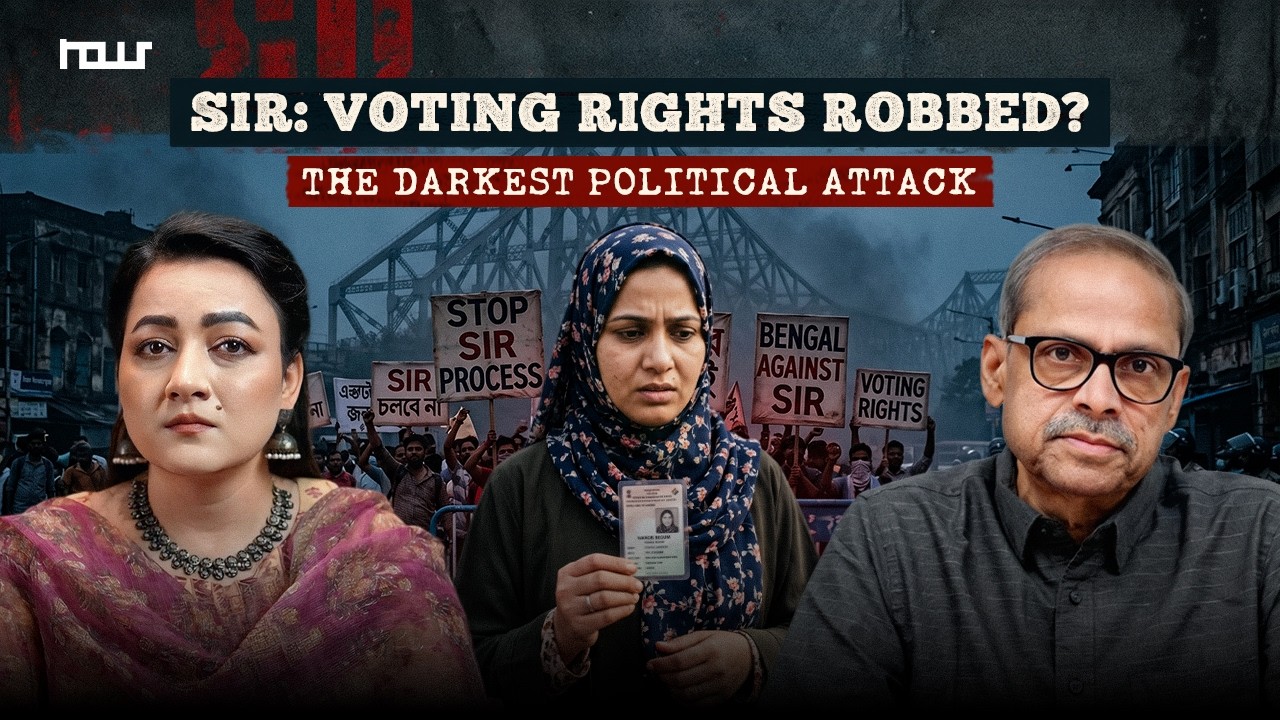
An Economist Turned Election-Reform Crusader
Parkala Prabhakar is best known as an economist, a commentator who has spent years on television panels, in seminar rooms and on digital platforms arguing that India's electoral machinery is being quietly captured. He is also, incidentally, married to Union Finance Minister Nirmala Sitharaman — a biographical fact that makes his sustained public campaign against the ruling party's use of the Election Commission all the more pointed. In this conversation with Nous Podcast host Bushra Khanam Fahad, recorded days before West Bengal goes to the polls on the 23rd and 29th, Prabhakar lays out, in granular and occasionally impatient detail, why he considers the Special Intensive Revision, or SIR, of the state's electoral rolls "a bloodless political genocide" — a phrase he says he arrived at only after concluding that gentler language could no longer describe what he was seeing.
A Process With No Paper Trail
Prabhakar begins not with allegations but with a procedural puzzle. India ordinarily conducts a Summary Revision of electoral rolls every year, from October–November through January–February. What has been rolled out instead in Bihar, and now in West Bengal, is something else entirely: a Special Intensive Revision, justified by the Election Commission's claim that the previous summary process had left the rolls clogged with dead voters, duplicates and people who had shifted addresses. Prabhakar says he and fellow activists, including the transparency campaigner Anjali Bhardwaj, filed RTI queries asking a simple set of questions: who ordered the study that supposedly found the rolls unsatisfactory, when was it conducted, and where is the report. The Election Commission's own Principal Secretary, he says, responded that no such decision was taken "by the Commission" at all — while simultaneously refusing to disclose any file noting, concept paper or review of how the Bihar exercise had gone before the same process was extended to Bengal. "Humko pata nahi kaun liya hai, kiske aadhar par liya hai yeh nirnay," he says — we don't know who took this decision, or on what basis.
What the Numbers in Bengal Show
Prabhakar does not dispute that voter rolls carry genuine errors — dead voters, duplicate entries, people who have moved. He cites Bihar's own post-SIR findings, including a case in which a Brazilian actress's photograph was used to register the same person across six to twenty different locations, and an address at which investigators found 89 people, of different faiths and regions, registered to vote. His argument is not that clean-up is unnecessary but that the clean-up has been "targeted" — deletions concentrated in specific communities, alongside targeted additions elsewhere. In West Bengal, he says, close to 93–94 lakh names were flagged on grounds of "logical discrepancy," a category unique to this round of SIR, with a further tier of "adjudication" created for cases still in dispute. Of roughly 27 lakh names still stuck in that adjudication limbo at the time of the interview, Prabhakar points to what he calls a telling detail: some 95 percent of those placed in adjudication are Muslim. For him, that single statistic is the clearest evidence that the exercise functions less as a purification of the rolls than as a mechanism for "targeted deletions" of Muslims, Dalits and Adivasis — voters who, not coincidentally, tend not to vote for the Bharatiya Janata Party.
"They Kill the Citizenship Instead"
Asked directly whether this amounts to "murder of democracy," Prabhakar reframes the question in starker terms. Historically, he argues, when a state wanted to erase a minority it did not share its religion, caste, region, language or civilisation with, it either expelled that population or, in the worst cases, killed it. Modern India, he says, can no longer do either openly — so it does something else: it kills the citizenship instead. "Aap unka nagrikta ko khatam kar rahe hain" — you are ending their citizenship — which is why he insists the phrase "bloodless political genocide" is not rhetorical excess but a precise description. He also inverts what he considers the basic logic of democracy: until now, he says, voters decided who would sit in power; after SIR, whoever sits in power gets to decide who the voters are. "Poora system hi change kar diya," he says — the entire system has been flipped.
A Backdoor NRC and the Making of Second-Class Citizens
Pressed on whether this is effectively a backdoor National Register of Citizens, Prabhakar agrees, describing a slippery slope he says follows naturally from disenfranchisement. Once a person's name is missing from the voter list, he argues, the same logic can be extended step by step: if you are not a voter, why do you need an Aadhaar card; without Aadhaar, why should you get a ration card; without a ration card, on what basis do you hold agricultural land; and eventually, why should you even remain in this locality. He is careful to note this is a foreseeable trajectory rather than something that has already fully happened — but he insists it is precisely why the process cannot be dismissed as bureaucratic housekeeping. The larger consequence, in his telling, is not confined to the BJP. Once some citizens have votes and others do not, he argues, every political party — communist, Congress, socialist, regionalist — will chase the voters who remain on the rolls and stop bothering with those who are not, because votes are what parties need. The disenfranchised will not just lose an election; they will lose the attention of the entire political system, becoming what he bluntly calls "second-class citizens" living in a country of which they are formally residents but not, in any functional sense, full members.
Courts That Won't Decide, and an Opposition That Won't Commit
Prabhakar reserves some of his sharpest criticism for the judiciary. Invoking the Hindi cinema line "tareekh pe tareekh" — date after date — he describes a Supreme Court that has let hearing follow hearing on the constitutionality of SIR without ever ruling on the core question, even as elections proceed on the very rolls in dispute. By the time a court decides, he warns, the process will already be complete and irreversible. He also argues that the roughly 27 lakh voters still awaiting an adjudication verdict should, in the interim, retain their voting rights by default, since the older electoral roll on which their names appear has never been formally discarded — a principle he says the Election Commission's painfully slow tribunal process effectively violates by leaving people in limbo through the election itself. He is equally unsparing of the political opposition, which he says treats the crisis as "momentary" — a press conference here, a yatra there — rather than as the emergency he believes it is. He singles out the "vote chor, gaddi chor" (vote thief, seat thief) slogan for its internal contradiction: if opposition parties genuinely believe the mandate itself is stolen, he asks, why do they continue contesting elections and taking seats in a legislature they claim has no legitimacy?
The Case for Satyagraha
Prabhakar's proposed remedy is neither judicial nor purely electoral. Comparing the current moment to the Bihar voter-rights yatra, which he says drew far more public support than political parties anticipated but was never converted into a sustained national movement, he argues that India's opposition has repeatedly reduced a citizenship crisis to a simple win-lose electoral binary. His alternative is for civil society to stop waiting for political parties to act and instead organise directly — what he calls "peaceful satyagraha" and "feet on the ground agitation." Political leaders, he says, will follow public pressure rather than lead it, since ordinary citizens who mobilise are not competing for the same seats and offices that make parties cautious. He frames the coming Bengal result in civilizational rather than partisan terms: this, he says, is not merely a contest between Trinamool Congress and the BJP but a test of whether India remains a democracy at all — one that, if lost, would represent what he calls the near-completion of a hundred-year ideological project. Diagnosis, he concludes, is no longer the task at hand. "Abhi action ka time hai" — now is the time for action.


Discussion
0Readers only · Comments are reviewed by the desk before they appear
The journalism is free for everyone — create a free account to join the discussion.