

Parties as Private Companies: Qurban Ali on Defection, Muslim Politics and India's Political Crisis
Veteran journalist Qurban Ali argues that the collapse of ideology has left India without an effective opposition, while pressing Muslims to use the Constitution and the courts as the host questions how much of that burden falls on the community.
Contents · 6 sections
Parties without ideology
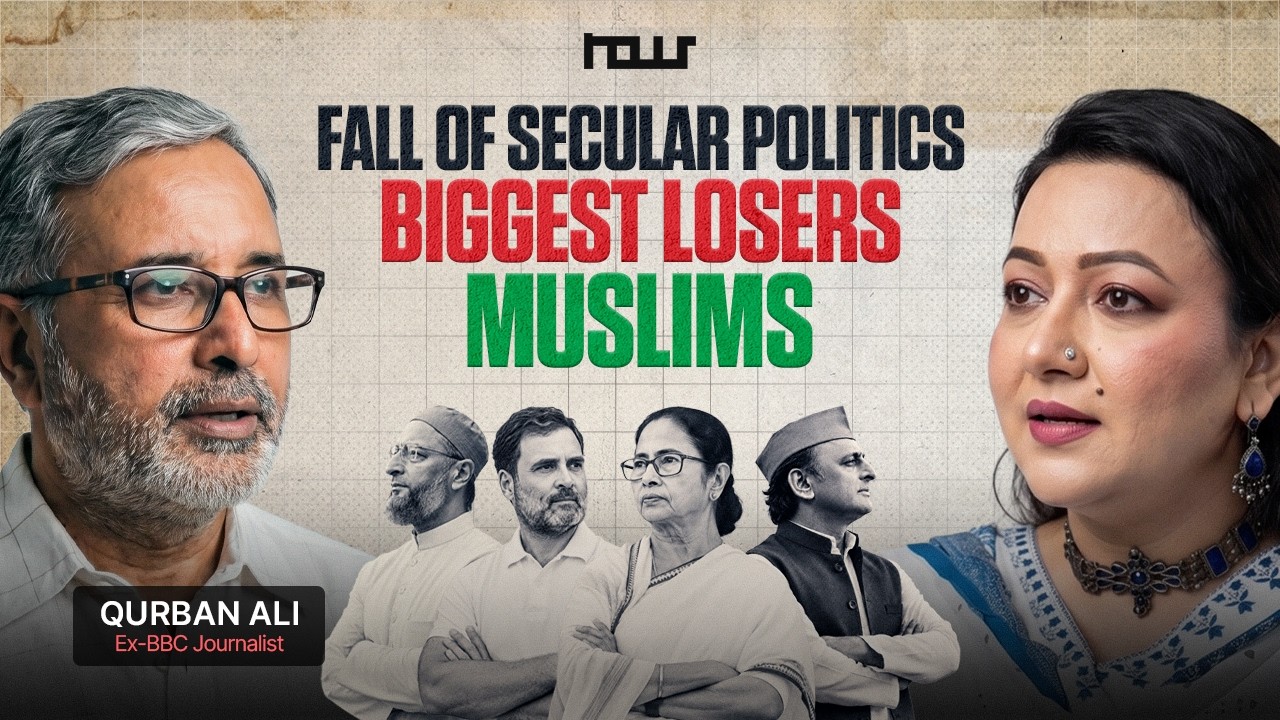
The conversation opened with a question the host, Bushra Khanum Fahad, framed around West Bengal: within weeks of the state election, she noted, legislators and MPs elected on the Trinamool ticket had broken away and drifted toward the BJP. Is defection now a bigger threat to secular politics than the right wing itself? Qurban Ali, a journalist with more than 40 years in the profession, including a stint at the BBC and editorships at several channels, said the Bengal case is one example of something happening everywhere.
His explanation was that ideology has drained out of Indian politics. Until roughly 1980, he said, parties had a philosophy and people stayed with it, and even those who switched sides felt some shame. The term "Aaya Ram, Gaya Ram" dates from Haryana, but what was once an embarrassing exception has become a marketplace: buying and selling of legislators, as in Karnataka and Madhya Pradesh, where elected Congress governments were toppled, and, in his telling, in Rajya Sabha contests in Himachal Pradesh, where nominations are rejected or reversed and votes are bought. Political parties, he said, have turned into private limited companies with one slogan, love me and love my lot, and dynastic control is no longer a Congress-only charge. Anyone entering politics today, he said, will admit he came to become an MP or minister, and may be in the SP today, the BSP tomorrow and the BJP the day after.
He was emphatic that he did not think Mamata Banerjee was beaten fairly. She won more than 41 percent of the vote, he said, and those now leaving were, until a week earlier, silent about grievances they now voice.
The Constitution and an undeclared emergency
Qurban Ali described the 2024 general election as being fought over whether the Constitution would survive. He recalled the "400 paar" slogan and the implication, as he read it, that a large enough majority would allow the ruling party to rewrite the Constitution, though the Supreme Court held in the Kesavananda Bharati case that its basic structure cannot be changed. He said the party in power has never embraced the Constitution, democracy, socialism or secularism wholeheartedly, and treats the words "socialist" and "secular" in the Preamble as a stigma because Indira Gandhi added them during the Emergency. Technically that is correct, he acknowledged, but the spirit of the Constitution, he said, was always fraternity and democracy.
Comparing the Emergency with the present, he argued that Indira Gandhi at least acted openly and paid for it in 1977, when she lost her own seat. What exists now, in his words, is what he called an emergency in all but name, and a worse one: mainstream media that cannot speak, courts that do not deliver justice, a civil society frightened of jail, and investigative agencies used against opponents. He also noted that the party in power lost 43 seats in Uttar Pradesh in 2024, evidence to him that voters could still be reached.
Muslims and the political question
The host turned to what she called the Muslim question. Muslims are beaten, their homes bulldozed and their mosques demolished, she said, and they look to two places for relief: the courts and a change of government. If the representatives they elect end up in the BJP, where does that leave them? Qurban Ali answered in stages. The organisation behind the ruling party, he said, has worked for a century toward a Hindu nation and, in his view, has largely achieved one in practice if not in law. He noted that the BJP's more than 240 Lok Sabha MPs and roughly 100 Rajya Sabha members include no Muslim and no Christian, and said the party's explanation is that Muslims do not vote for it and its Muslim candidates lose.
But his sharper criticism was aimed at the opposition. Every party, he said, has adopted the narrative set by the BJP instead of countering it. When the Supreme Court decided the Ayodhya case, all parties welcomed it and declared the matter settled; the same happened with Article 370. Meanwhile state governments are legislating on a uniform civil code and even adivasi personal laws are being dismantled. In this account, the country is drifting toward a system with one religion, one flag and one colour, which also makes elections easier to win. His consolation was that the majority has not become communal: those who are, he said, have not grown beyond about 40 percent, though the other 60 percent is weak and disorganised.
AIMIM, Muslim League and the limits of community parties
The host asked why parties such as the AIMIM are quickly dismissed as the BJP's B-team when nobody says so of Mayawati's party, which speaks for Dalits, and why leaders who fight the BJP and then join it escape the label. She added that the AIMIM has repeatedly asked to join the INDIA bloc without success, and that its leader Asaduddin Owaisi has won awards as a parliamentarian and spoken constantly about the Constitution.
Qurban Ali distinguished caste-based parties from religion-based ones. Caste, he said, is a five-thousand-year-old affliction, and the Constitution offers redress through reservations; the Sikh, Christian and Muslim communities are not free of it either, though Dalit Muslims and Dalit Christians are denied Scheduled Caste benefits. A party organised around a religion, in his view, has limited acceptance beyond a few seats, and it gives the BJP a justification for its own religion-based politics. He offered the Indian Union Muslim League in Kerala as a different model. Its candidates won 22 seats in the state, he noted, and it has been in governments led by both the Left and the Congress and even sent a representative to the Manmohan Singh cabinet, because it avoids emotional slogans and has built a secular character. Politics built on such slogans and polarisation, he said, would be suicidal. The host responded that the label is applied unevenly, and that she does not endorse the AIMIM's politics but cannot dismiss the record.
On the wider history, he recalled Ram Manohar Lohia's slogan of the late 1960s, that the backward castes should get 60 in every 100, and the non-Congress governments in nine states it helped produce in 1967. His point was that Indian politics has organised around caste and class, not religion, and that Muslims need to work out who their real friends are and whether they are being treated as a vote bank. He cited the ten years of the Manmohan Singh government as a period when communal temperature was at an all-time low, with the Sachar Committee putting facts about Muslim conditions on record and challenging the appeasement narrative. He called the Ministry of Minority Affairs a non-starter in practice but noted that even the present government has not dared abolish it.
What the community can do for itself
The most contested part of the conversation was Qurban Ali's insistence that the community has a responsibility as well. He said he was not absolving governments or parties, which are failing, but that Muslims cannot leave everything to them. The Constitution allows people to go from the lowest court to the Supreme Court, and even repeated dismissals put a matter on record. He said Muslims have come to believe that speaking up invites jail, and that this fear did not stop people from protesting during the Emergency.
He pointed to what has worked. He said he himself went to the Supreme Court over hate speech, and that a ruling in Qurban Ali v. Union of India directed police and administrators to act on their own instead of waiting for FIRs. He credited the lawyers Vrinda Grover and Rebecca John with pursuing the Hashimpura case to convictions, contrasting it with the killings at Maliana a day later, in which some 70 people died and where, he said, nothing was documented and no case was pressed. Documentation, he argued, is never wasted, and he said Muslim organisations and NGOs could do far more of it.
The host disputed the burden. When her team made a documentary on the widows of the Delhi riots, she said, it was hard to reach them, and there was no complete count; Sikhs, by contrast, still hold annual protests for 1984 and have documented their cases. She also asked how a community can set its identity aside when its identity is why it is targeted. Qurban Ali agreed she had a point, and did not deny the scale of the oppression, but said this is not permanent: a "dark night" and a long tunnel, in the spirit of Faiz's line that the night of oppression is still only a night. He cited Gaza and Iran as evidence that refusal to surrender counts for something, and said that the doors of justice have not closed for everyone, though they have narrowed.
Uttar Pradesh next
Asked about the coming Uttar Pradesh election, the host also mentioned Congress's new emphasis on using the word "Muslim" instead of "minority" and Rahul Gandhi's visible stand. Qurban Ali was direct with the Congress. When it played a Hindu-Muslim card in the 1980s, opening the Babri Masjid lock and allowing the shilanyas, and Rajiv Gandhi spoke of Ram Rajya, it lost both communities' votes, he said, and it has not governed in Uttar Pradesh or Bihar since 1989. The BJP then took the issue up as its own. Rahul Gandhi is doing well as an individual, he said, but as Leader of the Opposition he is expected to take a firm stand on communalism, democracy and secularism.
On how Muslims should vote, he said Muslim votes make or break governments only when they combine with another party's own base. Uttar Pradesh is about 20 percent Muslim, Bihar similar, Bengal near 30 and Assam around 35, but no party can win on that alone. If secular candidates could win 43 seats in Uttar Pradesh in 2024 under the banner of social justice, he said, a repeat is possible, but it requires a broad secular front, with the Samajwadi Party under Akhilesh Yadav as the main force, and tactical voting. The host closed with a reminder that Muslims are not sheep to be herded toward one party, and that the Samajwadi Party and RJD have seldom spoken up for Muslim rights, which raises the question of how long they can go on relying on the same parties.


Discussion
0Readers only · Comments are reviewed by the desk before they appear
The journalism is free for everyone — create a free account to join the discussion.