

Rooh Afza: How a Delhi Hakim's Summer Tonic Outlived an Empire and a Partition
A ruby-red syrup invented in 1907 to fight heatstroke in Old Delhi became a charitable trust, then three national brands split by Partition — and is still bottled by the hundreds of thousands every day.
Contents · 4 sections
A remedy for the Delhi summer
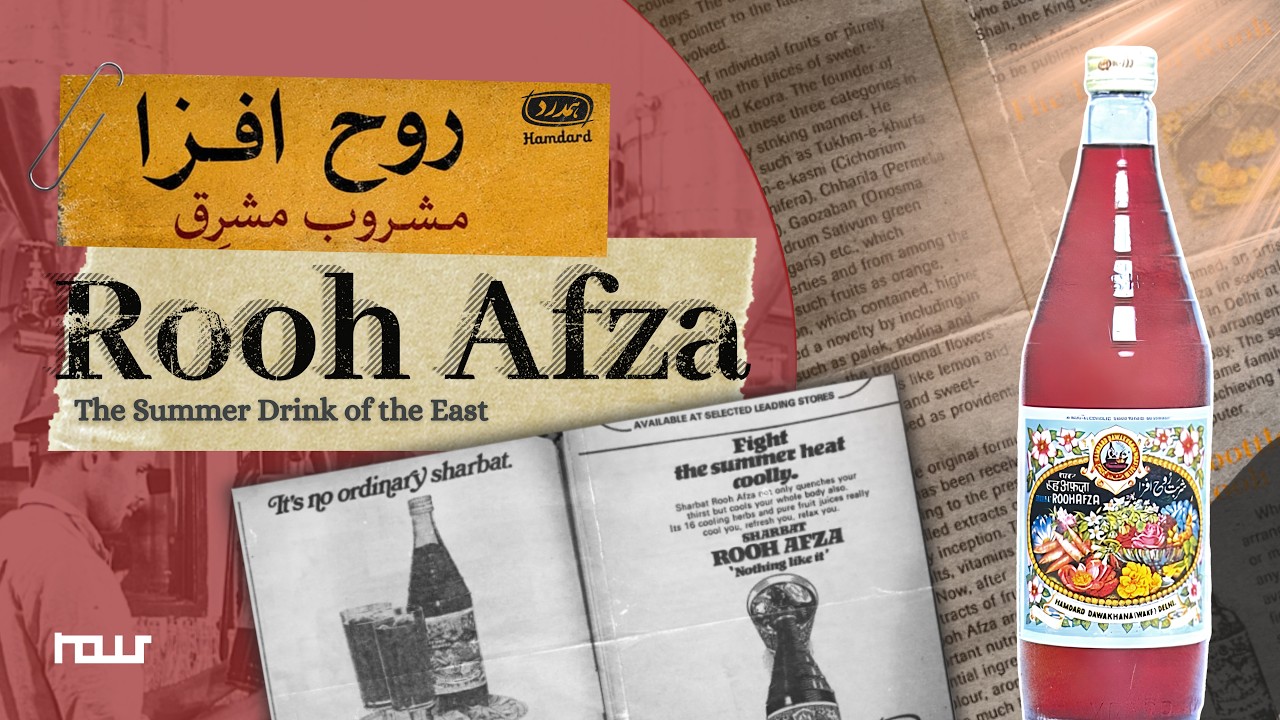
The story Nous tells here begins in 1907, when Delhi was still under British rule and a young Hakim — a practitioner of Unani medicine — named Abdul Majeed was mixing remedies in a small dawakhana, or medicine shop, called Hamdard in the lanes of the old city. His target was mundane and universal: the dehydration, fatigue and heatstroke that came with the north Indian summer. Experimenting with flowers, fruit and herbs, Majeed arrived at a ruby-coloured syrup he named Rooh Afza — literally, the refresher of the soul. It found an instant following among visitors to his shop, and the business never looked back.
The film frames Rooh Afza as more than a product: a piece of shared cultural memory passed down the way rhythms and rituals are, something that, if poured into a glass, would look and smell distinctly like a particular time and place. Even the label has barely changed. In 1910, Majeed commissioned an artist, Mirza Noor Ahmed, to design the illustration that was then sent to Bombay to be printed at the Bolton Press. More than a century on, aside from the move from glass bottles to commercial PET plastic, that same design still wraps the bottle.
A widow's decision
Majeed did not live to see the brand he had built mature. He died in the 1920s, while Hamdard was still finding its footing, leaving behind his wife and children. His widow, Rabea Begum, took over the business and made a decision that would shape everything that followed: she declared Hamdard a waqf, an Islamic charitable trust, meaning the bulk of its profits would be legally bound to serve public welfare rather than accrue to the family alone.
That structure held through Partition in 1947, even as the family itself did not. Of Rabea Begum's two surviving sons, the elder, Hakim Abdul Hamid, chose to remain in Delhi, while the younger, Hakim Mohammad Saeed, moved to the newly created Pakistan. The syrup went with both of them, and a third branch followed later in Bangladesh. Rooh Afza is now made and sold as three separate national businesses in three countries that share a border, and in some cases a fraught history, but the recipe and the label in each are still recognisably the same.
Eleven herbs, in a trust that still gives most of its profits away
The explainer walks through the syrup's production much as it has run for over a century: a base of sugar and water is turned into syrup, into which distilled herbal extracts, or arks, are mixed, along with fruit juices such as pineapple and orange. Company staff describe roughly eleven distinct Unani herbal ingredients going into the final distillate — among them rose, chicory, mint, watermelon, carrot and raisin, according to the names given on camera — with a small share of approved colourings and flavourings making up the rest. The company puts the mix at roughly 90 to 99 percent natural ingredients, produced today in factories running around 21 batches a day, each yielding more than 11,000 bottles. Between its plants, Hamdard's India operation alone accounts for something in the region of 440,000 to 450,000 bottles daily — what staff describe as the company's single biggest product by volume.
The waqf structure Rabea Begum set up in the 1920s is still legally binding on the business today. As a tax-exempt trust, the company says 85 percent of its profits are required by law to go into charity, channelled mainly into healthcare, education and skill-development programmes that are, per the company's own description, open to the general public irrespective of caste or creed. The film frames this as continuous with the spirit of the original waqf declaration — the idea of charity as a foundational value, expressed here through a soft drink's profit margins rather than through the medicine chest Majeed originally built the brand from.
One recipe, three flags
What the film keeps returning to is how little the actual product has had to change to survive a century that included the end of colonial rule, the death of its inventor, and a Partition that split the subcontinent — and the family that owned the brand — into separate nations. Rooh Afza is still advertised, in copy the film attributes to Hakim Mohammad Saeed himself, as mashroob-e-mashriq: the summer drink of the East. It is manufactured today in India, Pakistan and Bangladesh alike, each operation independent of the others, each still selling more or less the same syrup under more or less the same label Mirza Noor Ahmed drew in 1910.
The film closes on a couplet from an Urdu poet, its point made without needing translation for anyone who has grown up with the drink: that a fragrance and a memory can outlast the glass that held them, and, evidently, the borders drawn across the region where it was invented.



Discussion
0Readers only · Comments are reviewed by the desk before they appear
The journalism is free for everyone — create a free account to join the discussion.