

Rooh Afza: The Ruby Syrup That Crossed Three Borders
A Delhi physician's 1907 remedy for the summer heat became a century-old waqf whose profits still fund hospitals and schools in three countries.
Contents · 5 sections
A Physician's Cure for a Delhi Summer
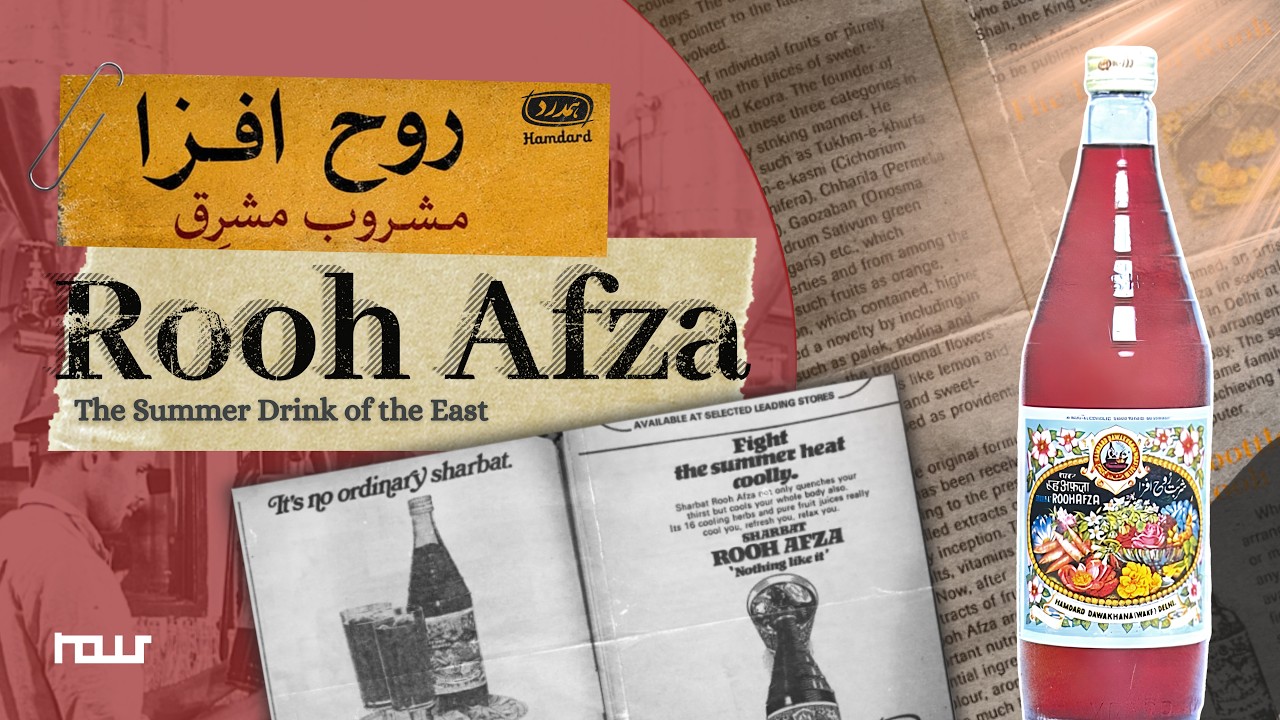
In 1907, in the old city of Delhi, a young Unani physician named Hakim Abdul Majeed was mixing potions in a small dawakhana, or dispensary, that he had named Hamdard. His aim was practical rather than commercial: the north Indian summer brought with it a predictable list of ailments — dehydration, fatigue, heatstroke, the everyday miseries of Dilli ki garmi — and he wanted a remedy his patients could actually enjoy taking. His experiments with flowers, fruits and herbs produced a ruby-coloured, intensely fragrant syrup. He called it Rooh Afza, "the refresher of the soul." It was an immediate hit with visitors to his dispensary, and demand grew quickly enough that, by 1910, he commissioned an artist, Mirza Noor Ahmed, to design a label for it, which was sent to be printed in Bombay. More than a century on, and after the bottle has changed from glass to plastic, that label's design has barely changed.
A Widow's Vow: How a Family Business Became a Charitable Trust
Abdul Majeed did not live to see Hamdard grow into an institution. He died in the 1920s, while the dispensary was still finding its footing, leaving behind his widow, Rabia Begum, and their children. Rather than sell the business or run it privately for the family's benefit, Rabia Begum made a decision that would define Hamdard for the next century: she declared it a waqf, an Islamic charitable trust, under which the bulk of its profits would be directed toward public welfare rather than kept as private wealth. It was a choice rooted in the idea, central to Islamic tradition, that charity is not an act of occasional generosity but a structural obligation on wealth itself.
Partition and a Drink Split Three Ways
That structure was tested by history almost immediately. When India was partitioned in 1947, Rabia Begum's family, like millions of others, was split by the new border. Of her two surviving sons, the elder, Hakim Abdul Hamid, stayed on in Delhi to run Hamdard there, while the younger, Hakim Mohammad Said, moved to the newly created Pakistan and built a second Hamdard from scratch. After Bangladesh's independence in 1971, a third, separate Hamdard trust took shape there as well. The result is unusual for any consumer brand: three legally distinct charitable trusts, operating under three different nationalities, each still selling a syrup that is recognisably the same drink, in a bottle that still carries a version of the same 1910 label. The company itself leans into this: its advertising has long described Rooh Afza as "Mashroob-e-Mashriq," the drink of the East — copy that Hakim Mohammad Said is said to have written himself — framing it as a shared regional memory that, unlike the people who first sold it, was never really divided by the border.
What Actually Goes Into the Bottle
The manufacturing process, according to a Hamdard production official, has changed little in principle over 120 years, even as the scale has grown enormous. It starts with a base syrup of sugar and water, into which distilled extracts, or "arks," of herbs and flowers are mixed, along with fruit juices such as pineapple and orange, and approved natural colourings and flavourings. Roughly eleven Unani herbal ingredients go into the distillate — among them rose, mint, sandalwood, khus and carrot seed — reflecting Rooh Afza's origins as a medicinal preparation rather than a soft drink. The official put the finished product at roughly 90 to 99 percent natural. On the factory floor, the syrup is filled by volume, 750 millilitres to a bottle, with an automated arm picking up a label and pressing it onto each bottle as it passes. Hamdard's Delhi facility alone runs around 21 batches a day, at roughly 11,400 bottles per batch — about 240,000 bottles daily — with a comparable output from its Aurangabad plant, putting combined production in India at somewhere around 440,000 to 450,000 bottles a day. "It's bread and butter to Hamdard," the official said. "Actually, it's our biggest product."
Charity by Law
The company that grew out of Rabia Begum's original decision is now formally structured as a tax-exempt trust — its Indian operations run today through an entity called HD Foods India, itself a trust — and Indian law requires that 85 percent of a waqf's profits be spent on charitable purposes. Hamdard channels that money into three areas: healthcare, education and skill development, offered, as a company representative put it, "irrespective of any caste or creed." What began as one physician's attempt to get Delhi through the summer is now a drink manufactured in three countries and, on its maker's own account, a permanent source of funding for hospitals and schools across the subcontinent — a business whose bottom line was, from its very first years, deliberately tied to the public good rather than kept apart from it.



Discussion
0Readers only · Comments are reviewed by the desk before they appear
The journalism is free for everyone — create a free account to join the discussion.