

Saharanpur's Demolished Mosque: What the Land Papers Still Say
Days after a mosque inside the Saharanpur Collectorate was bulldozed, the local MP says revenue records still name two private owners for the land, and that the real fight now moves to the Allahabad High Court.
Contents · 3 sections
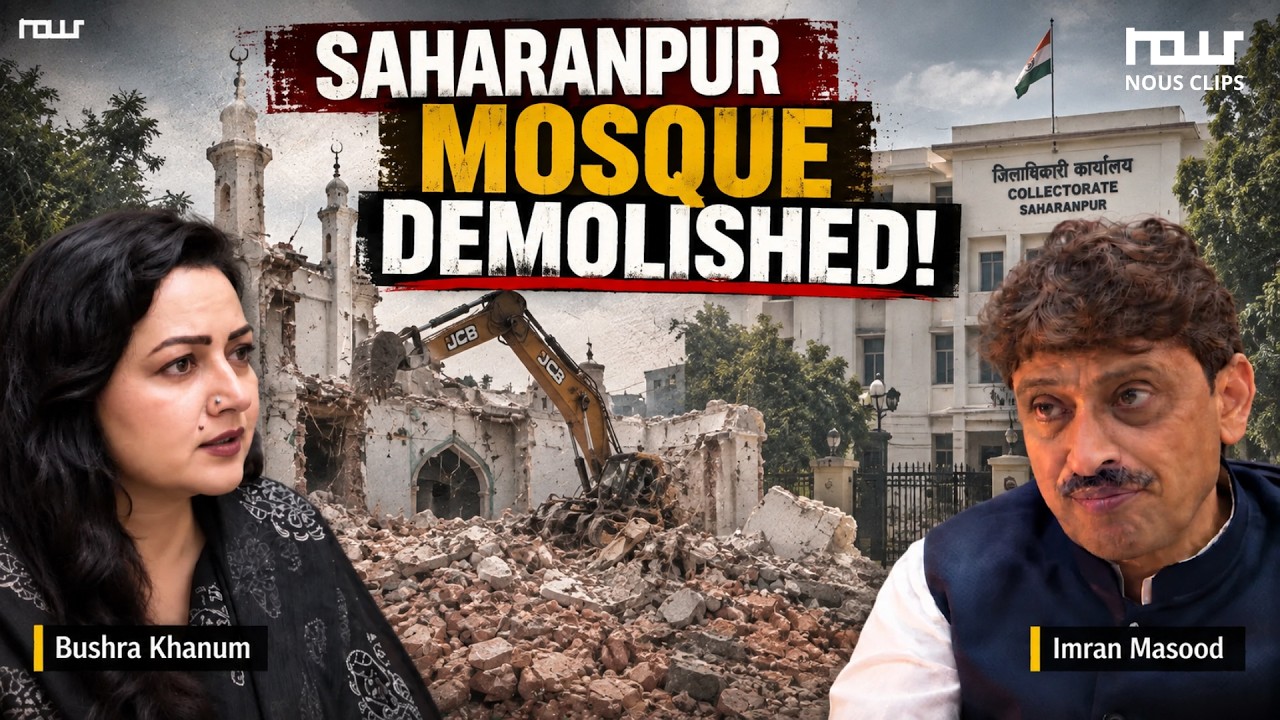
A mosque that stood inside the Saharanpur Collectorate compound in western Uttar Pradesh has been demolished, its remains cleared so completely that a visiting correspondent said no trace was left to show a mosque had ever been there. Nous Explainers put the details of the case, the land records, the court process, and the political fallout, to Imran, the Member of Parliament for Saharanpur, who has emerged as the demolition's most vocal challenger.
Papers That Predate the Government's Claim
Imran's central argument is that the mosque was demolished on land the government does not legally own. He said the site falls within plot number 84, an 84-bigha parcel on which the entire collectorate complex stands, and that revenue records, including settlement papers from years 1324 and 1359, still list the owners as Yaqub Khan and Waheed Khan. "The papers are saying it," he said, rejecting the suggestion that he was distorting the facts. He argued the government cannot claim adverse possession over the land either, citing a Supreme Court ruling that the state acts as a custodian, not a land-grabber, and so cannot benefit from prolonged occupation the way a private encroacher might.
He also invoked the Places of Worship (Special Provisions) Act, 1991, arguing it protects the mosque because the structure existed before 1947. Separately, he said the Limitation Act applies because the Telecommunications Department had paid rent to the two named owners since 1960, effectively recognising their title for six decades, and that continuous, unbroken use of the mosque for prayers, right up to two namaz before its demolition, adds a further layer of protection.
A second point of contention is the mosque's age. Critics have argued it is only about seventy years old, built after Collectorate staff were allegedly given permission to pray there and gradually treated the space as their own. Imran rejected this, arguing that permission to worship can only come from an actual owner, and that by the government's own revenue papers, the owner has never been the state. He also pointed to a disputed piece of evidence: an electricity bill dated 1911, submitted as proof of the mosque's age, which sceptics said could not be genuine since electricity reached Saharanpur only in 1906. Imran said the date was consistent with that history, that the bill had been pulled directly from the state electricity board's own website, and that he had asked officials to summon the board's superintending engineer to verify it, a verification he said was never carried out. On the underlying property record, he cited a separate Supreme Court ruling that a khasra entry alone can establish title only in Madhya Pradesh; in Uttar Pradesh, he said, it is the khewat and khatauni that matter, and those, too, still carry the original owners' names.
A Demolition Order That Wasn't for Demolition
Imran also challenged the process itself. He said the City Magistrate's order concerned eviction, bedakhali, not demolition, dhwastikaran, and that bulldozing the structure went beyond what had actually been ordered. He said the magistrate acted entirely under government influence and did not examine a single document before ruling, and that an earlier inquiry into the matter, conducted by Additional District Magistrate Archana Dwivedi, produced a report that subsequently disappeared. The timeline, he said, left no real room to respond: the order came on the third of the month, and demolition began the following evening, well short of the roughly three-week window ordinarily available to approach the High Court. A writ petition has since been filed at the Allahabad High Court, where Imran said he expects "100 percent justice," pointing to the same court's past decision to penalise the Prayagraj Development Authority financially over an unlawful demolition elsewhere in the state.
Why the MP Says He Didn't Fight in the Streets
Pressed on why he had not visibly confronted the demolition as Saharanpur's MP, and on suggestions that he was effectively under house arrest, Imran said neither was true. He said he spoke twice with the District Magistrate the night before the demolition and concluded that leading a crowd of roughly two thousand people against the police would not have stopped the bulldozers; it would only have risked bloodshed and set the city on fire. He pointed to Sambhal, where he said five people were killed by police gunfire even though the standoff was only between police and Muslims, with the FIR nonetheless blaming "rioters." He pointed also to Bareilly, where he said Tauqir Raza still has not been granted bail, with at least fifty others around him having lost everything. He contrasted this with Saharanpur's 2014 riots, when he says he personally worked to stop the violence while a different MP held the seat. His position, he said, is that he would rather risk his own life than the lives of others, and that keeping Saharanpur peaceful matters more to him than looking combative. He said the case has drawn concern even among some BJP legislators in the state, alongside continued support from Hindus in Saharanpur, two of whom, he noted, testified as witnesses in the case before the City Magistrate.


Discussion
0Readers only · Comments are reviewed by the desk before they appear
The journalism is free for everyone — create a free account to join the discussion.