

Six Years After the Delhi Violence, Its Widows Are Still Waiting for Justice
A documentary returns to the lanes of north-east Delhi to hear from women whose husbands were killed in February 2020, and finds livelihoods, courts and grief all stalled.
Contents · 7 sections
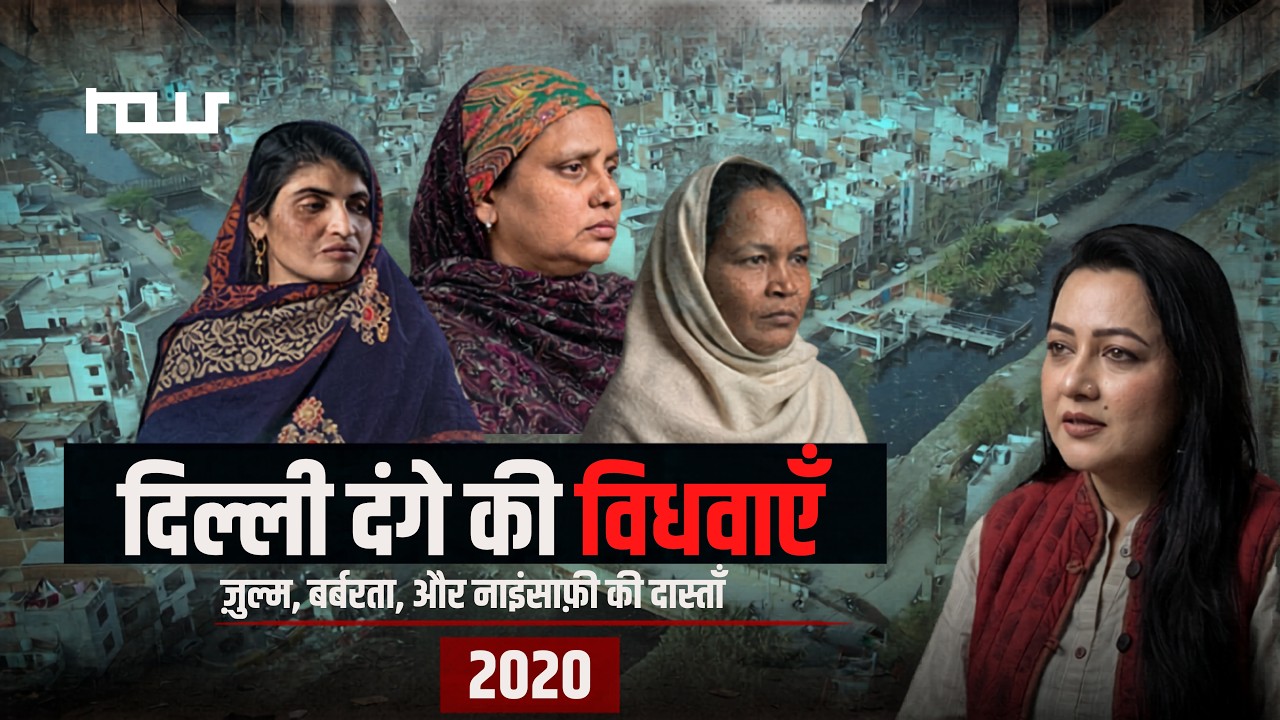
The film opens with a question about silence: what it sounds like after the screaming stops. Six years on from the violence that swept north-east Delhi from 23 February 2020, the lanes the reporter walks are quiet, but the film's argument is that the quiet hides more than it heals. The documentary lists what the three days left behind: 53 dead, 18 mosques burned, homes, shops and schools reduced to ash, and a collapse of trust in the administration, the police, the government and in neighbours who had lived like family.
The reporter returns to those streets to speak with widows, three of whom agree to appear on camera. Their accounts are not offered as a complete record. As the closing narration puts it, there are 18 more widows, 18 more names and 18 more shattered households behind the three we meet.
The night the gate was locked
Mallika's story begins with a neighbour. She says the main gate of her lane was locked from inside by Sapna, a Hindu woman renting a home there, and that a crowd of more than 200 armed men then entered, signalling that a "mulla" was hiding inside. From a window she watched what followed. Her husband Musharrat, she says, pleaded that he was a daily wage earner who had done nothing wrong. She recalls that the men answered by mocking the word "brother" and beating him.
According to Mallika, her husband was struck with iron rods, his head was hit against walls, and he was dragged down the stairs, thrown into a fire while still alive and then into a drain. She and her children begged the men to stop and were kicked aside and threatened. When she later reached the mortuary at GTB Hospital, she says, the bodies lay piled one upon another. The narration sums up the night in a single line: it took her husband, her children's father and a family's world.
The film returns repeatedly to the detail that the violence was intimate. Mallika does not describe a faceless mob arriving from elsewhere. She describes a neighbour's decision to lock a gate.
Waiting for a man who did not come home
Nargis was pregnant when her husband Mursaleen left for work on 21 February and never returned. She says she rang his phone through an afternoon, a night and a second day, until on the third day it was switched off. A police officer eventually took the family to GTB Hospital. She says she could not bring herself to look for long, but recognised him by a missing toe on his right foot. Her description of his injuries, which include gunshot and sword wounds, is among the most harrowing passages in the film.
Six years later, she is raising three children in Shiv Vihar's narrow lanes and running the household on small jobs. She says she lives for the children, that she sees no one near her to turn to, and that in moments of panic she becomes almost unmoored. Her daughter Hiza, Nargis says, still cries at night for the father she never got to know.
Zahira's story has the same pattern of search and dread. Her husband had come to visit her mother, stayed on as the violence continued, and set out for home once things seemed calm. Contact then broke. She says he managed one call to an acquaintance in Mustafabad to say he was stuck. For three days the family phoned relatives and friends, half hoping he was hiding or in police custody, until someone suggested looking at GTB Hospital. His body was there, she says, having been recovered from a drain.
Two mothers, two economies of grief
Much of the film is not about the night itself but about what came afterwards. Zahira is a mother of four, two sons and two daughters. Her eldest son now works, and she and her daughters work at home. She has, in the narrator's words, become both mother and father to her children, and a woman who had never stepped outside alone now guards the house and earns its income.
The children's grief is often triggered by other people's ordinary lives. Zahira says they watch fathers greet their children at a nearby shop and imagine the affection they would have received, and that Eid, approaching as the film was made, is when they miss their father most. She says she hides her tears from them, because seeing her cry hurts them more.
Asked whether the passing years have softened things, Zahira pushes back on the assumption that memory fades. People outside may be forgetting, she says, but those it happened to remember all night.
The financial cliff
An advocate who works with the affected families, and whom the film does not name on screen, explains why the loss compounded so quickly. The first shock, as he describes it, was psychological and social: in the communities the film is set in, a married woman's identity is tied to her husband, so his death is an existential crisis as much as a bereavement. The second was livelihood. School fees, rations and medical costs suddenly fell on a household member who had never carried them.
Relatives helped at first, he says, but the families' own support networks are poor, so aid could not last. Around the time the second Covid wave ended, the women realised they were in severe financial trouble. Building a dignified livelihood, he says, became the second great crisis after simply accepting the loss.
One widow shows what that means in practice. She describes work in which her hands are burned by the heat, for around ₹6,000 a month. Every missed day is deducted from that wage, so falling ill costs her money she does not have.
A courtroom that asks the wrong questions
The legal picture, as the widows tell it, is a story of exhaustion. One says a lawyer filed a case on her behalf, and she was summoned to hearing after hearing. Each time, she says, she was asked who her husband's enemy was. She did not know, because he had none she knew of, and she says she would not name a person she could not identify. Her father-in-law, who had been at the hearings, died in the interim. She says she gave testimony twice and that three or four men were jailed as a result, though she does not know whether they remain there.
Another widow says she has given up on human courts. In her words, she has left justice to God. A younger voice in the film is blunter: if the authorities will not deliver justice, she says, they might as well kill the family too. She notes that those who killed her father walk freely and live in comfort, while her family goes door to door asking for help.
The advocate goes further and makes a serious charge about the state's response. He says the Delhi Police were themselves party to the violence, and that their investigative energy has gone into cases against people he says were falsely implicated, including the case known as FIR 59, rather than into identifying those who did the killing. These are his claims, made on camera and not tested by the film, but they reflect a deep distrust among the families of the institutions that are meant to deliver accountability.
Why 2020 has no 1984
The film sets the widows' plight against the memory of 1984. The reporter observes that when visiting the colonies where 1984 survivors live, she finds meticulous paperwork, photographs and organisation, and a community that still speaks with political agency. Among the families of 2020, she says, she sees less of that.
The advocate offers reasons. Around 90 percent of the victims in these cases, he says, were below the poverty line and often uneducated, and the political climate has left them afraid that fighting on could cost them what little they have left. He works with APCR, which he says is handling about 2,700 cases, a number he describes as beyond the organisation's capacity and rising daily. In his telling, the scale of a systematic assault on Muslims has outrun any response mechanism the community can muster.
The reporter presses on the obvious question. Compensation of a lakh of rupees, and the work of NGOs, are not justice. The film gives the question no clean answer. The advocate's reply is a reminder of how much is demanded of lower-middle-class families: to skip work, sit in court all day, and wait for a date on which little may happen.
What the film leaves open
The documentary is candid about its limits. It gives voice to three women because those were the three who agreed to face a camera. It relies on unnamed speakers for its analysis of policing and legal strategy, and its most serious allegations rest on their word alone. What it can offer, and does, is testimony about consequences: households that lost their earner, children raised on the memory of a father, and a legal process the widows describe as slow, alienating and disconnected from the harm they suffered.
The final lines return to the same silence with which it opened. Eighteen more widows wait, the narrator says, stuck in February 2020 with countless questions, waiting for justice.


Discussion
0Readers only · Comments are reviewed by the desk before they appear
The journalism is free for everyone — create a free account to join the discussion.