

The Biggest Threat to India's Judiciary Right Now Is Fear, Says a Former High Court Chief Justice
Justice Iqbal Ahmed Ansari, former Chief Justice of the Patna High Court, argues that judges are not always pressured into unjust rulings — many simply become too frightened to rule justly, and Muslims have learned to predict which way a case will go before it is even heard.
Contents · 6 sections
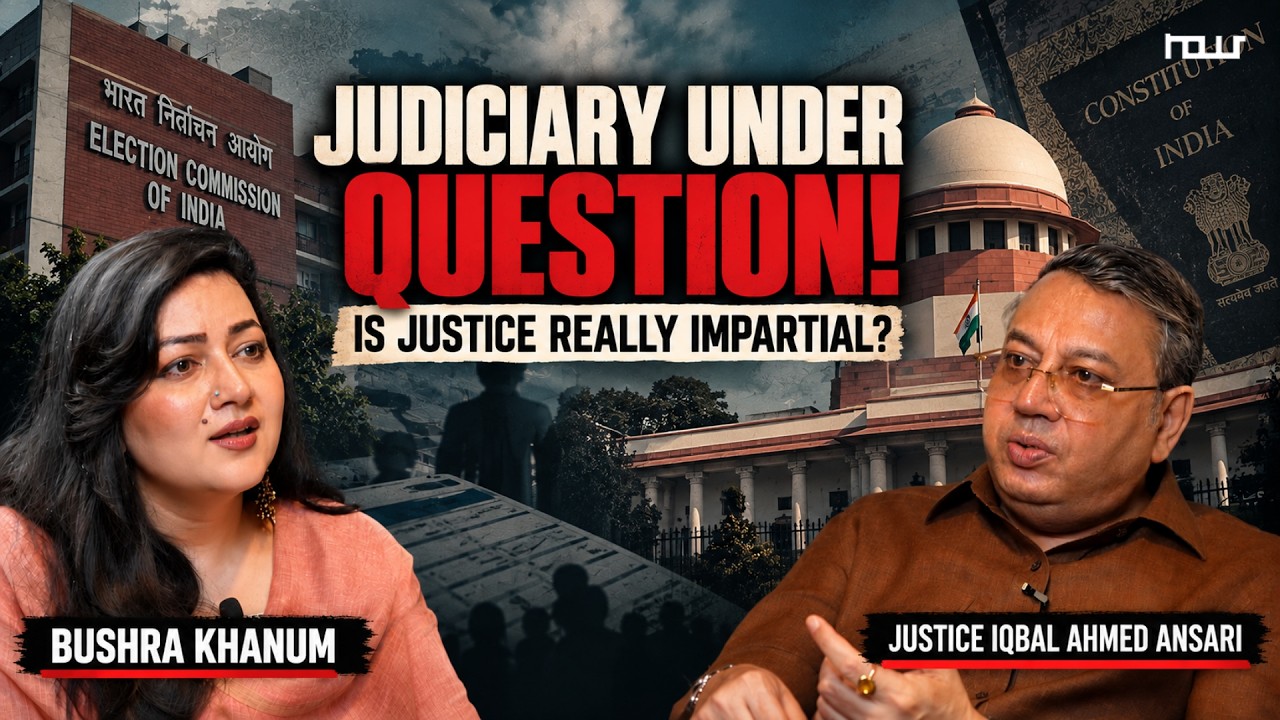
Justice Iqbal Ahmed Ansari has spent a career inside the system that Indian Muslims are now told, with rising frequency, they must simply trust. As the former Chief Justice of the Patna High Court, he has watched that system from the bench, not the gallery. So when he says, in a conversation on the Nous Podcast, that "the biggest question before the judiciary today is fear," it carries a different weight than the same sentence spoken by a litigant. Fear, in his account, is not a metaphor for government pressure. It is a precise diagnosis of what has gone wrong.
A Fear That Doesn't Need to Be Imposed
Justice Ansari's central argument cuts against the easiest explanation for a compromised judiciary — that judges are simply told what to rule, and comply. "It is not necessary for the government to pressure everyone," he says. "People themselves are succumbing to pressure when they shouldn't be." A judge's oath, he points out, binds him to decide cases "without fear or favour" — two failures that are often treated as opposites but are, in his reading, the same failure wearing different clothes. Favour is bought with money. Fear works just as well, and costs the government nothing.
He traces this fear to concrete signals rather than abstract anxiety. Justice Loya's death is one of them — a Special CBI Court judge who died in 2014 while hearing a politically sensitive case, whose family later raised questions the Supreme Court ultimately declined to reopen. "That is a very painful example," Ansari says, noting that the Court not only found nothing suspicious in the case but also directed that no complaint be filed anywhere on the matter, even as the judge's own sister and son spoke publicly about their doubts. "How can that happen?" he asks. "You are conducting an inquiry in such a way that it can never be raised again." The judges who wrote that order, he notes pointedly, were considered among the best on the bench — which is itself the lesson other judges are meant to draw.
When Prediction Replaces Faith
Ansari draws a careful distinction that he insists is often missed: he is not saying Muslims alone distrust the courts, or that Hindus, Christians and Sikhs have no comparable grievances against institutions currently under strain. But on matters that touch their religious identity specifically, he says, Muslim litigants have reached a different and more corrosive state — not distrust, but foresight. "What in English is called, you can foretell what is going to happen, and almost exactly that is happening," he says. "This is very, very bad for the judiciary." A litigant who can predict a verdict from the identity of the parties alone is not describing a slow institution. He is describing one that has stopped functioning as a court in the sense that matters.
The examples he offers are specific rather than rhetorical. A young man from a well-connected background gets bail within days; Umar Khalid and Sharjeel Imam, both under sedition and terrorism-related charges since 2020, remain in jail for years without trial — and in one instance the Supreme Court told Khalid's case could simply wait another year before being heard. "Has any court ever told anyone 'don't come' until today?" Ansari asks. "This is a new era, a new law, a new Supreme Court." He is careful to note that many non-Muslim, "justice-loving" citizens feel the same unease — but the specific texture of delay, he says, tends to fall disproportionately on cases involving Muslim defendants and Muslim grievances.
Faith on the Bench
The conversation turns, inevitably, to the 2019 Ayodhya verdict, in which the Supreme Court awarded the disputed site to the Hindu parties while simultaneously acknowledging that no temple had been demolished to build the Babri Masjid, and that the archaeological evidence did not establish any such destruction. "In that verdict, the court admitted that no temple was demolished to build it there," Ansari says. "The matter should have ended right there." Instead, the land went to the Hindu side under Article 142, the Supreme Court's power to do "complete justice" — a phrase Ansari treats with open scepticism. "Where are you providing complete justice?" he asks. "That sounds like bullying, doesn't it?"
He is particularly troubled by former Chief Justice D.Y. Chandrachud, who co-authored that verdict and was, for many, a source of cautious hope when he later became CJI — hope complicated, Ansari notes, by reports that Chandrachud performed prayers at the Prime Minister's residence before delivering a separate judgment, and by his own account that he "sought refuge in God" the night before the Ayodhya ruling. More recently, in a 2025 interview, Chandrachud described the mosque's original construction in 1528 as "a fundamental act of desecration" — a characterisation Ansari finds impossible to square with the judgment itself, which found no evidence that any temple had stood there. "If Justice Nazeer had written it," he says of a Muslim judge on the same bench, "they would have said Allah was guiding him."
Ansari argues that the verdict did not close a dispute so much as license a method. Since 2019, courts have entertained a rising number of petitions seeking archaeological surveys of mosques on the premise that examining history does not itself alter a site's legal status — a reasoning he says opens every mosque in the country to the same treatment. He points to Sambhal and to a mosque dispute in Saharanpur that he "covered on the ground" personally, where he says authorities claimed only to be sealing a structure before demolishing it overnight without due process. "There is a list of about 30 to 40 thousand mosques that circulates on WhatsApp groups of the RSS, VHP and other Hindutva organisations," he says, "and one by one, every few days, a new mosque comes into the headlines." Courts, in his view, have a straightforward responsibility here that they are failing to exercise: to shut such petitions down at the threshold, in the name of preserving social order, rather than entertain them case by case.
Careers Built and Broken on Proximity to Power
Some of the interview's most striking material is autobiographical. Ansari says his own path to the Supreme Court was blocked after he delivered a ruling against the CBI that displeased Ranjan Gogoi, who went on to become Chief Justice of India and later a Rajya Sabha MP after retirement. "With me, it was absolutely clear," he says. "Our Justice Gogoi... was against me; no one could overrule him." He recalls watching Gogoi receive the Prime Minister in his chambers for tea — a courtesy Ansari says should have been extended in a common area, not a private show of closeness — and says that had ordinary process been followed, he himself would have retired as a Supreme Court judge.
He offers other examples of what happens to judges who do not fall in line: Justice S. Muralidhar, who ordered a status report on hate speech and police inaction during the 2020 Delhi riots and was transferred out of Delhi the same evening; Justice Sanjib Banerjee, transferred from Chennai to the comparatively marginal Meghalaya High Court after an earlier controversy, and who, Ansari says, drove himself the roughly 2,000 kilometres from Shillong back to Delhi after his farewell rather than fly. "A man is driving a car from Shillong... What must be that person's mental state?" These are not dramatic punishments, in Ansari's telling — no one is jailed, no salary is cut. They are quieter signals, aimed less at the judge being moved than at everyone still watching.
He also recalls his own resistance to fear in a small, unglamorous case: villagers who took spilled tea leaves from an overturned truck were prosecuted, and Ansari initially leaned toward denying them bail as a "lesson" to society, before recognising the thought for what it was and granting it instead. He offers the story not as a triumph but as evidence of how easily a judge's reasoning can be colonised by an instinct to punish rather than to weigh facts — an instinct he says becomes dangerous precisely when it aligns with power rather than resisting it.
What Delay Actually Costs
Ansari returns repeatedly to the human cost of prolonged incarceration without trial, particularly under terrorism charges. Men held for twenty to twenty-five years, he notes, sometimes emerge only after the charges against them collapse in court — elderly by the time of acquittal, their working lives and family relationships already destroyed. "What meaning does justice even have left?" he asks. "Don't you think that if justice is delayed this much, it is also justice denied?" He extends the same logic to the police response to lynchings, where video evidence — including footage lynch mobs themselves post to social media — routinely fails to produce named suspects in FIRs, and to the treatment of protesters, citing pellet-gun injuries and degrading treatment of demonstrators in Delhi that he says should have triggered suo motu action from the Delhi High Court's own Chief Justice.
Whose Loyalty Needs Proving
Toward the end of the conversation, Ansari draws a line he considers important: the Constitution's guarantee of free expression, he argues, permits people to imagine and even advocate for an explicitly religious nation-state, so long as that advocacy does not translate into actual interference with the constitutional functioning of the executive, judiciary or legislature. He resists the idea that open talk of a "Hindu Rashtra" — including detailed, televised discussion of what its laws and the status of Muslims within it would look like — is by itself something courts must silence. Where he draws the line firmly is at Dharam Sansads that call explicitly for violence, weapons, or economic boycott against Muslims, and he does not hesitate on whether courts and police have failed to act against them. "This should not be happening," he says. "No one is celebrating this situation."
He closes by naming the demand that structures so much of the conversation — the routine expectation that Muslims prove a loyalty no one asks of anyone else. "I am a journalist. I am just a journalist," his interviewer observes. "Why do I need to keep saying this, and why am I constantly told that I am a Muslim journalist?" Ansari's answer is not despair. Asked what he would tell citizens who feel hopelessness has become their destiny, he invokes his own oath — to preserve, protect and defend the Constitution, not against some outside enemy, but against exactly the people entrusted with power inside the system. "Keep faith in the courts," he says. "This too shall pass. We will treat this as a bad chapter in the history of this country, and move forward." It is, by his own admission, a difficult thing to say with full conviction. He says it anyway, from inside the institution he is describing as failing.


Discussion
0Readers only · Comments are reviewed by the desk before they appear
The journalism is free for everyone — create a free account to join the discussion.