

"The Fight Is Legal": Imran Masood on the Saharanpur Collectorate Mosque
Saharanpur MP Imran Masood says the demolition of the mosque inside the district collectorate was illegal, that the case belongs in court rather than on the street, and that he will protect the mosque and the temple alike.
Contents · 6 sections
A demolition and a question of land
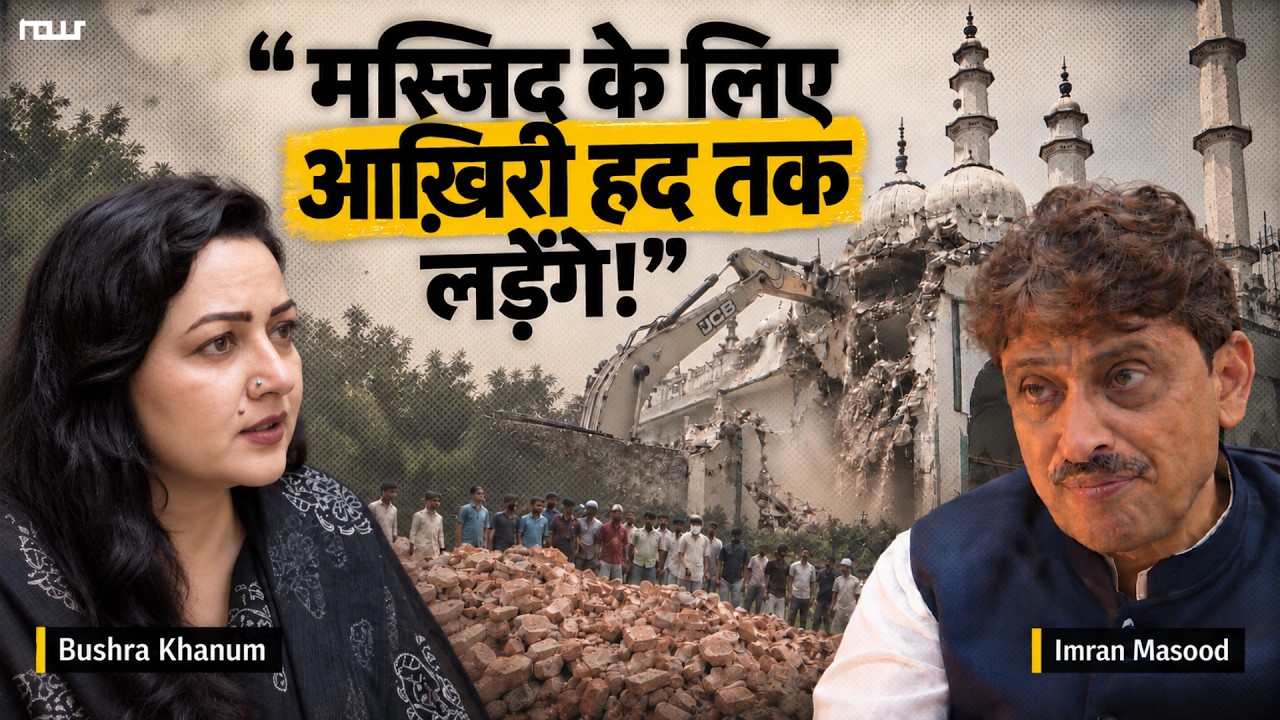
The mosque inside the collectorate compound in Saharanpur has been bulldozed. In this interview, recorded after the interviewer had visited the site and found no trace of the building, Imran Masood, the Congress MP from Saharanpur, describes the demolition as illegal and lays out the case he says will now be argued before the Allahabad High Court, where a writ has already been filed.
His argument starts with ownership. The collectorate, he says, stands on an 84-bigha plot, and the land records still name Yaqub Khan and Waheed Khan as its owners. He says he submitted the 1324 and 1359 settlements to the authorities and that they were brushed aside. Adverse possession, he argues, cannot be claimed against a private owner by the government, and he cites a Supreme Court ruling that the state is a protector, not a land mafia. The records used by the authorities, he adds, rested on the khasra, whereas in Uttar Pradesh the khewat and khatauni prevail, and the owners' names are still in the khewat.
Beyond title, he lists several legal protections that he says covered the building. It was a pre-1947 structure and therefore, in his view, protected by the Places of Worship Act of 1991. Since 1960, he says, the Government of India had paid rent to the owners through the Telecommunications Department, which he reads as acknowledging their ownership and bringing the case under the Limitation Act. And because prayers were held in it continuously, up to two prayer sessions before the demolition, he says it qualified as waqf by user, to which the newer waqf law would not apply.
The procedure
Masood's second line of attack is on process. The order issued by the City Magistrate, he says, concerned eviction, not demolition. The order was given on the third, and demolition began on the evening of the fourth, giving the mosque's side no chance to use the 22 days in which they could have gone to the High Court. He calls this a hurry "under the cover of darkness" and a political agenda, and says the officials who carried it out will be the ones who have to answer for it.
An appeal against the eviction order was rejected by the district court, he says, and an earlier official investigation, he alleged, was made to disappear. He says he expects "100 per cent" justice from the High Court, pointing to earlier instances in which the Allahabad High Court fined the Prayagraj Development Authority over demolitions.
Disputed evidence
The interviewer put the other side's claims to him directly. One is a 1911 electricity bill supplied by the mosque committee, which critics say cannot be genuine because electricity reached Saharanpur later. Masood said electricity came to Saharanpur in 1906, that the bill was taken from the electricity board's website, and that the committee's application asked the magistrate to summon the Superintending Engineer to verify it. That verification, he says, was never done.
The interviewer also noted that a journalist had shown bricks from the debris said to date from 1906 or 1909, while the opposing account holds that the mosque is only about 70 years old and that people working at the collectorate were given permission to pray there and then occupied the space. Masood's answer is that permission can only come from an owner, and the owners are still the same families. The magistrate, he says, did not look at any of the papers.
Why he did not protest in the street
The sharpest exchange concerns an accusation that Masood did not fight visibly enough. He says he was not placed under house arrest and never claimed to be; he was in Delhi, spoke twice with the District Magistrate at night, came straight to Saharanpur and held a press conference. He says he sensed the mosque would be demolished and that sticks and clubs could not stop it.
His argument is about consequences. Had he brought a crowd of 2,000 people, he says, bullets would have been fired, the outcome for the mosque would have been the same, and the city would have caught fire. He points to Sambhal, where he says police fired directly and five people died, and to Bareilly, where he says Tauqeer Raza has still not received bail and around 50 people who were with him have had "everything destroyed". He also says he had information that jails had already been cleared for mass arrests. His job, he says, is to save his city and fight under the law, not to set it alight.
The interviewer pressed the point that a leader who sat in protest all night might look like a fighter. Masood replied that he would not look like a fighter, because Muslims would be seen dying, and that he will not take responsibility for getting 10 or 20 people killed.
Saharanpur's Hindus and the temple
Masood repeatedly says Hindus in Saharanpur are standing with him. He says two Hindus gave testimony before the City Magistrate in favour of the mosque, and that a senior woman leader of the BJP has posted tearful videos about it. Saharanpur, he says, does not rub salt into wounds, it applies balm.
The interviewer, who said that speaking to ordinary people showed a visible divide and a silence, asked whether Masood was confident that attempts to communalise the atmosphere had failed. He said posters were put up the next day but nothing came of it, and that there will be no communal tension.
Asked about a temple near the collectorate that was neither demolished nor declared illegal, Masood ruled out any demand against it. "I will protect the mosque," he said, "and I will protect the temple too." He said he had been told by some people that he was trying to provoke, and rejected the charge.
Politics and a warning to the community
On his relationship with the Samajwadi Party, Masood said their parties are different, that any alliance decision belongs to the party, and that he will talk about the survival of the Congress, as everyone does about their own. Asked about a Friday of possible tension, he appealed to people to offer prayers, keep calm and pursue the fight legally, saying anyone who speaks of provocation is an enemy who can only get people beaten or killed.
Pressed by the interviewer on how long Muslims can stay silent, given Sambhal, the Babri Masjid and long lists of mosques circulating on WhatsApp, Masood urged Muslims not to walk around blindfolded but to act with awareness and wisdom, and not to fall into a trap whose aim is to make them jump. A community of 250 million, he says, cannot be sidelined or removed from the country.
The interviewer also asked what would happen if Chief Minister Yogi Adityanath came to Saharanpur to hold a rally over the mosque, as he had spoken about the Jauhar University and Maulana Mohammad Ali Jauhar. Masood treated it as the same pattern: the aim, he says, is for Muslims to react, and the moment they react the other side gathers votes while Muslims are the ones who get beaten. His answer, throughout, is the same. The papers, he says, are "speaking" and the fight has to be conducted on the file, in court, with the city's peace intact.
This article reports Mr. Masood's account and the interviewer's questions as they appear in the conversation; the legal claims are his and are matters before the courts.


Discussion
0Readers only · Comments are reviewed by the desk before they appear
The journalism is free for everyone — create a free account to join the discussion.