

The Myth of the Muslim Mandate for Pakistan
A historian argues that the case for mass Muslim support of Partition rests on a franchise of just 14 percent, a migration record too messy to read as a verdict, and a Congress party that had its own reasons to let Muslim-majority provinces go.
Contents · 7 sections
- A question historians still cannot answer
- A book written in the shadow of the "clash of civilizations"
- What a 14 percent franchise can prove, and what it cannot
- Class and fear, not only faith
- Why migration is not a referendum
- The "gift" that closed off a conversation
- An arrangement that suited more than one party
A question historians still cannot answer
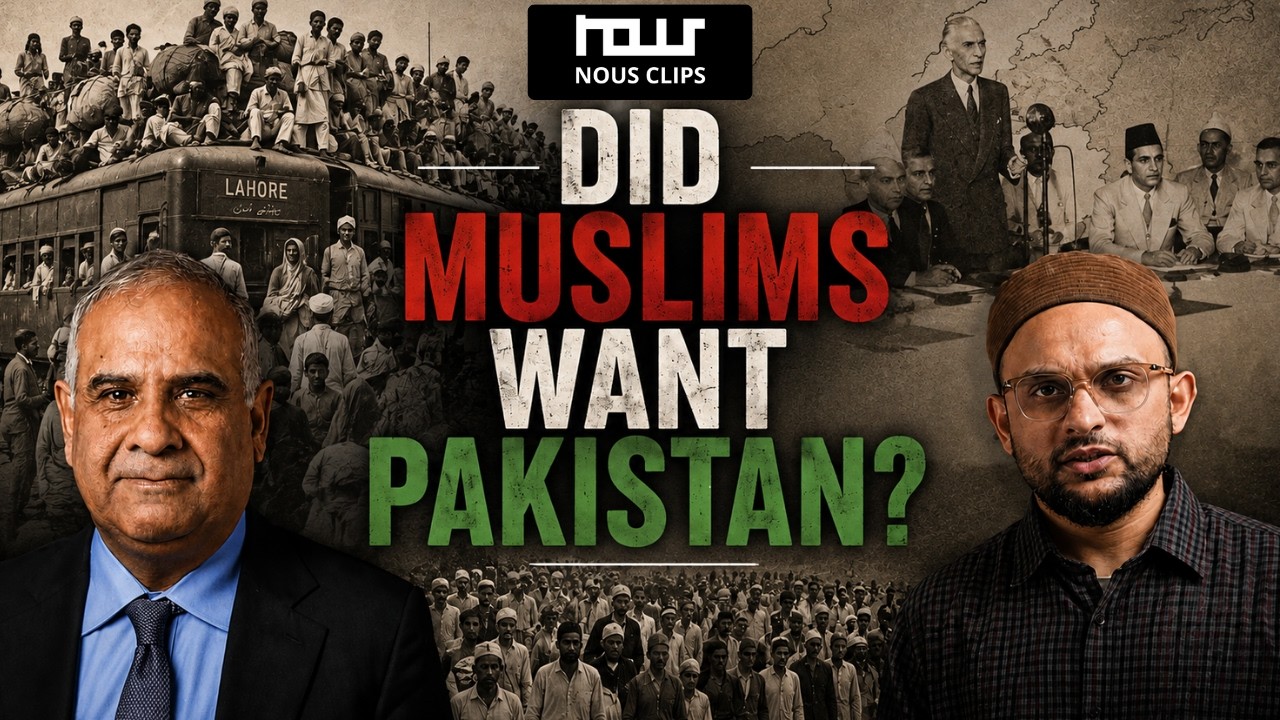
Did India's Muslims, as a community, actually want Pakistan? It is one of the most contested questions in the historiography of Partition, and historians remain divided. The scholar Venkat Dhulipala has argued that the demand for a Muslim "new Medina" carved out of British India took shape well before the political crises of the 1940s. Ayesha Jalal has countered that Muhammad Ali Jinnah's demand for a separate state functioned less as a settled goal than as a bargaining chip, leverage in negotiations with the Congress and the British rather than a fixed destination. In a discussion on Nous Explainers, a historian was pressed on a pointed version of this debate: if Jawaharlal Nehru was, in the host's words, someone willing to gamble with the fate of a huge population, was Jinnah doing something similar, using Muslims and the idea of a separate state as a stake in his own gamble, one that ultimately served the feudal Muslim elite far more than it served the Muslims left behind in India.
A book written in the shadow of the "clash of civilizations"
The historian's answer was not a flat denial. He agreed that an element of genuine Muslim separatism existed, pointing to Dhulipala's own evidence: the book centers on the United Provinces and cites ideologues such as Maulana Usmani who were pushing for a sovereign Muslim state well ahead of the final crisis. But he argued Dhulipala's account has a structural blind spot. It does not seriously engage the attitude of the Hindu right and the Congress toward the legitimate concerns Muslims had at the time; it examines Muslim politics in detail while largely bracketing the other side of the relationship. He situated the book's reception in a specific intellectual climate: it appeared when Samuel Huntington's "clash of civilizations" thesis was, in his words, "flavor of the month," and when framing Muslims as aggressive, difficult, and prone to jihad had become fashionable in public discourse. In that climate, he suggested, it was easy for a narrative that placed the responsibility for Partition on Muslim separatism to find a receptive audience.
What a 14 percent franchise can prove, and what it cannot
His central evidentiary argument turned to the numbers. The Government of India Act of 1935, the constitutional framework under which the decisive pre-independence elections were held, extended the vote to only about 14 percent of the population. Even the more polarized 1946 election, held after the Great Calcutta Killings and amid deepening communal violence, cannot be read as a clean verdict on whether Muslims as a whole wanted Pakistan, because the franchise itself was so narrow. A vote confined to a sliver of the population, he argued, simply cannot tell historians what the overwhelming majority of unenfranchised Muslims believed.
Class and fear, not only faith
Who, then, made up that enfranchised minority? The historian argued that better-off, educated Muslims, particularly young graduates anxious about their professional prospects in a Hindu-majority India, were disproportionately represented among voters and among the ranks of the Muslim League. Their support for the Pakistan demand, he suggested, was frequently rooted in economic anxiety about opportunity and status rather than religious conviction. It was a class calculation as much as a communal one, made by a narrow, enfranchised, and comparatively privileged segment of a much larger and more heterogeneous Muslim population whose views were never systematically recorded.
Why migration is not a referendum
The second body of evidence often invoked, migration across the new border, fares no better under his scrutiny. He put the number of people who actually crossed into either wing of Pakistan at roughly 7 million, a small fraction of India's Muslim population at independence. The reasons individual families left, he argued, are largely unknowable and were rarely ideological: fear of violence, discrimination, uncertainty about the future, or simply following a relative who had already gone. He offered his own family as an example, one uncle crossed the border while the rest of the family did not, a divergence he said had nothing to do with differing convictions about Pakistan. He drew a direct parallel to Hindus and Sikhs who fled Punjab in the same period, leaving not out of ideological commitment but because they feared violence. On this basis he pushed back on the framing, associated with Sardar Vallabhbhai Patel, that Muslims who "opted" for Pakistan were somehow disloyal to India: for many, he argued, there was no real choice being exercised at all, only survival under conditions of terror. He added that most Muslims living in the Muslim-majority provinces of Punjab and Bengal never opted for anything; the border was simply drawn around them. India's Muslim population fell to about 11 percent after 1947 largely because those two provinces were partitioned away, not because millions of individuals chose to leave.
The "gift" that closed off a conversation
The historian's sharpest point concerned what happened after the uncertainty was resolved by force of fact. He argued that the Hindu right came to treat the granting of Pakistan as a vast concession to Muslims, a gift so complete that it discharged Indian society of any further obligation toward the Muslims who remained. Once that gift had been given, the logic ran, Muslims in India could no longer make legitimate demands on the state or on society, since their community's needs were assumed to have already been met elsewhere. He called this the most tragic consequence of the whole episode, one that has "bedeviled the Muslim question" in India ever since, built on a premise, that Muslims collectively wanted and received Pakistan, that the historical record cannot actually support.
An arrangement that suited more than one party
He closed by widening the frame the host had opened with. It was not only the Muslim League's feudal elite whose interests were served by Partition, he argued. The Congress party also benefited from the removal of the Muslim-majority provinces, which left the party's dominant position within a smaller, more politically manageable electorate. That arrangement, he suggested, helped guarantee Congress political hegemony for roughly three decades after independence. The implication was pointed: the question of who wanted Pakistan may be unanswerable, but the question of who found the outcome convenient has a clearer, if less comfortable, answer.


Discussion
0Readers only · Comments are reviewed by the desk before they appear
The journalism is free for everyone — create a free account to join the discussion.