

'This Is Not Strategic Silence, This Is Surrender': Yashwant Sinha on India's Iran Dilemma
Three weeks into the Israel-Iran war, former finance and foreign minister Yashwant Sinha argues that India's official quiet is costing it more than it is saving.
Contents · 6 sections
Three Weeks Into an Unending War
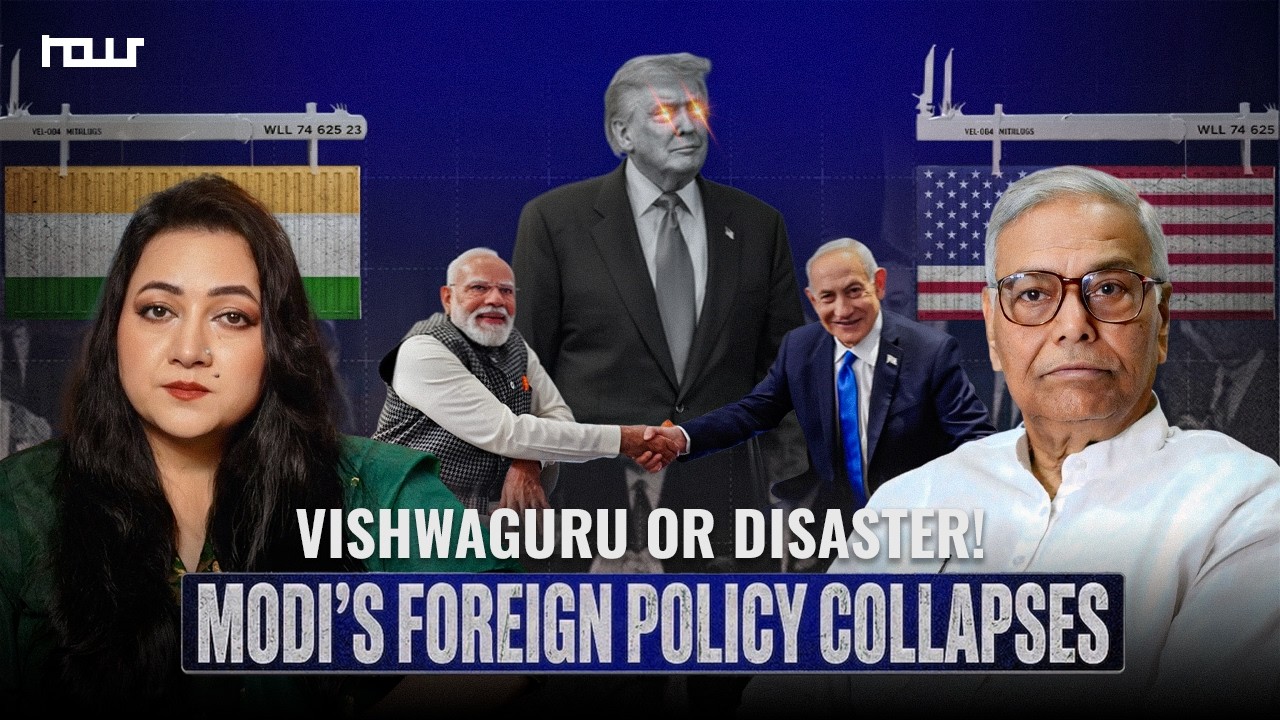
By the twentieth day of the Israel-Iran war, what had briefly looked like a possible opening for negotiation had instead hardened into open-ended escalation. Israel struck Iran's South Pars gas facility, among the largest hits of the war so far; Iran retaliated against American interests across the Gulf, including a major gas facility in Qatar; and the killing of senior Iranian official Ali Larijani, along with his son, signalled that Israel had moved from military infrastructure to targeting individual leaders. Against this backdrop, former Indian finance and external affairs minister Yashwant Sinha joined Nous Network for an assessment of what the war means for India, and how New Delhi has chosen to respond to it: largely, in his account, by saying nothing at all.
"This is strategic silence. This is surrender," Sinha said of the government's posture, adding that India has effectively become "a satellite country of the US."
The Economic Toll: Oil, the Rupee, and the Market
Sinha's starting point was blunt: India imports roughly 80 percent of its oil, and a war disrupting Gulf supply lines is not an abstraction for New Delhi but an immediate and serious economic threat. He linked the recent slide in India's stock market directly to investor anxiety over an open-ended conflict, explaining that foreign institutional investors pulling money out of Indian equities convert those rupees into dollars, pushing up dollar demand and weakening the rupee in turn. The Reserve Bank of India's job, he noted, is not to fix an exchange rate but to intervene only when volatility becomes extreme — a role it has increasingly been forced to play.
On the specific question of fuel supply, Sinha challenged the government's public messaging. Officials, he said, were celebrating the arrival of two tankers carrying LPG through the Strait of Hormuz as evidence that a single phone call from the prime minister had resolved the crisis. In fact, Sinha said, those two shipments amounted to roughly two days' worth of India's LPG consumption — and Iran had allowed them through on humanitarian grounds, not as a broader guarantee of continued passage. Those two ships, he said, carry "mere two days' supply," dismissing the idea that the crisis had been solved as its own kind of misinformation.
He extended the same warning to fertiliser. India imports roughly a quarter of its urea from Gulf countries, he said, and with the kharif sowing season beginning in June and July, a fertiliser shortfall arriving in the same window as the war could inflict serious damage on farmers — a risk he said the government's public messaging had almost entirely ignored in its focus on crude oil.
A Foreign Policy of Silence
Asked what New Delhi should have done differently, Sinha argued that India had a moral basis for taking a clear position rooted in international norms, and should have stated plainly that the initial attack was wrong and called for an immediate end to the war. Instead, he said, the government chose what commentators have described as "strategic silence" — a posture he rejects entirely, arguing that India should stand with the country that was attacked, not stay neutral between an aggressor and its target.
He was particularly critical of the government's handling of a 30-day US exemption allowing India to import limited quantities of Russian oil already at sea — oil that had already been produced and was sitting on the high seas rather than newly extracted. That Washington should be in a position to grant or withhold such permission from a country of 1.4 billion people, Sinha said, was itself a mark of how far Indian foreign policy had drifted, calling it a matter of national shame that a country of India's size was being "run from Washington."
Sinha also pointed to the government's asymmetric public statements: swift condemnation of Iranian strikes on Gulf states, he said, paired with near-total silence on the strikes against Iran itself, including no public statement at all on the killing of Iran's supreme leader for thirteen days.
Why the Silence? Two Theories
Pressed on why Prime Minister Narendra Modi's government appeared unusually deferential toward both Israel and the United States, Sinha offered two speculative explanations rather than firm claims. The first involved Pegasus, the Israeli-made spyware India is widely reported to have purchased; Sinha suggested — without direct evidence — that if it later emerged the software had been used domestically against members of the prime minister's own cabinet or other Indian officials, the resulting embarrassment could be a reason for New Delhi's reluctance to publicly criticise Israel. The second was a reference to the so-called Epstein files, with Sinha noting that a member of the Indian cabinet has retained his position despite reported proximity to Jeffrey Epstein, in contrast to the resignations and investigations such associations triggered elsewhere. Sinha offered both as conjecture rather than established fact, but framed them as possible explanations for what he called India's unusually deferential posture.
A Proposal: Revive IBSA
Sinha's central policy suggestion was procedural rather than rhetorical. He noted that BRICS, which includes Iran as a member, has grown too large and unwieldy — expanding from its original three-country core to a bloc of 17 or 18 states — to build the kind of consensus a moment like this requires. As foreign minister, Sinha had helped found IBSA, a trilateral grouping of India, Brazil and South Africa, precisely because a three-country forum could reach consensus that a larger bloc could not. He argued that India should convene an IBSA meeting now and use it as a vehicle to press for an end to the war, framing the urgency in stark terms: India, he said, cannot absorb the economic shock of a prolonged conflict as easily as other countries can.
Assassinations, Nuclear Risk, and What Comes Next
Sinha also addressed the killing of Iranian leadership figures directly, calling it an unprecedented and dangerous departure from historical norms of warfare — noting that even during the Second World War, Allied forces did not attempt to personally assassinate Hitler or his inner circle. He warned that if other states adopt the same tactic in future conflicts, the precedent could prove destabilising well beyond this war.
On the question of whether Israel might use a tactical nuclear weapon out of frustration, or whether the United States might commit ground troops, Sinha was more measured, saying he did not believe Washington would take the "reckless" step of putting boots on the ground given the scale of resistance Iran would mount. He did, however, urge that India pay close attention to Pakistan's missile capabilities, in light of statements from US officials naming Pakistan, along with Russia, North Korea and China, among countries whose missile programmes now concern Washington.
Sinha's one note of cautious optimism concerned dissent inside the American security establishment itself, pointing to the resignation of a senior US counterterrorism official who stated publicly that Iran had posed no direct threat to the United States. That kind of internal pushback, Sinha suggested, might eventually be what forces a change in course — even if, for now, the war shows no sign of slowing down.


Discussion
0Readers only · Comments are reviewed by the desk before they appear
The journalism is free for everyone — create a free account to join the discussion.