

What a Jamia Nagar Study Reveals About Muslims and Education
A survey of nearly 3,900 children in a Muslim-majority Delhi neighbourhood finds that families are pushing hard for schooling, even as a shrinking public system and rising private costs push many children out along the way.
Contents · 8 sections
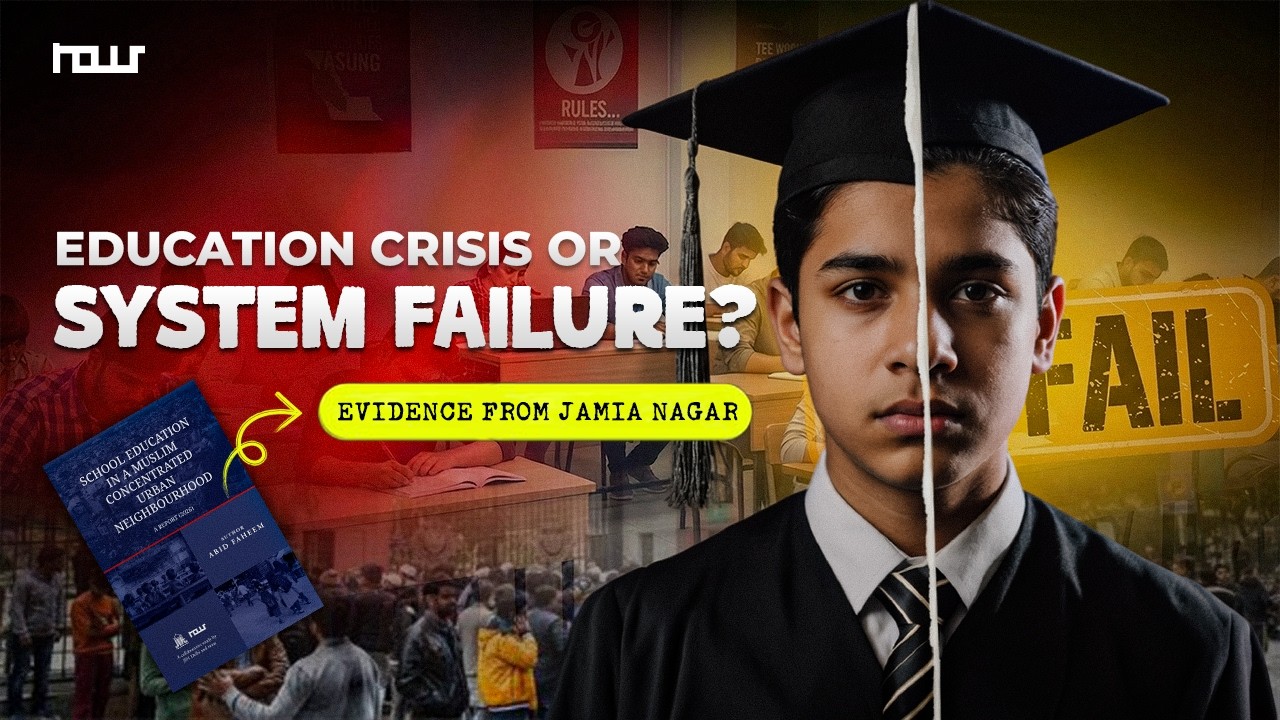
It is one of the most durable assumptions in Indian public discourse: that Muslim families place a low priority on formal education. A detailed household survey conducted in Jamia Nagar, in south-east Delhi, tests that assumption against actual data from one of the country's largest Muslim-concentrated urban neighbourhoods — and finds it does not hold up.
A neighbourhood-level study
The research, titled "School Education in a Muslim Concentrated Urban Neighbourhood: A Case Study of Jamia Nagar," is a collaborative project between Nous and the Delhi unit of Jamaat-e-Islami Hind. It surveyed 2,700 households across 12 localities within Jamia Nagar and tracked the schooling journeys of roughly 3,900 Muslim children between the ages of 3 and 18. The study goes beyond enrolment figures alone, examining household conditions, the availability of schools, and foundational learning outcomes in language and mathematics.
One of the organisers behind the initiative described the motivation in direct terms: the community needed "a foundation of information on which we can build a long-term plan." Jamia Nagar, they noted, is home to influential Muslim individuals and institutions, but effective action on education requires reliable local data rather than assumption.
High enrolment, real strain
The headline numbers are unambiguous. Ninety-four percent of children in the surveyed households are enrolled in school. Only 3.7 percent have never been enrolled at all, and 2.3 percent have dropped out — a figure concentrated heavily at the secondary and senior secondary levels. The study's authors say that even among the lowest-income households, including families dependent on daily wage labour or domestic work, parents are actively trying to keep their children in school and push them forward.
The socio-economic backdrop helps explain both the effort and the strain. Most families in Jamia Nagar are nuclear households, and nearly half have migrant backgrounds, largely from Uttar Pradesh and Bihar. A significant share fall into low-income or lower-middle-income categories, and many homes lack basic amenities such as a separate kitchen, reliable digital access, or a dedicated space to study. About a quarter of parents never received formal schooling themselves — yet the study found that madrasa education accounts for only a small share of schooling in the community. Most parents were themselves educated in mainstream schools and colleges, suggesting a community managing education within limited resources rather than one disengaged from it.
Enrolment is not the whole story
Once the data is disaggregated by wealth, caste and migration status, the picture shifts. The study's findings indicate that dropout cannot be attributed to a lack of interest; the primary drivers are economic pressure, academic pressure, the rising cost of education, and household responsibilities. Migrant families show a higher dropout risk despite enrolment rates that remain comparably strong — evidence, the study suggests, that the underlying problem is economic stress and settlement instability rather than motivation.
A public system that is disappearing
At the school level, Jamia Nagar's education system is becoming steadily more dependent on private providers. About 57 percent of children attend private schools, against roughly 40 percent in government schools. The study frames this less as a preference than as a consequence of scarcity: in a densely populated area like Shaheen Bagh, there is not a single government school. Parents are left absorbing private school fees, transport costs and coaching expenses as a result.
The sharpest bottleneck appears at the secondary and senior secondary levels. Primary schooling is comparatively accessible, but government school options narrow considerably as children get older, forcing families toward private schools, longer commutes, and coaching — all of which add to household costs.
Unequal paths within one neighbourhood
A central contribution of the study is showing that education is not experienced uniformly even within a single neighbourhood. Wealthier and general-category households have greater access to private schools, English-medium instruction and coaching. Poorer and OBC families, by contrast, depend disproportionately on government schools, where resources and learning support are thinner.
Enrolment without learning
Perhaps the study's most sobering finding concerns what happens inside the classroom. Despite high enrolment and household investment, learning outcomes remain weak. Assessments modelled on the ASER framework found that fewer than 4 percent of Class 3 students could read at grade level in Urdu, and sentence-level reading in English was nearly absent. By Class 8, many children still had not reached expected proficiency in language and mathematics. Schooling is happening, in other words, but learning is not reliably following it.
The study links this partly to institutional strain on both sides of the public-private divide: government schools are burdened by administrative formalities that leave staff focused on simply keeping the school running, while most private schools operating in the area fall well short of the standards set by Delhi's own government-run model schools.
The rise of shadow schooling
Despite these gaps, aspiration remains extraordinarily high — more than 97 percent of children say they want to pursue higher education, a figure that holds steady across gender, caste and income groups. That consistency, the study argues, rules out aspiration as the problem. The real and widening gap is between what children and families want and what the institutional system can deliver.
That gap has a price tag. The study identifies education as an increasingly heavy financial burden, especially in private schools at the secondary level, where costs rise sharply. Coaching classes compound the pressure: most children, particularly those in private schools, take coaching not for enrichment but because classroom instruction alone is not enough to understand the material. Coaching, the study finds, has effectively become a shadow extension of the formal education system — one that low-income households struggle to sustain, and precisely the point at which dropout risk accelerates.
Structure, not culture
Taken together, the Jamia Nagar findings push back against a reading of educational disadvantage rooted in culture or in enrolment statistics alone. The study attributes the gap instead to poor public provisioning, rapid privatisation, economic pressure on households, and shortfalls in learning quality. Jamia Nagar, the researchers argue, is not an exception — it is a case study in how inequality persists when aspiration is high but the surrounding system is weak.



Discussion
0Readers only · Comments are reviewed by the desk before they appear
The journalism is free for everyone — create a free account to join the discussion.