

Who Actually Needs the Word 'Terrorist'? An Anthropologist's Case Against the Category
Professor Irfan Ahmad argues that terrorism has no agreed definition anywhere in the world, yet the claim that terrorism is uniquely Islamic has somehow become common sense across four continents — and traces why that particular story, rather than any other, is the one the modern nation-state needs told.
Contents · 8 sections
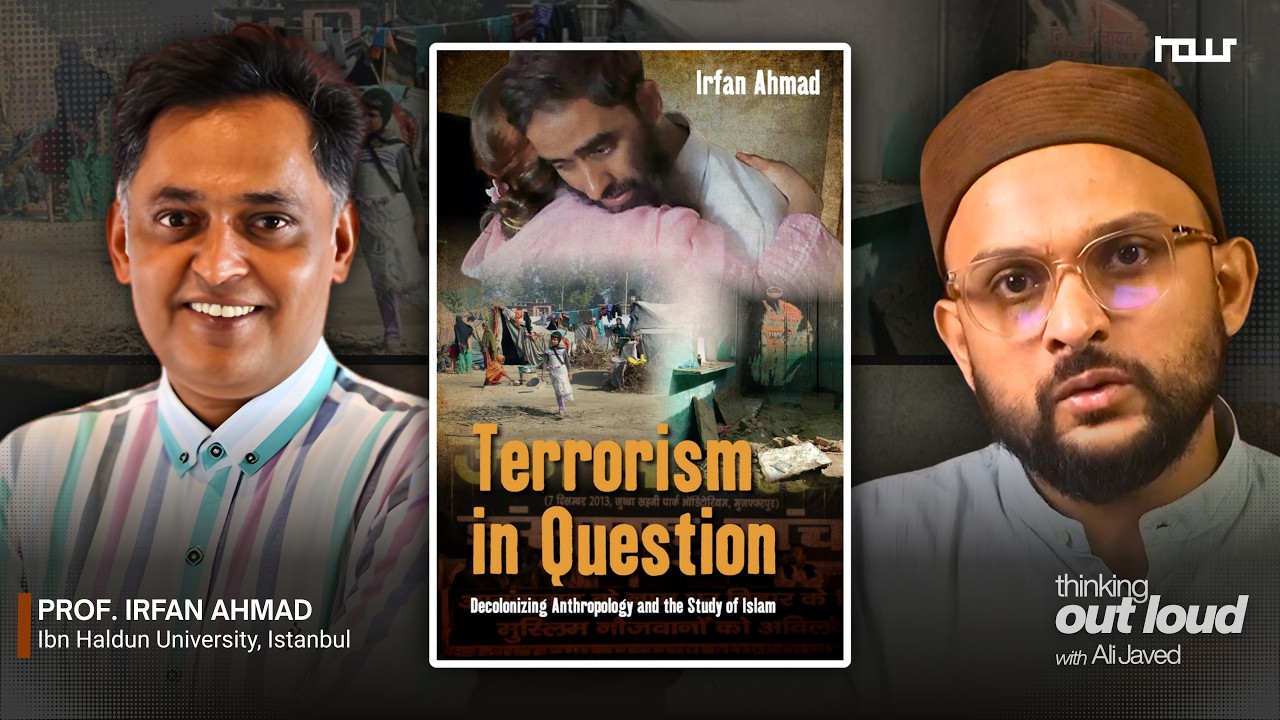
"All Muslims are not terrorists, but all terrorists are Muslim." Anthropologist Professor Irfan Ahmad opens his conversation on the Nous Podcast by pointing out that this sentence, in one form or another, circulates as received wisdom across five geographically unconnected nation-states — the United States, Canada, Norway, Australia and India. That such a specific claim can travel, largely unquestioned, across four continents is itself the puzzle his new book sets out to explain. Rather than accept the terms of the debate as given, Ahmad — who trained at Jawaharlal Nehru University and the University of Amsterdam, and previously examined Hindu nationalism's use of colonial-era categories in his work on "Hindu orientalism" — starts by refusing its most basic premise.
A Word With No Agreed Meaning
"There is no agreed universal definition of terrorism," Ahmad says, and he means this literally. A 2015 United Nations document, he notes, openly admits as much, even using "terrorism" and "radicalisation" interchangeably within the same text. In 1985, terrorism scholar Alex Schmid compiled some 200 existing definitions of the term; by 2005, revisiting the question, he concluded that "the search for a consensual definition continues." Even within a single government, Ahmad points out, agencies disagree: the US State Department, the Department of Defense and the CIA each work from their own definition, shaped by their own institutional history. "I do not know of any concept in the social sciences or humanities," he says, "which has a universally agreed definition" — and terrorism, in his account, is a particularly instructive case, because the absence of definition has not stopped the word from doing enormous political work.
Ahmad's response is to abandon the question of definition altogether and replace it with a different one: not "who is a terrorist," but "who needs the label of terrorist." The shift sounds semantic; it is not. Asking what a house is yields an answer about furniture and shelter. Asking who needs a house opens an entirely different inquiry into human need, history and desire. Applied to terrorism, the same reframing lets Ahmad examine not the individuals branded terrorists, but the states, industries and narratives that require the category to exist at all — and it is through that lens that he approaches the specific, and more troubling, question of why post-9/11 terrorism came to be defined as an essentially religious phenomenon, and more specifically an Islamic one.
Why Only Islam Gets a Religious Label
Two shifts define what Ahmad calls "new terrorism" after 2001. First, terrorism throughout most of history was understood as a tactic — a means groups used to pursue a goal — but after 9/11 it was recast as an ideology, and specifically a religious one. Second, that religious framing was applied asymmetrically. "You do not hear a word called Jewish terrorism. You do not hear a word called Christian terrorism. You do not hear a term called Hindu terrorism," Ahmad says. Only Islam was rendered inherently, definitionally violent. He also points out a third, quieter erasure: terrorism has historically been associated with states as much as with non-state actors — the word itself originates with the Jacobins' state-directed "Reign of Terror" after the French Revolution, and closer to home, British colonial forces hung the bodies of executed rebels from trees in Delhi after the failed 1857 uprising specifically, contemporary sources record, "to strike terror" into residents. Post-9/11 discourse, Ahmad argues, quietly dropped this entire tradition of state terrorism from the conversation, training attention exclusively on non-state actors — and predominantly Muslim ones.
He traces the genealogy carefully. Communism was the primary enemy of the Western-led world order after the Second World War; Ronald Reagan's era saw a partial transition toward framing terrorism as the enemy, layered atop the war on drugs. But Ahmad complicates the tidy story that Islam simply replaced communism as history's designated threat after the Soviet Union's collapse: the historian Bernard Lewis, he notes, was already drawing an explicit equivalence between communism and Islam as early as the late 1950s or early 1960s — decades before 9/11, and well before Samuel Huntington's 1990s "clash of civilizations" thesis, which Ahmad says Lewis had substantially anticipated. Even in India, Ahmad recalls, Girilal Jain — for years the editor of the Times of India, a figure rarely cited in these debates — had floated a version of civilizational clash in his own writing on what he called the "Hindu phenomenon."
Nation-States That Were Never Asked For
Ahmad locates one root of this exceptional treatment of Islam in the nation-state system itself — an arrangement, he argues, that was largely imposed on the Muslim-majority world rather than grown organically within it. After the First World War, the dismantled Ottoman Empire was carved into some 32 separate nation-states, few of which their populations had actually sought. "Did the people of Iraq really want a nation-state? Did the people of Syria really want a nation-state?" he asks, contrasting this with India, where a colonial government at least prompted an organised independence movement people fought for and won. When Iraq was declared independent, he notes, it had no national anthem of its own — the British anthem was played at the ceremony instead. Populations in what colonial cartography christened "the Middle East" — itself a term coined by the American naval strategist Alfred Thayer Mahan — came to accept these boundaries in practice, Ahmad says, while continuing to identify with older, larger senses of religious and cultural community that the nation-state framework never fully replaced. Sustained Muslim resistance to the nation-state's premises, he argues, is one of the most significant and least acknowledged threads of modern history — and one the "terrorism" label conveniently obscures rather than explains.
Israel, in Ahmad's account, occupies a specific place in this history. He cites a book edited by Israel's current prime minister, decades before he held that office, arguing that "Arabs are terrorist and Arabs alone are terrorist" — a framing, Ahmad notes, that folds Israel into "the Western world" it claims to defend, an inclusion he calls "a very problematic thing" in itself. That framing, he argues, erases a fact conveniently absent from the same discourse: Israel's own founding involved organisations — he names one, the Irgun, and gestures toward another — that were themselves classified as terrorist organisations before simply reconstituting as the Israeli Defence Forces once the state was created in 1948. He cites a leading Israeli politician who later became prime minister on record stating that no reading of Jewish ethics prevented the use of terrorism as a tactic at that time. In India specifically, Ahmad notes that the country's early anti-terror legislation was explicitly framed, in its own drafting committee's language, as addressing terrorism "emerging from the Middle East" — meaning that in India, unlike in France, discussions of terrorism cannot avoid invoking Pakistan and, later, Bangladesh, localising a global discourse while still feeding back into it.
A Word Turned Into a Weapon
One of the book's central arguments concerns the word "jihad" itself, and Ahmad illustrates it with a story from his own life. Completing his PhD at the University of Amsterdam, Dutch authorities insisted he produce a birth certificate — a document that did not exist in the rural Bihar village where he was born, and which required him to track down village elders willing to attest to his birth, most of whom could only sign with a thumbprint, before navigating from a local office up through the Bihar state government to the Dutch embassy. He calls the year-long ordeal, in his own PhD acknowledgements, "a legal jihad" — a fight, in his own self-understanding, against an unreasonable bureaucratic demand. Contrast that with jihad's contemporary use in Indian public discourse, where it has proliferated into "land jihad," "corona jihad," and similar phrases — an "endless proliferation," in his words, that has taught an entire generation that jihad means only violence and regression, in direct contradiction to how Muslims themselves understand the term.
Ahmad situates this distortion inside a larger structural shift he calls displacement. The post-war nation-state order, and its neoliberal successor after the Soviet collapse, is riddled with what he calls conceptual inconsistencies and real inequities — the erosion of welfare-oriented politics after Margaret Thatcher, the crisis of nationalism itself. Rather than examine those foundations directly, Ahmad argues, the system displaces its own internal contradictions onto an external enemy. He draws a direct line to the killing of George Floyd — "the boot of the police at the neck," a man saying "I cannot breathe" — as itself a form of state terrorism that received nowhere near the sustained institutional attention directed at non-state violence; he notes, by way of comparison, that far more people die on Indian roads each year from potholes than from terrorism, yet only one category of death dominates the news cycle. He is equally direct about genocide in Gaza, arguing that nationalism's role in mass violence against Palestinians goes almost entirely undiscussed even as the violence itself is, in his words, the most widely televised genocide in history.
Good Muslim, Bad Muslim, No Muslim
Ahmad engages directly with the scholar Mahmood Mamdani's well-known distinction between "good Muslims" and "bad Muslims" in Western security discourse, and argues it no longer captures the reality precisely enough. "A good Muslim is basically an anti-Muslim," he says — someone who actively denigrates or mocks Islam and is, for that reason, elevated as an acceptable public voice. He cites, without endorsing the comparison as equivalent in each case, a set of figures across different countries who built public profiles partly around criticism of Islam, arguing that this pattern is not confined to India but recurs wherever the same discourse operates.
Turning to his own discipline, Ahmad is unsparing about anthropology's history. Long before Huntington popularised the "clash of civilizations," he says, the anthropologists Irawati Karve — considered India's first woman anthropologist — and Claude Lévi-Strauss, the influential French structuralist, had already written about Islam as a "destructive force" and a form of fanaticism, in the 1940s. "Any anthropological exercise to study terrorism," he argues, "cannot remain loyal to these kinds of anthropological writings" — the discipline's own founding texts, in his account, share the orientalist assumptions it now claims to critique.
He proposes a methodological corrective he calls "ethnography at an awkward scale": traditional ethnography's strength is depth, achieved by living inside one community and learning its language and worldview intimately, but that depth becomes a limitation when a phenomenon like terrorism operates simultaneously at the local, national, regional and global level. Studying a single neighbourhood in isolation, he argues, cannot explain why the same slogan about Muslims and terrorism recurs identically across four unconnected continents; the analysis has to move, as he puts it, from a "worm's-eye view" to something closer to a bird's, without losing the ethnographer's depth in the process.
Reality, Truth, and Whose Job It Is to Name Them
Perhaps the most philosophically demanding thread in the conversation concerns Ahmad's distinction between the "real" and the "true." In English, he notes, the split between reality and truth is a post-Reformation development, tied to the rise of empirical science: reality became the domain of the senses, open to scientific method, while truth was relegated to religion and mysticism. Arabic, Persian and Urdu, he argues, preserve an older unity — deriving both terms from the same root, haqq — that Western academic convention has since split apart. Injustice, poverty, police brutality: these are all real, Ahmad says, in the plain sense that they exist and can be observed. But a scholar's task, in his view, cannot stop at describing what exists. "I also believe in a moral world which doesn't exist but which, in my view, should exist," he says — a commitment to a normative "true" alongside the empirical "real" that he argues most contemporary social science, chasing citation counts and institutional metrics, has simply abandoned.
This framework shapes his critique of "decoloniality" as an intellectual movement. Decolonising, he argues, is a necessary but insufficient exercise, because it defines itself only negatively, against what it opposes, without articulating what it is for. He is particularly sharp about the appropriation of decolonial language by Hindu nationalist commentators — naming the writer J. Sai Deepak specifically, alongside the scholar Arvind Sharma — who frame Islam and Muslims themselves as a colonising force in India, and their own project as decolonisation from it. This, Ahmad argues, is "basically a pseudo-scholarship," built on a fundamental misunderstanding of what colonialism actually was, and one he says functions in practice as "neocolonisation or recolonisation" — a tool for Hindu supremacist politics dressed in the vocabulary of liberation. What decoloniality actually requires to be meaningful, he argues, is a positive vision of what comes after — a vision he is candid about not having fully worked out, and one he says would require engaging seriously with non-Western intellectual traditions far beyond his own expertise.
The Machinery That Keeps the Story Going
Ahmad's account of how the "terrorism" narrative sustains itself is institutional rather than conspiratorial: no single actor needs to orchestrate it, because law, media and the judiciary each independently reinforce the same story. He invokes a Russian proverb — law is like a spider's web, in which the weak get trapped and the powerful simply break through — to describe how legal frameworks around terrorism function in practice. In India, he argues, the discourse that treats Muslims and Islam as outsiders to the national story is not confined to the BJP or RSS but has long been shared by the Congress as well, and it was that shared assumption that allowed the Vishwa Hindu Parishad's Babri Masjid demolition movement to draw support across the political spectrum, with media outlets amplifying the narrative and the judiciary, ultimately, giving it constitutional sanction.
His clearest example of this machinery in action is what he calls the "ditto theory" — the reflexive insistence that violence between a majority and a minority must always be framed as "violence on both sides." He cites Aung San Suu Kyi, once celebrated globally as a democracy icon, using precisely this framing to describe violence against Rohingya Muslims in Myanmar in a BBC interview, and traces the same rhetorical move in discussions of Israeli violence against Palestinians and in India's own communal riots. The term is deliberately not confined to any one country, he says, because the manoeuvre itself recurs everywhere state or majoritarian violence needs to be diluted into an apparent equivalence with minority resistance to it.
What Comes After Naming the Problem
Asked what Muslims and their allies should actually do with this analysis — as academics, activists, journalists, entrepreneurs — Ahmad resists offering a checklist. Different readers, he says, situated in different fields and with different life experience, will find different things useful in the book, and he is candid that a book's author does not get to control everything a reader eventually draws from it. But he is firm on one point: durable action requires conceptual clarity first. "Activism... will be more effective only when we gain a conceptual clarity," he says. "Tireless work in the absence of a conceptual clarity... will not necessarily bear the same fruit." His own contribution, as he frames it, is not a program but groundwork — an attempt to clear away the assumptions that keep the debate about terrorism circling the same unexamined premises, so that whatever collective action follows, in media, in courtrooms, in classrooms, starts from a sounder foundation than the slogan he opened with.


Discussion
0Readers only · Comments are reviewed by the desk before they appear
The journalism is free for everyone — create a free account to join the discussion.