

Why Iran Won't Build the Bomb: A Scholar's Case from Qom
An Indian-born seminarian who has spent two decades training in Iran's holiest city argues that the Islamic Republic's restraint, and the resistance network it anchors, flow from a theology two centuries in the making, not from sect or state alone.
Contents · 9 sections
- A Seminarian's View of a Live War
- Two Worldviews, Not Two Armies
- How Zaidi Reads Two Centuries of Decline
- Sayyid Jamaluddin al-Afghani and a Shared Awakening
- Why 1979 Was Different
- One Doctrine, Many Fronts
- Gaza, October 7, and the Century Before It
- The Case for Restraint as Moral Argument
- What the Axis Owes the Ummah
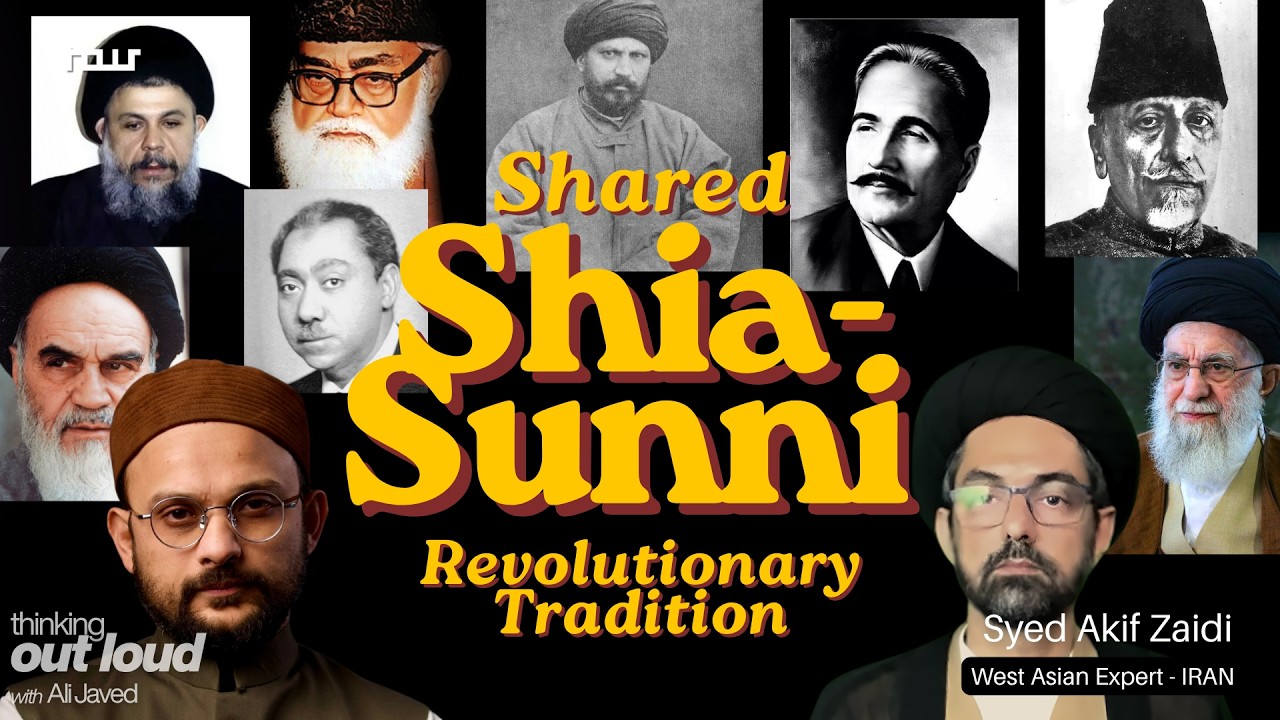
A Seminarian's View of a Live War
Syed Akif Zaidi grew up in Mumbai and has spent the past twenty years in Qom, the Iranian seminary city he calls the largest center of Islamic scholarship anywhere and the intellectual cradle of Iran's 1979 revolution. At the Hawza there he teaches dars-e-kharij, the highest tier of Islamic jurisprudence, alongside usul al-fiqh and history, and he travels through India delivering majalis and lectures. He is, in other words, an Indian Muslim who has spent two decades inside the world that much of the world is currently trying to explain from the outside.
The conversation was recorded while the Iran-Israel war was still active, roughly a month into the fighting. Zaidi frames his subject, the network known as the Islamic Resistance Axis, as far more than a Shia phenomenon organized around Tehran. Sunni movements sit inside it too, he argues, and the ideas behind it speak to the whole ummah. He opens by describing an Eid in Iran marked, despite the war, by unusual spiritual intensity, comparing wartime grief to the grief of Karbala, which he says brings energy and direction rather than despair, even as he mourns what he calls the shahadat, or martyrdom, of Iran's rahbar during the fighting.
Two Worldviews, Not Two Armies
Zaidi's recurring device is to insist that what looks like a contest between Iran and the United States, or between rival military networks, is really a contest between two worldviews. One he calls anthropocentrism, insaan-mehwari, in which the Renaissance and the European Enlightenment gradually made the human being, not God, the measure of right and wrong. He argues that liberalism, communism and capitalism all share this root even where they quarrel among themselves, and he points to Bentham and Mill, giants of Western liberalism, whose writings defended slavery and colonialism even as they preached liberty.
Against this he sets a God-centered order, khuda-mehwari or tawhid, in which humans are honored not because they set the standard of good and evil but because they are khalifatullah, stewards answerable to a transcendent authority. In his account, the most advanced and unrestrained expression of the anthropocentric model is what he calls, borrowing the host's phrase, the world of the "Epstein gang" — a system in which power, once freed of any transcendent limit, gravitates toward its worst human tendencies, from sex trafficking to child abuse, because nothing beyond the consensus of the powerful remains to check it.
How Zaidi Reads Two Centuries of Decline
Zaidi's history begins in the eighteenth century, with a Muslim civilizational space he says stretched from Morocco to India — imperfect, he is careful to add, but the most culturally and economically advanced sphere of its era. He locates modernity's first major defeat at the 1757 Battle of Plassy, where Nawab Sirajuddaulah's forces fell to the British in Bengal, and he endorses the view, which he credits to Latin American decolonial scholars, that colonialism is not a side effect of modernity but modernity itself.
He points to estimates that Mughal India accounted for roughly 24 percent of global GDP, with Bengal's textile economy alone contributing 12 percent, and argues that the famine which struck Bengal within five years of British control was policy, not accident. He traces the same pattern in the dismantling of waqf endowments, which he says once funded irrigation, education and poverty relief across a quarter of Bengal's cultivated land, and in the flattening of a plural Islamic legal system into uniform colonial codes drafted at Fort William. By the mid-nineteenth century, he argues, the Muslim world's manpower and resources, down to Indian soldiers conscripted into Britain's wars abroad, had been absorbed into the machinery of empire.
Sayyid Jamaluddin al-Afghani and a Shared Awakening
The turning point in Zaidi's narrative is Sayyid Jamaluddin al-Afghani, active from roughly the 1860s until his death near the close of the century, a figure claimed alike by Afghans, Iranians, Shias and Sunnis. Afghani traveled through Turkey, Kabul, Egypt and, on three occasions, India, staying in Bombay, Hyderabad and Calcutta and making contact in Delhi with the household of Shah Waliullah. His contribution, in Zaidi's telling, was to name the West itself, rather than rival Muslim courts, as the real adversary, to insist the contest was fundamentally intellectual rather than military, and to reject both withdrawal from the West and capitulation to it in favor of Islamic unity across sectarian lines.
Zaidi traces that influence crossing sect after sect. In Egypt, Afghani's direct student Muhammad Abduh revived philosophy and mysticism at al-Azhar, a lineage that runs through Hasan al-Banna's founding of the Muslim Brotherhood and later Sayyid Qutb. In 1950 Egypt founded Dar al-Taqrib bayn al-Madhahib to narrow the distance between Islamic schools of law, and in 1959 the Sheikh of al-Azhar, Mahmud Shaltut, issued a fatwa permitting Sunnis to follow Ja'fari, or Shia, jurisprudence. In Iraq, Najaf's Shia ulama led the 1920 revolt against British rule, and Ayatollah Muhammad Baqir al-Sadr, martyred in 1980, later ruled that membership in the Baath party was religiously forbidden. In Lebanon, Sayyid Sharafuddin al-Musawi built parallel Shia institutions under French and Christian dominance, while Sheikh Jawad Mughniyeh's book placed the Ja'fari school alongside the four Sunni schools in a single volume — what Zaidi calls a mirror image of al-Azhar's own fatwa, the same conversation approached from opposite ends. In India, Allama Iqbal, Maulana Azad, Maulana Maududi and Deoband's Mahmud-ul-Hasan carried the awakening forward in their own idiom, and in Indonesia, Muhammadiyah traces its founding to Afghani's students. This interconnectedness, Zaidi says, is not new invention but an attempt to recover something rooted in early Islamic history.
Why 1979 Was Different
For Zaidi, the puzzle of the twentieth century is that this awakening spread widely while remaining confined to a small, educated minority in Egypt, Iraq, Iran and India alike, even as the wider Muslim world grew more fractured under colonial and post-colonial borders. Khomeini's distinctive achievement, in his account, was to convert that minority intellectual awakening into the mobilization of an entire society, producing Iran's 1979 constitution and its central pillar, velayat-e faqih, which Zaidi describes as a direct derivative of Shia Imamate doctrine.
He offers a reason the Shia tradition proved more institutionally cohesive: figures who combined authority across jurisprudence, philosophy and Sufi mysticism, such as Mulla Sadra, recur through Shia scholarly history, producing what he calls a more synthesized political theology, where Sunni movements developed real strength in one dimension at a time without quite the same integration. As evidence of how deep this synthesis runs in Iran's own leadership, he cites a 1986 Tehran conference at which Khamenei, reading from Iqbal's Persian poetry, called Iran's Islamic Republic "the embodiment of Iqbal's dreams." He also points to a lesser-known fact: in 1968, Khamenei published a Persian translation, doubled in length by his own additions, of an Arabic book on Muslims' role in India's independence movement written by an al-Azhar scholar who had studied at Darul Uloom Deoband, and separately translated two books by Egypt's Sayyid Qutb into Persian.
One Doctrine, Many Fronts
From this base, Zaidi traces how the post-1979 model radiated outward into today's Islamic Resistance Axis, stressing its internal diversity rather than any uniform command structure. When Hezbollah's founding cadre, none of whom are alive today, traveled to Iran soon after the revolution seeking help to expel Israeli occupation from Lebanon, Khomeini's instruction, as Zaidi recounts it, was to return and start from zero, relying on nothing but God, not even on Khomeini himself. He treats that instruction as the seed of an organization that today draws support even from non-Shia Lebanese, citing opinion polling showing many ordinary Sunni and Christian Lebanese regard Hezbollah favorably as the country's most credible line of defense, even though Hezbollah has deliberately kept its formal share of political power small, holding only a handful of ministries despite the capacity for more.
He details the axis's variety deliberately. Hamas and Palestinian Islamic Jihad are Sunni organizations; Yemen's Houthi-led Ansarullah movement draws on the Zaidi and Shafi'i traditions in a country where Shia Muslims, he estimates, number only five or six thousand; Hezbollah is Shia; Iraq's Hashd al-Shaabi contains Shia units alongside Sunni and even Christian Iraqi units. Its relationship to state power varies just as sharply. In Iran, he says, government and resistance movement stand in complete correspondence. In Yemen, the Houthi administration controls Sana'a and the north but not the whole country and lacks international recognition. In Lebanon, Hezbollah holds a handful of ministries despite its military weight, and he argues the Lebanese government had, by the time of the conversation, effectively distanced itself from Hezbollah since the current war began. In Iraq, the Hashd's relationship with the state has swung between cooperation and friction.
Gaza, October 7, and the Century Before It
Zaidi places October 7 inside a Palestinian struggle he says spans a century, pointing to the 1930s campaign led by Sheikh Izz ad-Din al-Qassam, whose name Hamas's military wing carries today, as an early landmark. He identifies a turning point around the start of this century, when Gaza's fighters, including the late Sheikh Ahmed Yassin, built direct contact with Iran, a relationship whose depth, including Yassin's own visit and recorded meetings with Khamenei, became public only after October 7.
He traces a pattern across successive Gaza-Israel conflicts since 2007, citing a 2021-22 round in which he says Hamas dictated the ceasefire terms, of Gaza growing progressively stronger with each confrontation. He credits Iranian support, arms but more importantly the transfer of manufacturing know-how that let Gaza build weapons indigenously, and singles out the late Qassem Soleimani's role, drawing on statements by Hamas figures including Abu Ubaida describing how Iranian and allied forces helped build that capacity.
The Case for Restraint as Moral Argument
Zaidi's sharpest contemporary claim concerns what he frames as a moral asymmetry exposed by the war. He notes Iran has held nuclear capability for years yet, despite open threats of annihilation from nuclear-armed adversaries, has chosen not to build a bomb, a decision he attributes to a theological premise rather than a strategic calculation: victory and defeat, he says, rest with God. He contrasts this with what he describes as Israeli conduct in the war, asserting that despite Iran launching thousands of missiles and drones by the time of the conversation, no strike had hit a school, while he says the war itself opened with an Israeli strike on a girls' school in Iran that killed 160 children.
He extends the same argument to the toll inside the resistance camp, citing wartime displacement in Lebanon that he estimates at roughly 20 percent of the population nationally, rising to 40 to 50 percent in Shia-populated regions, a disparity he says Hezbollah has chosen not to turn into a grievance. Across the axis, he argues, restraint despite capability, whether Iran's nuclear posture or Hezbollah's limited claim on political office, is the through-line he wants outsiders to notice.
What the Axis Owes the Ummah
Zaidi closes by generalizing outward from Iran's model. The leadership this moment requires, he argues, is not organizational or national but doctrinal, resting with whoever carries the deepest ideological grounding, which he locates in the line of Islamic jurists running from Khomeini through Khamenei. He is careful to frame this as intellectual rather than administrative leadership: no claim that every organization's office-holder must be Muslim, only that direction-setting authority belongs to whoever has done the deepest work.
His formulation of the movement's actual purpose is compact: the task is not to establish an Islamic state, he says, but to establish goodness, a better way of life suited to whatever context Muslims find themselves in, whether as majority or minority, citing the Prophet's own adaptations across Mecca, Abyssinia and Medina as precedent. For Indian Muslims specifically, living as a minority, he argues the relevant project is not territorial sovereignty but engaging fiqh and tracing it to prophetic example, building dialogue with movements like the Indian left around shared concerns such as inequality, and offering what he calls Islam's own alternative solutions rather than retreating from the conversation. Looking at the wider revival now underway after two or three centuries of decline, his own assessment is blunt: I think this is only the start.



Discussion
0Readers only · Comments are reviewed by the desk before they appear
The journalism is free for everyone — create a free account to join the discussion.