

 0:54
Video· Nous Shorts
Who Profits from the Gaza War?
"War is also fought with power, politics, business and money."
Cut from our documentaries, explainers and conversations. Each one links back to the full episode it came from.
0:54"War is also fought with power, politics, business and money."
 1:24
"Progressive thought is not necessarily Western modernity."
 2:04
"Operation Sindoor may have lasted only four days—but its geopolitical consequences are still unfolding."
 2:03
"How has the legacy of Karbala shaped Iran's political culture?"
 1:32
"If we don't act on the evidence against Israel, we can't redeem ourselves." — Justice S. Muralidhar
 0:38
“At its core, it is a clash of two ideologies.”
 1:13
"For hours, five-year-old Hind Rajab pleaded for help. Rescue never came."
 2:14
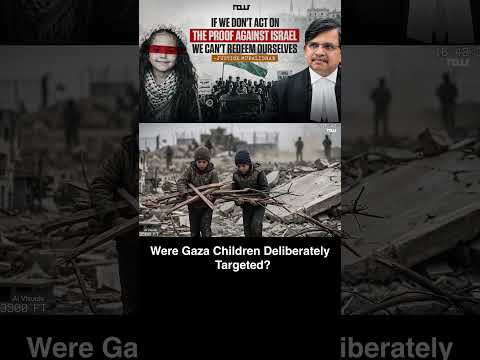
"The Commission found indisputable evidence of the deliberate, targeted killing of Palestinian children."
 1:06
"United Nations investigation reveals that essence of childhood destroyed in Gaza."
 0:58
"The government makes foreign policy. Diplomats don't—they carry it forward."
 1:45
"Your religion is for you, my religion is for me." Can faith become the foundation for peaceful coexistence rather than conflict?
 1:03
"Time is on the side of Iran. Time is not on the side of America."
 2:57
"We cannot imagine Hindus without Muslims,"
 1:54
"The Ummah is defined by moral principles—not by identity alone."
 2:39
"Iran is fighting a war of survival. America does not know why its soldiers are fighting."
 2:52
"We identify with justice, not with nation-states."
 1:53
"After nuclear tests, role of army in Pakistan was central to diplomacy."
 2:33
"How can a Muslim remain fully Muslim while also being fully Indian?"
 1:52
“As Muslim votes are split across seats, their impact becomes less decisive.”
 1:42
"The question is not about Hindutva—it is about the character of India."
 1:53
"Military options only work when you can change the battlefield—and that is precisely the challenge in Iran."
 2:23
"The current foreign policy is flawed, counterproductive, and damaging for India."
 0:35
“She still cries at night for a father she never really had the chance to know.”
 2:39
This episode features a wide-ranging and critical conversation with Dr. Rahul Sonpimple, Founder President of the All India Independent Scheduled Castes Association (AIISCA) and former leader of the Birsa Ambedkar Phule Student Association (JNU), in discussion with Asad Ashraf. The podcast challe…
 1:41
Journalist Asad Ashraf speaks with Professor Apoorvanand on Mahatma Gandhi’s life, politics, economics, and death. The conversation moves beyond familiar narratives to examine Gandhi as a political thinker and moral force, his ideas on non-violence, mass politics, and his critique of modern civil…
 2:38
"Pakistan has achieved three big things: from facilitator to mediator, and now a recognised regional power."
 2:08
What does a peaceful, prosperous, and inclusive India look like from a Muslim perspective?
 2:04
A strong India is built when every community has the opportunity to contribute and thrive. We share our perspective on the Muslim Vision for a peaceful, prosperous, and inclusive India, based on the ideas of prominent thinker and Islamic scholar @drjavedjamil
 2:27
"This was not a protest over identity—it was a protest for citizenship."
 1:21
"If President Trump wants, he can stand against powerful Jew lobby."
 0:52
"Iran has won the war."
 1:32
Was the failure of Composite Nationalism driven solely by Muslim separatism, or did majoritarian politics also shape the road to Partition?
 1:28
"The world has changed. It is no longer unipolar—it has become multipolar."
 1:49
"To understand nationalism, leave theology aside and look at history and politics."
 2:21
"The world has changed. India's foreign policy has not."
 1:37
Salman Khurshid argues that recent legal disputes over places of worship represent a reversal of a constitutional consensus that sought to draw a line under historical conflicts.
 0:59
"If 50 crore people feel excluded, it is not governance—it is exclusion."
 1:24
"Constitutional protections for minorities are not appeasement—they are compensation."
 2:30
"We have lost our regional independence and our global independence."
 2:16
"A new type of civil society is emerging among Muslims."
 2:41
"As Islam expands in its true spirit, it is compatible with society, contributory to society, and not inherently in conflict with it."
 2:11
"Democracy is not just about elections—it is about giving power to citizens."
 2:59
"Muslim and Sikh Nationalism did not have theological origin."
 2:18
"A promise made to every Indian citizen must be honoured—regardless of religion, caste, language, or region."
 1:54
"If Chabahar Port had been fully developed, there would have been no dependence on the Strait of Hormuz."
 2:23
"There is no superiority based on caste, race, language or region—the Qur'an commands the establishment of justice."
 2:58
“For two days, I kept on calling him”
 2:13
Professor Tanweer Fazal in conversation with Asad Ashraf on Muslims and the question of citizenship in India. Watch here: https://youtu.be/rrWE5Ob5z3E